Heavy.
Diesel.
Then another.
Then a third.
Every man in the cafe heard it at once.
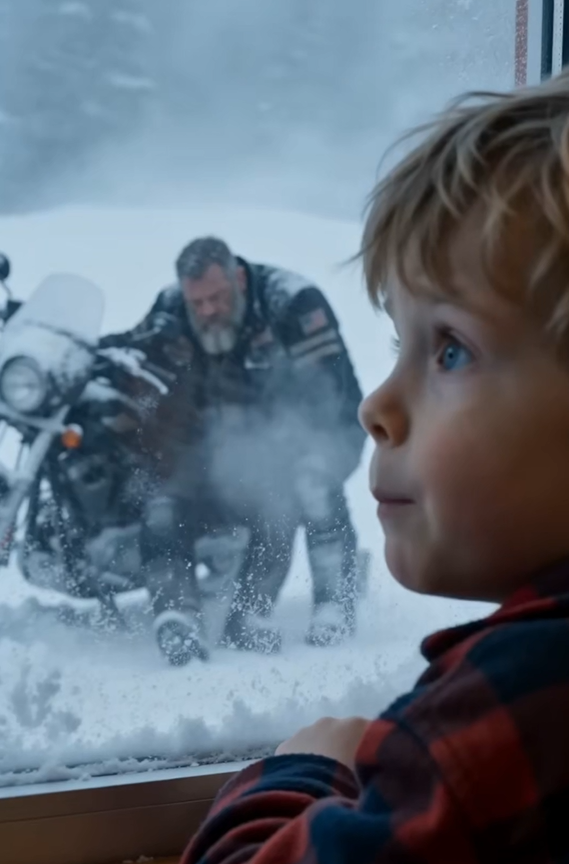
Jack reached the window in three steps.
His hand rested flat against the glass.
“Not Voss,” he said.
The room’s tension did not leave.
It changed shape.
“Sheriff’s Department.”
Three vehicles pulled up outside.
Two cruisers.
One unmarked.
“The unmarked is the problem,” Jack said.
A knock struck the front door.
Three sharp hits.
Deputy Ray Garner stood outside in civilian clothes under his department jacket.
He was shorter than Emily expected, older than she imagined, with a face that looked carved by weather, guilt, and bad decisions.
He asked for five minutes.
Jack gave him two.
Garner looked at Emily as if he wanted her gone.
She did not move.
He accepted that.
“Voss knows where you are,” Garner said.
The room froze.
“He has known since last night.”
Jack’s face did not change.
“How?”
Garner swallowed.
“I told someone you’d likely come over the pass.”
Ethan was on his feet before Emily saw him move.
“You told someone.”
“I thought he was clean.”
“Dell is dead,” Ethan said.
His voice had lost all its careful calm.
“You knew what that meant.”
Garner flinched.
Jack stepped between them without touching either man.
“Ethan.”
One word.
Final.
Ethan walked to the back, and the storeroom door closed behind him.
Garner’s mistake had led Voss straight toward the cafe.
But Garner had also come prepared to fix what could still be fixed.
He had evidence bags.
He had a contact in the state attorney general’s office.
He had a plan to create an official record and move Dell’s documents into custody before Voss could reach them.
It was messy.
It was late.
It was still something.
Jack looked at him.
“The man you told.”
Garner hesitated.
“Tom Briggs.”
Jack’s voice changed.
Only a fraction, but enough.
“Briggs has been in Voss’s pocket for three years.”
Garner went pale.
“No.”
“We believe he was on Route 12 the morning Dell died.”
Garner stood in the doorway and received the collapse of eleven years of trust.
Emily saw it happen.
A man discovering that closeness had fooled him into thinking it was knowledge.
The real conversation moved to the kitchen.
It always seemed to in that building.
Maybe because the kitchen made performance difficult.
There were too many practical things around.
Coffee cans.
Cast iron.
Inventory shelves.
A crooked light.
The plan was simple because there was no time for elegance.
Jack would retrieve Dell’s file from his saddle bag.
Emily would photograph every page.
Garner would seal the originals and establish chain of custody.
The state contact would receive confirmation.
The documents would no longer be something Voss could take quietly.
Ethan had to agree.
They found him in the storeroom with Noah’s drawing in his hands.
He was sitting on the floor, back against the shelves, staring at the little figure in the window and the word help above it.
“My father used to draw with me,” Ethan said.
No one interrupted.
“When I was little.”
He looked at Jack.
“Then he stopped.”
Jack’s face tightened.
Ethan asked about Route 7, about a silence between Jack and his father that had lasted two years and changed the architecture of their family.
Jack closed his eyes for one beat.
“Not now.”
Ethan stared at him.
“I will tell you everything,” Jack said.
“I promise.”
It was enough for the moment.
Ethan stood.
“What do you need?”
They moved quickly.
Jack brought the envelope in a waterproof sleeve.
Emily spread the pages across the counter and photographed each one twice.
Manifests.
Route logs.
Shell company records.
Transfer notes.
Dell’s handwritten timeline in cramped, careful script.
She uploaded the copies through her phone when three bars of signal returned.
The originals went into evidence bags.
Garner sealed them.
Jack signed the custody receipt.
Garner left with the documents.
For one minute, everyone breathed.
Then Cade’s radio crackled.
“The junction vehicles are moving.”
Jack lifted the radio.
“Direction.”
“North.”
Ethan’s face went hard.
“That’s not retreat.”
“No,” Jack said.
“That’s consolidation.”
The four visible vehicles were returning to the larger group staged at the lumberyard.
Voss no longer needed the documents.
They were in custody.
What he needed now was control over the people who knew what the documents said.
Jack.
Ethan.
Then Cade’s voice came again, tighter now.
“The lumberyard vehicles are moving too.”
Jack stood still.
“How many?”
“All of them.”
A breath hissed through the radio.
“They’re coming south.”
The cafe became a countdown.
Twelve minutes.
Maybe less.
Jack’s voice filled the room, calm enough to hold everyone steady.
“On your feet.”
Men moved.
Not panicked.
Not loud.
Precise.
Construction men took the windows two deep.
Heavy tools came in from saddlebags.
No one drew first blood.
No one threatened.
They simply made the building into a place that would not be easy to enter.
Emily went to Noah.
He was at the corner booth with a pencil still in his hand.
“We’re moving to the middle of the building for a little while,” she said.
He looked at her.
“Is something happening?”
She wanted to lie.
She could feel the word no waiting in her mouth.
But Noah had never been protected by soft lies.
“Yes,” she said.
“Something is happening, but we’re okay.”
He put the pencil down.
“Okay, Mom.”
They crouched behind the counter, the solid oak one Marcus had bolted to the floor with pride.
Noah held his drawing in his lap.
“Are the bikers going to be okay?” he whispered.
Emily looked at the men around the room.
The same men Hollow Creek had locked out.
The same men who had lowered their voices for her son, fixed her roof, cooked in her kitchen, and taken positions between danger and a child they had met the night before.
“Yes,” she said.
She said it as if saying it could help make it true.
Jack crouched beside them.
“They’re coming for me and Ethan,” he said quietly.
“Stay here.”
“Where is Ethan?”
“Back office.”
“Why?”
“Because I need them looking in the wrong place for four seconds.”
“Four seconds for what?”
“For Ethan to be where he needs to be.”
Emily held his gaze.
“What is Ethan going to do?”
Jack’s face was unreadable.
“End this the way Dell would have.”
Then the first glass broke.
Not the front door.
The side window.
Gus and two riders stood on the other side of it, unmoving, clear as stone.
The attempt stopped.
A moment later, the front door opened.
The man who entered was not Darren Voss.
He was six foot two, clean clothes, controlled eyes, and a face built for carrying someone else’s threats.
He looked at the room.
He saw the numbers.
He saw the positions.
He saw that twenty-three men outside had not entered an empty rural cafe full of frightened strangers.
They had entered a room where fifty-nine bikers had been waiting.
Jack stood in the center.
“You’re a long way from Pueblo.”
The man’s jaw tightened.