Dell had spent fourteen months building a file on Voss.
Manifests.
Route changes.
Shell companies.
Financial transfers.
Then he had died on Route 12 in what the coroner called an accident.
But before he died, he had given the documents to Jack.
Emily listened without interrupting.
She had learned during Marcus’s illness that some stories fell apart if you grabbed them too soon.
“So Voss followed you,” she said when Ethan stopped.
“We think so.”
“You think.”
“We lost the trucks in the storm.”
“But you don’t know.”
Ethan looked at her with the clear eyes of a man who respected her too much to soften it.
“No.”
Behind the counter, Noah stirred in the storeroom.
Emily looked toward the sound, then back at Ethan.
“Why didn’t Jack tell me?”
“Jack tells people what he thinks they can carry.”
“And you?”
“I tell people what they need to know.”
Emily stood.
“Tell Jack I need to talk to him.”
Ethan blinked.
“Now?”
“Not when he has time.”
Jack was on the roof.
Emily climbed the ladder in her boots and apron before anyone could tell her not to.
The cold cut through her jeans as she knelt in the snow beside him.
Two riders working near the fascia board took one look at her face and moved away without being asked.
“Ethan told me about Voss,” she said.
Jack looked out over the white valley.
“He shouldn’t have.”
“He was right to.”
“This is your building,” Jack said.
“My son is in it.”
“I know.”
“No, you don’t.”
Her voice stayed level because if it broke, everything would come through.
“You brought danger into my cafe.”
“If I had known the storm would trap us here, I would have kept riding until there were no people around.”
“But you didn’t know.”
“No.”
“And now?”
Jack turned toward the buried road leading back to the pass.
“Now we confirm whether they followed.”
“How?”
“One of ours is going to the ridge.”
Emily waited.
“What does Voss want from you?”
Jack was silent long enough that she understood the answer mattered.
“Dell’s documentation.”
“You have it.”
“In my saddle bag.”
“Here.”
“Yes.”
She looked down at the roof beneath them, at the old building Marcus had believed would last.
A six-year-old boy had seen a man fall in the snow.
A mother had opened a door.
And now buried documents linking a freight boss to years of crimes sat outside her cafe beside fifty-nine motorcycles.
“You need to tell me everything,” she said.
So he did.
It took forty minutes.
He told her about Dell’s research.
About Deputy Ray Garner, the lawman who had been supposed to meet Dell the morning he died.
About four months of silence and fear.
About the trucks that had followed the Iron Brotherhood for three days.
About Voss’s patience.
About the way dangerous men did not always arrive loudly.
Sometimes they waited at junctions.
Sometimes they changed routes with you.
Sometimes they let the storm do half their work.
When Jack finished, Emily said, “Okay.”
He looked at her.
“Okay?”
“We deal with it.”
She used his own cadence back to him.
For the first time since she had met him, Jack Reynolds looked almost surprised.
Then he looked almost grateful.
The briefing happened in the dining room.
Fifty-nine men went quiet when Jack stood.
Not obedient quiet.
Trusting quiet.
He told them the truth without drama.
Voss.
The documents.
The ridge.
The unknown.
The risk.
Questions came fast and practical.
Who scouts.
What if the road opens.
What if law enforcement comes.
What about the woman and the kid.
That last question came from a lean older rider near the back.
Emily did not move.
Jack looked straight at him.
“They’re our concern.”
The man did not argue.
He only said, “We brought this here.”
“No,” Jack said.
“The storm brought us here.”
Then his eyes moved to Emily.
“But what happens here is on us.”
Cade Marrow went to the ridge just after breakfast.
He was lean, quiet, and comfortable in snow in a way that made Emily believe he had spent half his life in places where roads were optional.
He took binoculars and a radio that did not need cell towers.
Gus came into the kitchen afterward and began cooking eggs like a man who had been assigned a mission.
Emily watched him flip hash on the griddle.
“You cook.”
“My mother was a short order cook in Raton.”
“It shows.”
“She’d still tell me I’m doing it wrong.”
He said it without sentiment, which made the loss in it sharper.
Emily looked at the crooked pendant light.
“My husband built this kitchen.”
Gus looked up.
“He hung that wrong?”
“He did.”
“You want it fixed?”
“No.”
“Then it stays.”
That was the correct answer.
Noah brought a drawing into the kitchen at nine thirty.
He set it near the pass-through and disappeared again.
Emily glanced at it while stirring coffee grounds into the machine.
Then she stopped.
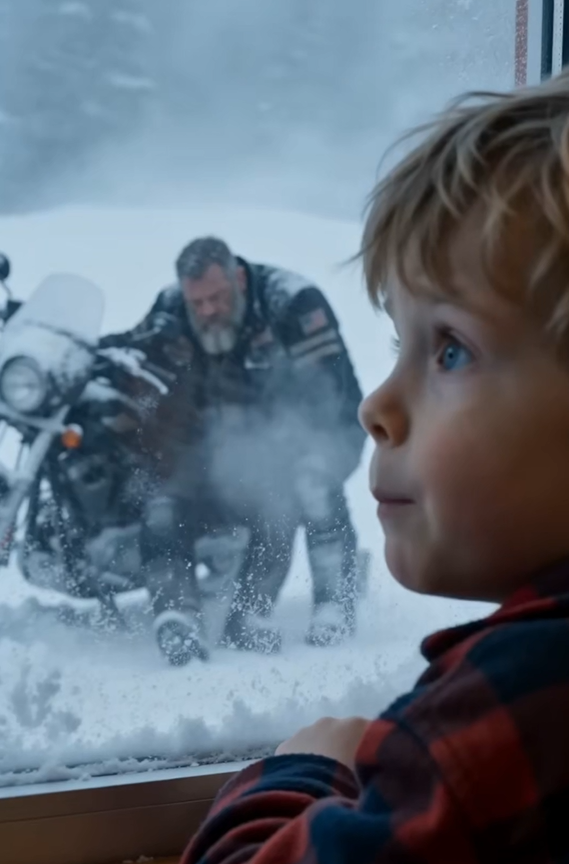
The drawing showed the cafe from outside.
Snow.
Motorcycles.
A small figure in the window.
A speech bubble over the small figure contained one word.
Help.
Emily touched the paper with one finger.
She thought of Marcus, of the way he used to kneel to Noah’s height and speak to him like his thoughts mattered.
He gets it from you, she thought.
She folded the drawing carefully and slipped it into her apron pocket.
At eleven forty-seven, Cade came back.
The whole room knew before he spoke.
Jack’s stillness changed.
It sharpened.
Cade leaned close and said three words too quietly for Emily to hear.
Jack turned to the cafe.
“Everyone listen.”
The room stopped.
“They’re at the junction.”
No one spoke.
“Four vehicles.”
Cade stood near the back door, snow on his shoulders.
“Eight visible men.”
“Waiting?” Gus asked.
Jack nodded.
“Not moving.”
The meaning settled over the cafe.
Voss had not vanished into the storm.
He was waiting at the mouth of the valley.
Emily looked at the foreclosure notice.
Nine days had once seemed like the most frightening countdown in her life.
Now there were men at a junction, sealed documents in a saddle bag, and her son in a booth drawing motorcycles with careful hands.
She took the foreclosure notice off the corkboard and carried it to Ethan.
“This is my side of the situation,” she said.
“Nine days.”
Ethan looked at it.
“I know.”
“Jack told you?”
“Jack tells me things he doesn’t tell anyone else.”
Emily stared through the window at the white parking lot.
“What did he decide?”
Ethan folded his hands.
“He made calls this morning.”
“What kind of calls?”
“Legal people.”
“Financial people.”
“People who understand foreclosure pressure points.”
Emily’s anger rose because it was supposed to.
A man she had known less than a day had stepped into the most private ruin of her life and started touching wires.
But beneath the anger was something worse, or maybe better.
Relief.
Not rescued.
Not saved.
Not helpless.
Just not alone.
Then an engine came from the south road.
Not a motorcycle.