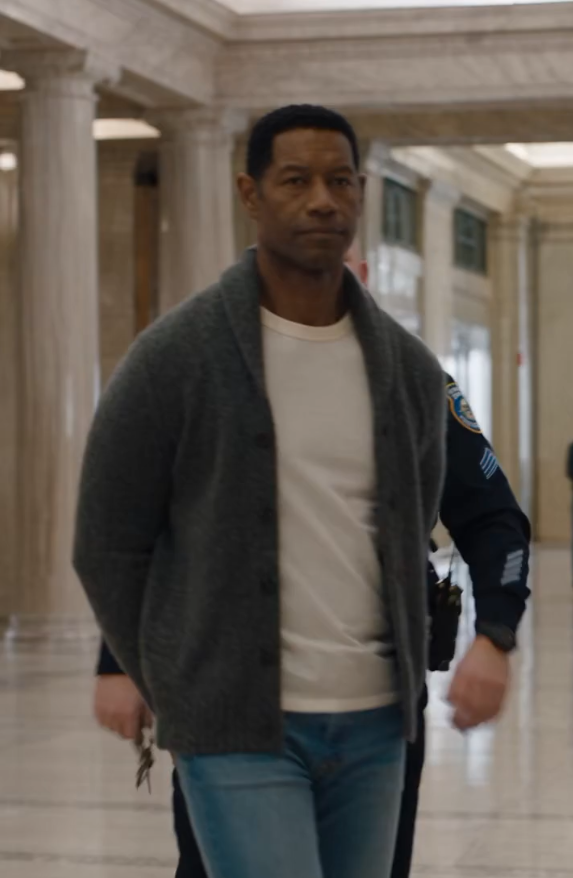
Part I — The Man at the Metal Detector
The first thing I remember clearly is the sound of the handcuffs closing.
Click.
Click.
There are moments when your mind narrows itself to something small because the larger truth is too absurd to absorb all at once. I remember the chill of the marble pillar against my cheek. The pressure in my right shoulder where Officer Bradley Jenkins had twisted my arm behind my back. The faint smell of floor polish and burnt coffee drifting through the City Hall lobby. The little red light on somebody's phone as they recorded us from twenty feet away.
And I remember thinking, with a strange kind of calm:
Thirteen days.
I had been mayor for thirteen days.
Jenkins tightened the cuffs as if he expected me to suddenly become dangerous.
“You should've walked away when I gave you the chance.”
His voice was low enough that he probably assumed only I could hear it.
I breathed through my nose and kept my weight balanced.
“I wasn't trying to go anywhere.”
“That mouth is what got you here.”
A few feet behind us, Officer Toby Miller said, “He's not resisting.”
Jenkins turned his head sharply.
“I didn't ask you.”
Miller was young enough that his uniform still seemed slightly too formal for him. Mid-twenties, maybe. Clean-shaven. Alert. He had spent most of the last several minutes looking like a man standing beside railroad tracks while something approached too quickly for him to stop.
Jenkins turned back to me.
Twenty-two years on the force had given him the easy confidence of someone used to having his interpretation become reality the moment he spoke it aloud.
Security threat.
Trespasser.
Suspicious male.
The words changed depending on the situation.
The power behind them did not.
Less than an hour earlier, my biggest problem had been coffee.
At 7:30 that morning, I had stood in my kitchen staring down at the dark stain spreading across the front of my navy suit.
My chief of staff, Khloe Davidson, took one look at me and laughed.
Not politely.
Not briefly.
She leaned against the counter and laughed until she had to wipe beneath one eye.
“You're presenting a billion-dollar budget dressed like a coffee filter.”
“Helpful.”
“I try.”
I stripped off the jacket and handed it to her.
Khloe held it at arm's length.
“You got the shirt too.”
“I noticed.”
“The tie?”
“Collateral damage.”
She shook her head.
Thirteen days into the administration, Khloe had already developed the exhausted patience of someone who understood that serving as my chief of staff would occasionally require handling problems no transition manual had mentioned.
“I'll take it to the cleaner on the way in,” she said.
“I need to be upstairs by eight-thirty.”
“You will be.”
“My notes are in the inside pocket.”
“I know.”
“My wallet too.”
She was halfway toward the door.
“I know.”
That should have stopped me.
It didn't.
I changed into jeans, a white T-shirt, an old gray fleece, and brown work boots I had owned since before my first law office had a conference table.
Khloe glanced back at me.
“You look like you're about to inspect a roof.”
“Good. Maybe the council will underestimate me.”
“They already do.”
She smiled.
Then she pointed at me.
“Underground garage. Private elevator. Upstairs. Don't wander around making friends.”
“I am capable of entering my own building.”
Khloe opened the door.
“That sentence feels dangerous.”
Twenty minutes later I discovered the underground garage entrance blocked by maintenance trucks.
A water pipe had burst overnight.
A city employee in a reflective vest waved me away.
“Garage is closed, sir.”
“For everybody?”
“Unless your car floats.”
So I circled twice, found street parking three blocks away, and walked toward City Hall beneath a pale morning sky.
Rockford's City Hall was not beautiful in any conventional sense.
The original building had been expanded so many times that the result looked like three decades of municipal architecture arguing with each other. Limestone on the older wing. Glass on the newer section. A broad public lobby with marble columns that taxpayers had complained about paying for when they were installed twenty years earlier.
I entered through the front doors at 8:15.
A security line curled toward the metal detectors.
I joined it.
Nobody recognized me.
That surprised me less than it might have surprised someone else.
Campaign photographs were flattering abstractions. Television appearances were usually done in suits beneath studio lighting. In jeans and an old fleece, standing among contractors, city employees, residents with folders under their arms, and a mother trying to keep two children from swinging around a velvet rope, I looked like what I was before I became mayor.
A man waiting in line.
I liked that.
There was something clarifying about watching City Hall operate when nobody thought the mayor was watching.
A clerk quietly helped an elderly man fill out a form.
A security guard opened a side gate for a woman using a walker.
A sanitation supervisor joked with somebody he apparently knew from high school.
Ordinary human exchanges.
Then I stepped through the metal detector.
It beeped.
“Sorry,” I said. “Probably the boots.”
Officer Bradley Jenkins looked up.
He had been standing near the screening station with one hand resting on his belt.
Broad shoulders.
Buzz cut.
A face that carried its certainty before he spoke.
“Step aside.”
“I can remove the boots.”
“I said step aside.”
His tone changed the air between us.
Not much.
Just enough.
I moved toward the wall.
He looked at my clothes.
Then my face.
His eyes stayed there half a second longer than necessary.
“The housing offices are across the street.”
I stared at him.
“I'm not here for housing.”
“Then what are you here for?”
“The executive floor.”
He laughed.
Actually laughed.
“Sure.”
Something inside me became very still.
For months, residents had told me stories with that exact rhythm.
Different details.
Same progression.
An assumption first.
A question second.
Respect made conditional on whether the answer satisfied the person asking.
During the campaign, I had heard those accounts in church basements, union halls, barbershops, living rooms, neighborhood association meetings.
A father stopped walking home from work.
A college student questioned outside the library.
A woman told she couldn't possibly live in the neighborhood where she had owned a house for eleven years.
Police leadership didn't deny every story.
They used softer language.
Incomplete information.
Officer-safety judgments.
Isolated incidents.
Misunderstandings.
Exceptions.
Chief William Granger had once told me, in a conversation that became tense without either of us raising our voices, “You have to be careful building policy from anecdotes.”
I had replied, “Anecdotes become data when enough people are telling the same story.”
He hadn't liked that.
But he hadn't walked away either.
Now Jenkins held out his hand.
“Identification.”
I reached toward my back pocket.
Nothing.
Then the morning rearranged itself in my memory.
The suit.
Khloe.
The cleaner.
My wallet.
“I don't have my physical ID.”
Jenkins gave a small smile.
It wasn't amusement.
It was satisfaction.
“But I can call my chief of staff.”
“No.”
“You can contact the mayor's office.”
“No ID, no access.”
“That is fine.”