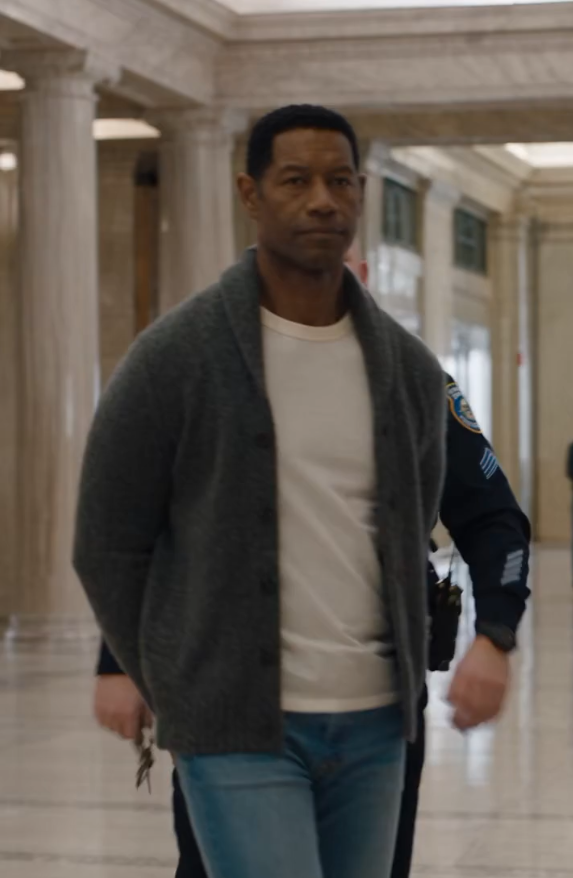
I kept my voice calm.
“Tell me the policy and I'll wait while you verify my appointment.”
His eyes narrowed.
“You people always want to argue.”
Behind him, Miller shifted his weight.
Those two words landed harder than the insult probably intended.
You people.
I could have ended it.
I knew exactly how.
I could have said my name.
I could have asked for Chief Granger.
I could have watched Jenkins' expression change.
Part of me wanted to.
Not because I was afraid.
Because power has a seductive shortcut built into it.
Use the title.
Make the call.
Open the door.
Then I thought about everyone who had stood in front of a man like Jenkins without a title that could rescue them.
So I said, “Officer, I'm asking you to call a supervisor.”
Jenkins lifted his chin.
“I am the supervisor.”
“Then please explain the legal basis for detaining me.”
His face changed.
Only slightly.
But I saw it.
To him, the question was not a question.
It was a challenge.
“Turn around.”
“For what?”
“Trespassing.”
“This is a public building.”
“Turn around.”
Miller moved one step closer.
“Sir, maybe we can just verify—”
“Stay out of it.”
Jenkins grabbed my shoulder.
I let my arms hang loose.
“I am not resisting you.”
“Face the pillar.”
He twisted my arm behind me and pushed me forward.
My cheek struck marble.
Someone gasped.
Phones appeared throughout the lobby.
Miller said, louder this time, “He's not fighting you.”
The cuffs closed.
Click.
Click.
My shoulder burned.
My cheek hurt.
But my mind became incredibly clear.
Jenkins searched my pockets.
Keys.
Phone.
A folded page of budget notes.
He opened it.
I watched him scan the page without understanding what he was reading.
Then he folded it again.
“What's this?”
“My notes.”
“For what?”
“A meeting.”
“With who?”
“The city council.”
Jenkins looked down the hallway toward the chamber.
Then at his watch.
A smile formed.
“The council's meeting down there.”
“Yes.”
He grabbed the short chain connecting my cuffs.
“I think I'll show them what happens when somebody tries sneaking into their building.”
I turned enough to look at him.
“You want to take me into the council chamber?”
“That's exactly where you're going.”
For the first time that morning, I almost smiled.
“Officer Jenkins,” I said quietly, “I have absolutely no objection to that.”
He mistook my calm for surrender.
That was the first serious mistake he made after putting on the handcuffs.
It would not be the last.
Part II — The Walk
Jenkins marched me down the corridor with one hand gripping the chain between my wrists.
He did not hurry.
That detail stayed with me.
He wanted people to see us.
City employees flattened themselves against walls as we passed. A woman carrying a stack of binders stopped so abruptly that one slid sideways in her arms. Two maintenance workers stared openly.
Jenkins seemed energized by the attention.
“Keep moving.”
“I am moving.”
“Then don't talk.”
Miller followed several paces behind us.
I could hear the uneven rhythm of his shoes.
He was thinking.
That mattered.
Good officers did not become bad officers only through cruelty. Sometimes they became bad officers through silence.
I had said variations of that sentence at public forums.
It sounded cleaner behind a podium.
Walking through City Hall in handcuffs, I understood its weight more precisely.
At the end of the corridor stood the double wooden doors to the council chamber.
Beyond them, somewhere inside, my administration waited to begin its first serious legislative battle.
The budget proposal was not revolutionary.
That fact irritated me every time someone described it that way.
Mental-health crisis teams.
Violence-prevention grants.
Training upgrades.
An independent system for reviewing serious complaints.
In other cities, similar programs had existed for years.
In Rockford, they had become declarations of war.
The police union had released a statement the previous week accusing my administration of “treating experienced officers as presumed offenders.”
Several council members privately told me they supported parts of the proposal but feared the review system would anger police families in their districts.
Chief Granger was more complicated.
He had served thirty-one years.
He knew the department.
He knew its strengths.
He also knew where its habits had hardened into excuses.
During our last meeting, he sat across from me in my office with his reading glasses low on his nose.
“The crisis teams, I can defend,” he said. “Training, I can defend. Violence prevention, sure.”
“And independent review?”
He took off his glasses.
“You're creating a system outside my chain of command.”
“For serious complaints.”
“That sends a message.”
“Yes.”
His eyes sharpened.
“You say that very easily.”
“I don't mean it easily.”
“Then what message are you sending?”
“That public trust cannot depend entirely on an institution investigating itself.”
Granger leaned back.
“You know what officers hear?”
“I know what the union says they hear.”
“No. You know what they hear. They hear that their mayor assumes they're lying.”
“I don't.”
“Some of them think you do.”
“That isn't a reason not to do it.”
He rubbed his jaw.
“You're thirteen days into office.”
“Twelve.”
“That makes my point.”
“People did not elect me to spend six months pretending I hadn't heard what they told me for two years.”
Granger stared at me for a long moment.
Then he said something I remembered as Jenkins pulled me closer to the chamber doors.
“David, if you move too fast, the people you need will stop listening before you get a chance to prove you're right.”
I had answered, “And if I move too slowly, the people who trusted me will decide I sound exactly like everyone before me.”
Neither of us had won.
Now the argument was about to follow me into the council chamber in handcuffs.
Jenkins stopped outside the doors.
“Stand there.”
I did.
Miller caught up.
“Bradley.”
Jenkins looked at him.
“What?”
“We should call downstairs.”
“For what?”
“To confirm who he is.”
Jenkins' expression hardened.
“I've handled security in this building longer than you've been carrying a badge.”
“I understand.”
“Then act like it.”
Miller glanced at me.
Our eyes met briefly.
I said nothing.
He lowered his voice.
“There's a budget meeting in there.”
“I know.”
“What if he's staff?”
Jenkins shrugged.
“Then staff needs identification.”
“What if he's supposed to be there?”
“He should've thought about that before refusing instructions.”
I finally spoke.
“I didn't refuse instructions.”
Jenkins stepped closer.
“You really cannot help yourself.”
“No.”
He frowned.
I continued.
“I cannot help noticing when facts change to justify what already happened.”
Miller looked away.
Jenkins' jaw tightened.
“You're lucky I'm taking you in there instead of booking you.”
“For trespassing in a public lobby?”
“For disorderly conduct.”
“That wasn't the accusation five minutes ago.”
He leaned close enough that I smelled coffee on his breath.
“You think knowing legal words makes you smart?”
“I used to practice civil-rights law.”
For the first time, he hesitated.
A very small pause.
But it was there.
“What?”
“I said I used to practice civil-rights law.”
Miller looked at me sharply.
Jenkins recovered.
“Well, congratulations.”
He reached for the chamber door.
Then my phone began vibrating in the plastic property tray he had tucked under one arm.