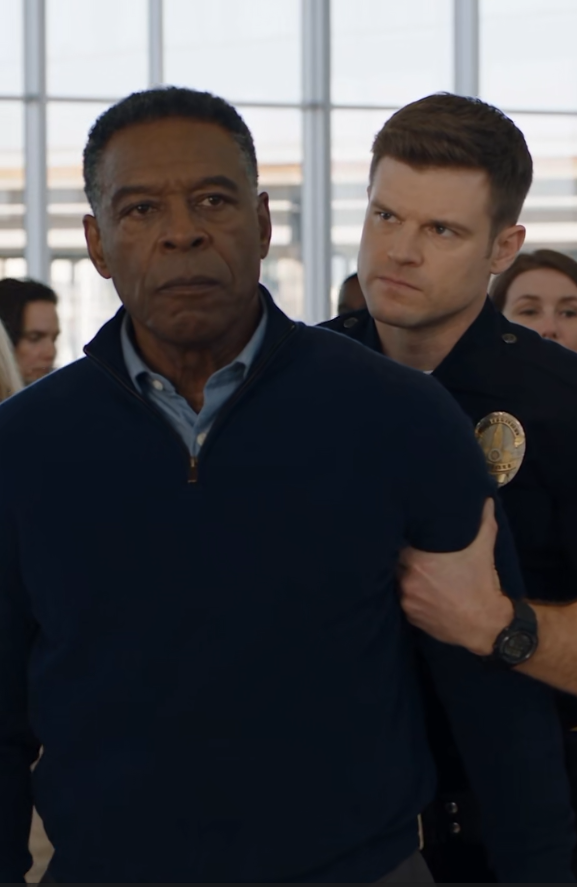
“No.”
“When you demanded access to my phone, did I threaten you?”
“No.”
“Raise my voice?”
“No.”
“Move toward you?”
“No.”
He looked past me.
I stepped slightly into his line of sight.
“Officer Brennan.”
His eyes returned.
“When you instructed me to remove the object from my jacket slowly, did I do so slowly?”
He said nothing.
Holloway spoke.
“Yes.”
Brennan turned toward her.
“Tanya.”
“No,” she said.
It was almost a whisper, but it cut through the space between them.
Doyle lifted one hand.
“This is not the place.”
I looked at him.
“It was the place when your officer searched me.”
He said nothing.
“It was the place when my belongings went onto the floor.”
Still nothing.
“It was apparently the place when I was handcuffed.”
A boarding announcement sounded again.
My flight.
Final call.
I looked toward the gate.
The door would be closing within minutes.
I thought of Denise waiting somewhere in another concourse, probably wondering why I had stopped answering my phone.
I called her.
She answered immediately.
“Warren?”
“I’m all right.”
There was a beat of silence.
That was our marriage.
She could hear the lie in four words.
“What happened?”
“I had an encounter with airport police.”
“What kind of encounter?”
“I’m all right.”
“You said that already.”
“I know.”
“Where are you?”
I gave her the concourse marker.
“I’m coming.”
“Denise, your flight—”
“Warren.”
I stopped.
“Fine.”
She disconnected.
Doyle cleared his throat.
“We can assist with rebooking.”
I looked at the scattered pages of my speech.
“I imagine you can.”
Holloway began collecting them.
I crouched despite the ache in my back and helped.
One page had a shoe print across the paragraph I had planned to use to open my keynote.
The speech was about trust in public institutions.
I stared at the print for a moment.
Then folded the page and put it back inside the folder.
Holloway found the wooden gavel beneath the seats.
She held it carefully.
“This yours?”
“My daughter made it for me when she was eleven.”
She wiped dust from it with her sleeve.
“I’m sorry.”
I accepted it.
For the first time since Brennan stopped me, someone had apologized.
Not for my title.
Not for the embarrassment.
Not for the optics.
For something specific.
A damaged object that mattered to me.
“Thank you,” I said.
Doyle pulled Brennan aside.
They spoke too quietly for me to hear.
Holloway stood beside me.
“You should photograph your injuries.”
“I will.”
“And your property.”
“I will.”
She looked toward Doyle, then back at me.
“There are cameras everywhere.”
“I noticed.”
Her meaning was clear.
Do not let them tell you otherwise.
A minute later, Denise appeared at the far end of the concourse.
She did not run.
Denise Foster never ran unless someone was in immediate medical danger.
She walked fast, travel bag over one shoulder, eyes scanning the scene.
Then she saw the blood on my mouth.
Her pace changed.
“Warren.”
“I’m okay.”
She stopped directly in front of me and touched my chin.
I flinched.
Her eyes shifted to Brennan.
Then Doyle.
Then the open bag on the floor.
“What happened?”
Nobody answered.
She looked back at me.
“What happened?”
I said, “He thought I had a gun.”
Her eyes moved slowly toward Brennan again.
“Did you?”
“No.”
“Did he have a reason to think you did?”
“He told me to reach for identification.”
Denise closed her eyes for one second.
Only one.
When she opened them, she became very calm.
That was worse.
“Which one?”
I nodded toward Brennan.
She looked at him.
“Officer, what exactly did my husband do?”
Brennan opened his mouth.
Doyle intervened.
“Ma’am, we’re reviewing the circumstances.”
Denise faced him.
“I asked him.”
“Denise.”
“No, Warren.”
She did not take her eyes off Brennan.
“I asked him.”
Brennan’s voice was low.
“He reached into his jacket.”
“Because?”
Silence.
Holloway answered.
“He was told to remove identification.”
Denise looked at Holloway.
“And then?”
“Officer Brennan believed he saw a weapon.”
“Did you see a weapon?”
“No, ma’am.”
Denise nodded once.
Then she looked at my broken glasses.
The blood.
The scraped leather credential case.
The scattered paperwork.
She said nothing else.
That silence was not restraint.
It was storage.
Everything she saw was being placed somewhere it would remain.
Doyle said, “Judge Foster, we need to complete an incident report.”
“Yes.”
“We’d prefer to do that in an office.”
This time I agreed.
Not because he preferred it.
Because I wanted the record to begin.
Part II — The Version That Survives
Airport police put us in a conference room with no windows and a table bolted to the floor.
That detail struck me immediately.
A room designed for control.
Brennan was no longer present.
Neither was Holloway.
Doyle sat across from Denise and me with an airport police lieutenant named Mercer, who had arrived after the incident.
A paramedic cleaned my lip.
“You may need a stitch.”
“I don’t.”
“You might.”
“I don’t.”
Denise gave me a look.
The paramedic smiled faintly.
“I’ll document that you declined transport.”
“Please do.”
He examined my shoulder.
“Pain when you lift?”
“Yes.”
“Any numbness?”
“No.”
“Headache?”
“No.”
“Dizziness?”
“No.”
“Did you lose consciousness?”
“No.”
He gave me an ice pack and left.
Mercer opened a notebook.
“We want to understand what happened.”
I placed the ice pack against my lip.
“Good.”
Doyle shifted in his chair.
Mercer began.
“Officer Brennan initiated contact after receiving a suspect description related to a reported theft.”
“What was stolen?”
“A passenger reported a laptop missing.”
“Where?”
“Coffee shop near B concourse.”
“How long before I was stopped?”
“Approximately fourteen minutes.”
“Was the suspect seen carrying the laptop?”
“We’re still determining that.”
“Was I carrying a laptop?”
“No.”
“Was I near that coffee shop?”
Doyle answered. “You were within the concourse area.”
“That is not what I asked.”
Mercer looked at him.
Doyle said, “We don’t know.”
“You have cameras.”
“We will review them.”
“Preserve them first.”
“We will.”
I leaned back.
“Preserve all footage from the coffee shop through the point of contact, all body-camera footage, dispatch audio, radio traffic, computer-aided dispatch records, officer notes, incident reports, use-of-force forms, and any communications regarding this incident.”
Mercer wrote quickly.
Doyle stopped him.
“We understand.”
“I’m not sure you do.”
His expression stiffened.
For the first time, something beyond embarrassment entered the room.
Defensiveness.
I recognized that too.
Institutions do not panic because something went wrong.
They panic because someone might prove it.
Mercer asked, “Judge Foster, are you planning to file a complaint?”
“Yes.”
Doyle exhaled.
Denise looked at him.
“Was that unexpected?”
“No, ma’am.”
“It sounded unexpected.”
“No.”
I said, “The complaint is not the important issue right now.”
Doyle looked at me.
“What is?”
“The record.”
He frowned.
I continued.
“Officer Brennan’s account will be written before this day is over. So will yours. Officer Holloway will write one. Dispatch will have logs. Surveillance exists. Witness videos exist. Somewhere right now, someone is deciding what adjectives to use.”
Nobody moved.
“Combative. Suspicious. Noncompliant. Aggressive. Reached. Resisted.”
Doyle’s face gave away just enough.