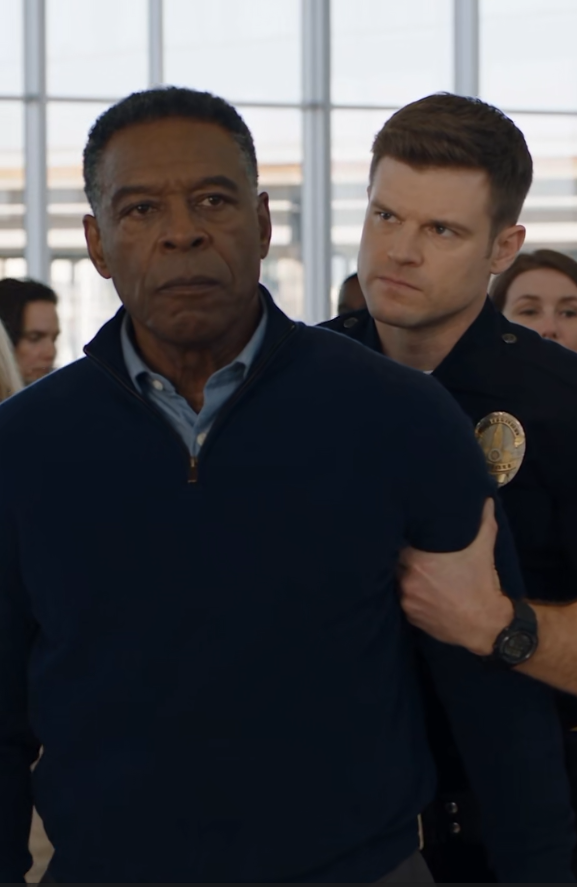
“Apparently whatever the officer wants.”
We found Doyle in the training attendance records.
He had taught the session twice.
Brennan had attended one.
Holloway had attended another.
A second slide said:
Questioning commands may indicate pre-asNextltive behavior when combined with nervousness, scanning, or delayed compliance.
There it was.
Looking around.
Asking why.
Moving slowly.
The ordinary behaviors that had turned me into the person Holloway pointed out.
None of those factors alone created the problem.
Together, they created a framework in which almost anything could become evidence after the fact.
The airport authority moved for summary judgment.
The case came before a federal district judge two states away after every local judge recused.
I sat in the courtroom as a litigant.
Not on the bench.
It was an experience I recommend for judges in small doses.
The defense attorney argued that Brennan faced rapidly changing circumstances.
He spoke about officer safety.
Uncertainty.
Split-second decisions.
All real concerns.
Then Elena stood.
She did not begin with the takedown.
She began with time.
“Fourteen minutes,” she said.
The judge looked up.
“That is the length of this encounter before Officer Brennan shouted ‘Gun.’”
She walked toward the lectern.
“The defendants would like the court to examine the final two seconds in isolation. But the Constitution does not begin two seconds before force is used.”
She moved through the timeline.
Weak description.
No corroboration.
Wallet search.
Bag search.
Phone demand.
Doyle’s arrival.
Dispatch update.
Acknowledgment.
Continued detention.
Second pat-down.
Instruction to retrieve identification.
Then force.
The defense attorney objected to her characterization.
The judge overruled him.
Elena played the radio transmission.
Gray outerwear.
Red roller.
South toward baggage claim.
Then Doyle’s acknowledgment.
Copy.
The sound was quiet in the courtroom.
Almost forgettable.
That was the point.
A single word had preserved what Doyle knew.
The judge denied summary judgment on the central claims.
Trial would proceed.
Afterward, reporters crowded the courthouse steps.
I said only one thing.
“This case is not about whether police officers are allowed to make difficult decisions. It is about whether institutions are willing to examine those decisions honestly.”
Then I went home.
That evening, Brennan called me.
Directly.
He should not have.
I almost did not answer.
“Judge Foster?”
“Yes.”
“This is Patrick Brennan.”
“I know.”
“I wanted to talk.”
“You have counsel.”
“So do you.”
“That is one reason this is inappropriate.”
“I know.”
“Then why are you calling?”
Silence.
His breathing sounded uneven.
“I’m sorry.”
I did not answer.
“I should’ve said it earlier.”
“Yes.”
“I was told not to.”
“That does not help you.”
“I know.”
“What are you apologizing for?”
Another silence.
“For putting you on the ground.”
“Why?”
“Because I was wrong.”
“That’s a conclusion. I asked why.”
He exhaled.
“Because I was angry.”
That was not what I expected.
“At what?”
“You.”
I waited.
“You kept questioning everything. Every instruction. Every search. You made me feel like I didn’t know what I was doing.”
His voice cracked slightly, then steadied.
“I’d already decided you were the guy. Every time you challenged something, it felt like you were trying to beat me.”
I sat at my desk.
“So when you told me to reach for identification—”
“I thought I saw what I expected to see.”
There it was.
Not racism denied.
Not bias confessed.
Something more ordinary and, perhaps, more dangerous.
Expectation.
“What did you expect?”
“A threat.”
“Why?”
He didn’t answer.
I let the silence remain.
Finally he said, “I’ve asked myself that every day.”
“Keep asking.”
“I probably deserve to lose my job.”
“That isn’t my decision.”
“They’ll blame me for everything.”
“That would also be wrong.”
He seemed surprised.
“What?”
“You made serious decisions. You are responsible for them.”
“I know.”
“But you didn’t write the training.”
No answer.
“You didn’t receive the dispatch update.”
“No.”
“You didn’t acknowledge it.”
“No.”
“You didn’t supervise prior complaints.”
“No.”
“You are not the entire institution, Officer Brennan.”
He was silent.
“Do not call me again without counsel.”
“I understand.”
Before hanging up, he said, “For what it’s worth, I didn’t know you were a judge.”
“I know.”
“That’s not what I meant.”
“I know that too.”
The call disturbed me more than I expected.
Because anger is easier to litigate when it belongs entirely to the other side.
Understanding complicates things.
It does not excuse them.
But it changes what you are willing to destroy.
Three weeks before trial, the airport authority offered a new settlement.
No confidentiality.
Public release of the body-camera footage.
Policy review by an outside organization.
Mandatory training changes.
A compensation fund.
Independent review of prior complaints involving Brennan and Doyle.
Formal apology.
And a large monetary payment.
Elena finished reading.
“This is substantial.”
“What’s missing?”
She looked at me.
“You already know.”
“Doyle.”
“He remains employed.”
“And Holloway?”
“Same assignment.”
“Retaliation protections?”
“General language.”
“Not enough.”
Denise sat at the far end of the table.
She had been quiet throughout the meeting.
Finally she said, “What happens if you reject it?”
“Trial.”
“What happens if you lose?”
Elena answered.
“Some reforms could disappear. Publicity could shift. Appeals could take years.”
“What happens if he wins?”
“Potential damages. Strong findings. More leverage.”
Denise looked at me.
“You’ve spent months saying this isn’t about you.”
“It isn’t.”
“Then don’t make the decision based on whether you get the perfect ending.”
I looked at her.
She continued.
“If they’ll change the system now, that matters.”
“Holloway matters too.”
“Yes.”
“So do the earlier complainants.”
“Yes.”
“And Doyle taught the training.”
“Yes.”
She leaned forward.
“Then negotiate those things. But don’t confuse punishment with reform just because punishment feels cleaner.”
That annoyed me because she was right.
Elena smiled slightly.
“I should hire your wife.”
“She’d fire you.”
“I probably deserve it.”
We sent back three conditions.
Independent review of Doyle’s supervisory conduct.
Full restoration of Holloway to patrol eligibility with anti-retaliation monitoring.
Reopening of all similar complaints from the previous five years under an outside review panel.
The airport authority rejected the third.
We rejected the settlement.
Trial began on a Monday morning in March.
The final confrontation was not dramatic in the way television imagines trials.
No one screamed.
No witness confessed unexpectedly.
No lawyer pounded a table.
The power came from accumulation.
Holloway testified first.
Elena asked about the morning.
The description.
Her observation.
The initial decision.
“Why did you identify Judge Foster as a possible match?”
“He was a Black male within the age range wearing dark clothing.”
“Anything else?”
“He was looking around.”
“Was that unusual in an airport?”
“No.”
“Did he appear to be concealing anything?”
“No.”
“Running?”
“No.”
“Avoiding police?”
“No.”
“Carrying a red suitcase?”
“No.”
“Wearing gray outerwear?”
“No.”
Then came the dispatch update.
“Did Captain Doyle hear it?”
“Yes.”
“How do you know?”
“He acknowledged it.”
“What did he do next?”
“He allowed Officer Brennan to continue.”
The defense attorney rose.
“Objection. Assumes Captain Doyle could have stopped—”
“Overruled.”
Elena asked, “What did Captain Doyle say?”
Holloway looked toward the jury.
“‘Let him finish.’”
Doyle testified the next day.