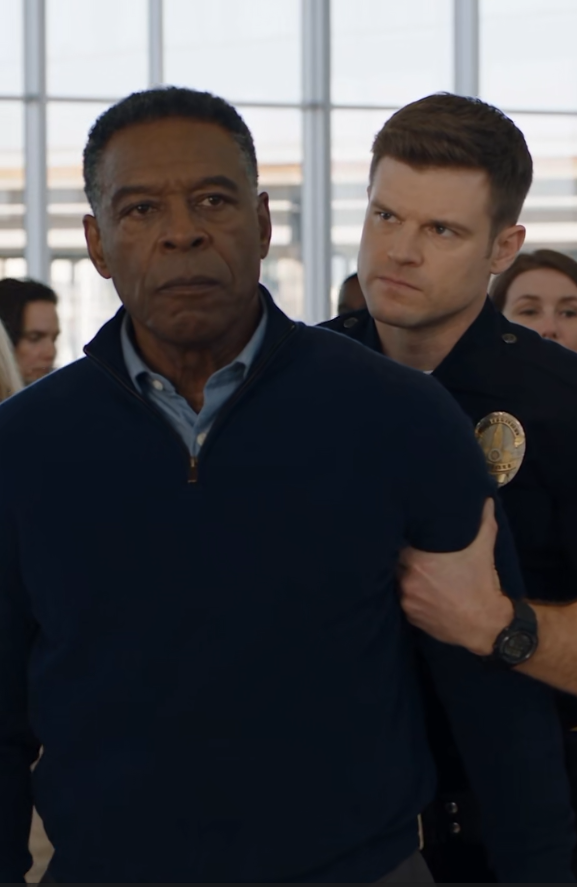
“What description?”
“Black male. Medium build.”
On video, the inadequacy sounded even worse.
Not because Brennan’s tone was openly hostile.
It wasn’t.
He sounded bored.
Routine.
That disturbed me more.
The search unfolded exactly as I remembered it.
My pockets.
My wallet.
His question.
“Where’d you get all this?”
Elena paused.
“Why did he ask that?”
“I have theories.”
“I don’t want theories.”
“I know.”
She resumed.
My bag.
My refusal.
His search.
The gavel striking the floor.
Documents falling.
Then Doyle arrived.
Brennan spoke first.
“Guy’s being combative.”
The camera caught my face in the background.
I was standing six feet away with my hands at my sides.
Elena paused again.
“Combative how?”
“He did not say.”
“Doyle didn’t ask.”
“No.”
She resumed.
The critical radio transmission came at 12:41:18.
Static.
Then dispatch.
“Units, update on B-concourse laptop theft. Video shows suspect male, gray outerwear, red roller, proceeding south toward baggage claim. Repeat, gray outerwear, red roller, south toward baggage claim.”
Brennan’s camera barely captured it.
His radio volume was indeed low.
But Doyle stood closer to the transmission from Holloway’s shoulder radio.
A second later, his own radio sounded.
“Captain 12, copy?”
Doyle’s voice came through.
“Copy.”
Elena paused the footage.
Denise folded her arms.
“There.”
“Yes,” Elena said.
The video resumed.
I heard my own voice.
“I’m already going to miss my flight. Unless I’m being detained for a specific offense, I’d like to leave.”
Doyle answered.
“We’re not finished.”
The footage continued.
Brennan requested another pat-down.
I raised my arms.
He felt my jacket.
“What is this?”
“My identification.”
“Take it out slowly.”
Then my hand moved.
Two fingers.
Slowly.
No sudden jerk.
No hidden angle.
No visible object.
“Gun!”
The television lurched as Brennan lunged.
My body hit the ground.
Denise looked away.
I didn’t.
The camera showed the back of my head.
The tile.
Brennan’s forearm.
My voice.
“There is no gun.”
“Stop resisting.”
“I am not moving.”
Then Holloway entered frame.
“Brennan, ease up.”
“He reached.”
“I saw.”
“Tanya, stay in your lane.”
The credential case appeared.
Holloway opened it.
Her face changed.
“Captain.”
The rest was exactly as I remembered.
But memory is generous to us in one peculiar way.
It lets us exist inside ourselves.
Video does not.
Watching the footage, I was no longer the person thinking carefully, calculating risk, choosing calm.
I was simply a middle-aged Black man on the floor.
A stranger.
That made the violence look less complicated.
Elena paused before the cuffs came off.
“You okay?”
“Yes.”
“That wasn’t a legal question.”
“I know.”
She closed the laptop.
“There’s enough here for a serious claim.”
“I assumed.”
“The stop itself may be difficult for them to justify depending on the original dispatch. The bag search is worse. The continued detention after the update is worse than that. The takedown is the part the public will focus on, but legally—”
“The middle matters more.”
“Yes.”
Denise looked at me.
“I told you.”
“You did.”
Elena opened a folder.
“They want to settle.”
I stared at her.
“It has been four days.”
“They want it gone.”
“What are they offering?”
“Enough that most people would sign.”
“How much?”
She told me.
Denise let out a slow breath.
I did not react.
Elena watched me.
“They would admit no liability.”
“Of course.”
“Confidentiality.”
“Of course.”
“No public release of additional video beyond what state law requires.”
“No.”
“Warren.”
“No.”
“I haven’t finished.”
“You did.”
Elena leaned back.
“The money isn’t the point.”
“I know.”
“But refusing money doesn’t automatically create reform.”
“I know that too.”
“What do you want?”
That question was harder than any she had asked.
I stood and walked to the window.
Outside, two reporters were parked across the street.
I thought of Brennan’s face after the credential opened.
Doyle’s voice changing.
Holloway calling me because she could no longer tolerate the report she was being encouraged to write.
My wife asking the question I had not wanted to answer.
What happens if you’re not Warren Foster?
“I want the records preserved.”
“They will be.”
“I want the full timeline.”
“We can get it.”
“I want to know whether this was an isolated failure or a practiced one.”
Elena studied me.
“That means discovery.”
“Yes.”
“That means other complaints.”
“Yes.”
“That means you stop controlling where this goes.”
“I understand.”
“Do you?”
“I spent thirty years telling litigants that discovery is not a morality play.”
She smiled faintly.
“Occupational hazard.”
I turned back.
“No settlement with confidentiality.”
“Understood.”
“No agreement preventing release of the objective evidence.”
“Understood.”
“And I do not want Brennan fired simply because my name made this embarrassing.”
That surprised both of them.
Denise spoke first.
“Warren.”
“I didn’t say he should keep his job.”
“What are you saying?”
“I want the process to decide based on conduct, not panic.”
Elena nodded slowly.
“That may be harder.”
“It usually is.”
The harder part began two weeks later.
Three prior complaints surfaced against Brennan.
None involved physical force.
All involved pedestrian or passenger stops based on vague descriptions.
Two complainants were Black.
One was Latino.
All three had been cleared internally.
Doyle had supervised two of the reviews.
That did not prove corruption.
It proved a pattern worth examining.
Then came a fourth case.
A twenty-two-year-old college student named Marcus Bell had been stopped eight months earlier after someone reported a stolen backpack.
Bell was wearing a backpack.
Wrong color.
Wrong brand.
Wrong concourse.
The officer had detained him for twenty-seven minutes.
The officer was Brennan.
The supervisor who approved the stop report was Doyle.
Bell had filed a complaint.
The department found no policy violation.
Elena slid the file across her conference table.
“This is where the case changes.”
I read it twice.
The language sounded familiar.
Subject became argumentative.
Subject questioned lawful commands.
Subject repeatedly asserted rights.
I looked up.
“They treat asserting rights as behavior supporting suspicion.”
“That’s what it looks like.”
“Who wrote this finding?”
She pointed to the signature.
Russell Doyle.
I sat back.
The problem was no longer one bad second.
It was vocabulary.
A system had taught officers how to convert disagreement into danger.
And the system had documents.
Part V — The Choice
The lawsuit was filed six weeks after the airport incident.
My name guaranteed attention I did not want.
The complaint did not ask a jury to decide whether I deserved respectful treatment because I was a judge.
It asked whether the officers had lawful grounds for what they did before they knew that.
That distinction became the center of everything.
Brennan was placed on administrative duty.
Doyle remained captain.
Holloway was reassigned from terminal patrol to an evidence unit.
The department called it routine.
She called Elena.
“It’s punishment.”
Elena asked, “Can you prove it?”
“No.”
“Then document everything.”
Holloway did.
Three months into discovery, the airport authority produced internal training materials.
One slide carried the title:
CONTROL THE ENCOUNTER.
Below it:
Unresolved challenges to authority can escalate subject resistance.
I read the sentence several times.
Then I asked Elena, “What does that mean operationally?”