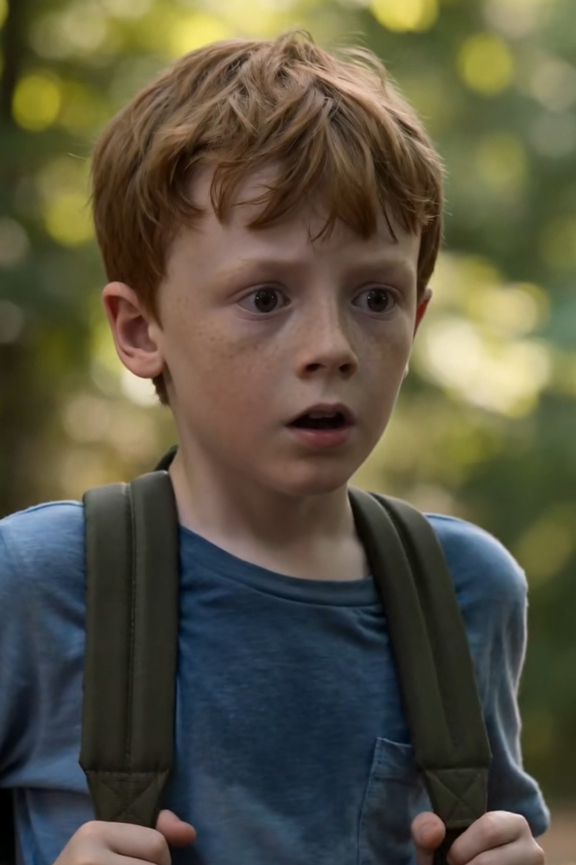
“Tell Silas a kid didn’t run.”
Colt nodded, though he had no idea who Silas was.
“I’ll tell him.”
Only then did Ren’s hand go slack.
They lifted her onto a stretcher and carried her toward the road.
Colt watched until the trees swallowed her.
A deputy knelt beside him.
“Son, that was the bravest thing I’ve ever seen.”
Colt did not answer that.
“Is she going to be okay?”
The deputy hesitated.
That pause told Colt more than words.
“They’ll do everything they can.”
Opal arrived before they could get Colt into the cruiser.
Her old pickup came rattling down the dirt road so fast dust rose behind it like smoke.
She jumped out and crossed the road with a cry that came from somewhere deeper than fear.
“Colt.”
She grabbed him and held him so tightly he could barely breathe.
“Are you hurt?”
“I’m okay, Grandma.”
“They said you went into the woods alone.”
“There was a lady,” Colt said into her shoulder.
“She was hurt.”
Opal pulled back and looked at his face.
His cheeks were scratched.
His shirt was torn.
His eyes looked older than they had that morning.
“I had to help her,” he said.
Opal’s face trembled.
Fear stayed there, but pride joined it.
“You did right, baby.”
She pulled him close again.
“You did right.”
Ren was taken to County General, fifteen miles away.
Colt insisted on going.
The deputies said he had done enough.
Opal said he needed rest.
A nurse said children should not sit outside an intensive care unit all night.
Colt only said one thing.
“I promised.”
Somehow, everyone understood.
The ICU waiting room was bright, cold, and smelled of disinfectant.
Colt sat in a plastic chair with a blanket around his shoulders.
His legs swung because his feet did not reach the floor.
Opal sat beside him with one hand on his knee.
Deputies came and went.
They asked gentle questions.
Did Ren say who hurt her?
Did Colt see anyone else?
Did he hear engines?
Did he notice vehicles near the road?
Colt told them everything.
He told them about the voice.
The chains.
The blood.
The water.
The way Ren had told him to run.
Then he told them her message.
“Tell Silas a kid didn’t run.”
The room changed when he said that name.
Deputies exchanged looks.
One of them stepped away to make a call.
Colt noticed.
He did not understand, but he noticed.
Outside the hospital, news vans began arriving before sunset.
Reporters stood under lights with microphones, already shaping the boy into a headline.
Opal saw them through the glass doors and went stiff.
“He’s eight years old,” she told a security guard.
“Keep those vultures away from him.”
The guard nodded.
“Yes, ma’am.”
Three counties away, the name Silas Maddox reached a clubhouse outside Knoxville.
The building had no sign.
No address anyone talked about.
Just concrete walls, barred windows, and a row of motorcycles parked out front like animals waiting for orders.
Inside, the air was thick with smoke and fury.
Men in leather vests stood around scarred wooden tables.
Phones buzzed.
Voices dropped.
At the center of the room stood Silas Maddox.
They called him Gravedigger.
He was tall, broad, gray at the temples, with hands that looked capable of wrecking a door or holding a frightened child without harm.
He listened while a younger rider repeated the news.
Ren Maddox had been found.
She was alive.
Barely.
She had been chained to a tree outside Sycamore Hollow.
An eight-year-old boy had found her.
The room waited for Silas to explode.
He did not.
His stillness was worse.
Someone had taken his wife.
Someone had beaten her.
Someone had chained her to a tree as a message.
Someone had meant for him to find her dead.
But the part that held him motionless was not the cruelty.
It was the child.
The boy who gave her water.
The boy who called for help.
The boy who ran back to hold her hand.
Silas finally spoke.
“What is the kid’s name?”
“Colt Whitmore.”
Silas nodded once.
“Then we ride for Colt Whitmore.”
The room shifted.
Men straightened.
Hands went to phones.
Engines outside seemed to wait for the command.
A chapter president stepped forward.
“Silas, that could mean thousands.”
“Call Knoxville,” Silas said.
“Call Nashville.”
“Call Chattanooga.”
“Call Kentucky, Alabama, Georgia, and every brother who ever wore the patch with honor.”
The man hesitated.
“You sure?”
Silas looked at him.
“My wife is alive because a child didn’t run.”
His voice dropped.
“The Iron Cobras wanted to send a message.”
He turned toward the room.
“We send one back.”
A low murmur moved through the riders.
“Nobody touches the Cobras,” Silas said.
“Not yet.”
First, we honor the boy.”
Within minutes, a message moved across encrypted phones, clubhouses, garages, diners, and roadside bars.
An eight-year-old saved one of ours.
Sycamore Hollow, Tennessee.
We ride at dawn.
By morning, thunder came to the hills.
Mrs. Petton heard it first.
She stood on the porch of her diner with a coffee mug in her hand, watching mist rise from the fields.
The sound began as a low rumble.
She looked up at the clear sky, wondering where the storm was.
Then the rumble grew.
It became vibration.
It pressed against her chest.
It shook the windows.
She turned toward Highway 41.
A line of headlights crested the hill.
Then another.
Then another.
Motorcycles poured over the rise in disciplined formation, chrome catching the early sun.
Mrs. Petton’s coffee mug slipped from her hand and shattered on the porch.
By seven o’clock, riders were entering Sycamore Hollow from three directions.
The sheriff’s office had six deputies.
They were facing thousands.
People locked doors.
Parents pulled children inside.
News vans clogged the highway shoulders.
Helicopters circled.
Social media called it an invasion.
Some said the town was finished.
Then the riders did something nobody expected.
They did not roar through Main Street.
They did not threaten anyone.
They rode to the abandoned fairgrounds outside town and parked in perfect rows.
Three thousand motorcycles formed lines so precise they looked drawn with a ruler.
Engines cut off almost together.
A silence fell that felt heavier than the roar.
Sheriff Beckett approached with every deputy he had.
He was fifty-three, tired, practical, and suddenly very aware of how small his badge felt in front of that many leather vests.
Silas Maddox stepped forward.
“This is a peaceful assembly,” he said.
“We’re here for one reason.”
The sheriff waited.
“A boy in your town showed more courage than most grown men.”
Silas looked past him toward Willow Creek Road.
“We came to say thank you.”
Sheriff Beckett blinked.
He had expected demands.
Threats.
A promise of retaliation.
Not gratitude.
Silas continued.
“My wife was left for dead in your woods.”
“An eight-year-old found her.”
“He gave her water.”
“He called for help.”
“Then he went back and held her hand.”
The sheriff had heard the story.
The whole county had.
But hearing it from Silas gave it weight.
“In our world, debts are sacred,” Silas said.