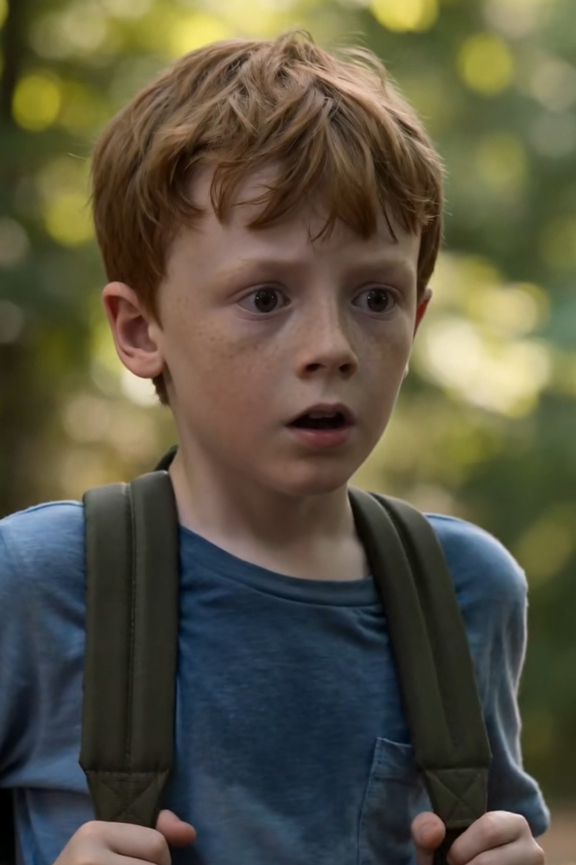
“And a child who does what he did is honored.”
The sheriff studied him.
He saw rage held in a cage.
He saw grief.
He saw power choosing restraint.
That was what finally made him nod.
“I’ll take you to the boy.”
By the time the convoy rolled down Willow Creek Road, half the town had found reasons to stand outside.
Opal Whitmore stood on her sagging porch with her arms folded.
She was five feet two inches of grandmother and grit, and she would not let anyone see her afraid.
Colt stood beside her in clean jeans and a fresh shirt.
Scratches still marked his arms.
Sleep shadowed his eyes.
Sergeant sat at his feet, uncertain about the rumbling machines.
Silas dismounted.
Three men followed him, each huge, tattooed, and quiet.
They removed their sunglasses before approaching the porch.
Silas climbed the steps.
Then the most feared man many of those townspeople had ever seen lowered himself to one knee in front of an eight-year-old boy.
“You’re the one who didn’t run,” Silas said.
Colt shrugged.
“She was thirsty.”
Something broke across Silas’s face.
It was not weakness.
It was recognition.
“My wife is alive because of you.”
A woman stepped from behind him.
Ren Maddox moved slowly, one arm in a sling, bruises still dark on her face.
She had left the hospital against medical advice because some debts had to be faced standing up.
Colt stared at her.
“You look better.”
Ren almost smiled.
“I remember you holding my hand.”
“You looked scared,” Colt said.
“I was.”
Silas reached into a saddlebag and pulled out a child-sized leather vest.
The watching deputies went still.
The vest was black, soft, and carefully made.
Across the back was a patch.
Honorary Guardian.
Courage Before Fear.
“This is not colors,” Silas said, looking first at Opal.
“This is not recruitment.”
“This is tribute.”
Opal’s eyes filled, but she nodded.
Silas helped Colt put it on.
It hung big on him.
Somehow, it looked right.
Then Silas turned toward the road and lifted one hand.
Three thousand engines roared to life.
The sound crashed across the hills.
Windows trembled.
Dishes rattled in cupboards.
Children clutched parents.
Then Silas dropped his hand.
Every engine stopped.
The silence afterward felt sacred.
Silas handed Colt a microphone.
Colt looked at the sea of riders.
He looked at his grandmother.
He looked at Ren.
Then he spoke.
“My grandma says being brave means helping even when you’re scared.”
His voice was small, but it carried.
“So if you came here because you think I was brave, you have to be brave too.”
He swallowed.
“Don’t scare my town.”
For a moment, nobody moved.
Then Silas nodded.
“You heard him.”
He turned to his riders.
“This town helped one of ours.”
“Now we help this town.”
What happened next became the first legend of Sycamore Hollow.
The riders filled gas stations and tipped attendants with hundred-dollar bills.
They packed Petton’s diner and left enough cash to cover a month of slow days.
They fixed the broken fence around the elementary school playground.
They repaired Sheriff Beckett’s old patrol car until it ran smoother than it had in years.
At the fairgrounds, donation jars filled with cash, checks, and jewelry.
By sunset, the total had passed sixty thousand dollars.
The next morning, the total passed one hundred thousand.
Riders who could not come had sent money.
Chapters across several states wired donations.
Men who looked like trouble sat around folding tables making plans to build playgrounds, upgrade the fire station, and buy medical equipment for the clinic.
Sheriff Beckett stood beside Silas at the fairgrounds and listened in disbelief.
“You’re telling me Hell’s Angels want to spend the day doing community service?”
Silas almost smiled.
“The boy asked us not to scare his town.”
“So we do the opposite.”
At the elementary school, bikers tore out rusted playground equipment and replaced it with safe new structures.
Principal Henderson stood with her hands over her mouth as men with tattooed arms measured, cut, lifted, and bolted everything into place.
One older rider wiped sweat from his forehead.
“Built to code, ma’am.”
“Better than code.”
At the fire station, Chief Morrison watched new turnout gear, breathing equipment, and tools being unloaded from a truck.
He had spent years writing grant applications that went nowhere.
Now the gear he had dreamed of sat in front of him because strangers on motorcycles had decided a small town’s firefighters mattered.
At the clinic, Dr. Hargrove opened an envelope and found a check large enough to change everything.
New diagnostic equipment.
A portable X-ray unit.
Monitoring devices.
Tools that could save people who otherwise had to wait for transport to Knoxville.
“Why?” she asked the biker who handed it to her.
He touched one leg, where an old limp showed when he shifted his weight.
“Because I once got hurt in a town like this.”
“The clinic didn’t have what it needed.”
“I almost lost my leg.”
He looked at the boxes stacked in her waiting room.
“That won’t happen here if we can help it.”
News cameras filmed everything.
Reporters who arrived expecting violence found themselves recording repairs, donations, and children climbing on brand-new playground equipment.
The headlines wrote themselves.
But Ren was not smiling.
She sat in a small room above Silas’s mother’s house, laptop open, watching the coverage spread.
The world was not talking about the Iron Cobras the way they had intended.
They had meant to make the Angels look weak.
They had meant to make fear grow.
Instead, they had created sympathy, gratitude, and national attention that made their brutality look smaller than a child’s courage.
Ren understood the outlaw world too well.
Pride was currency.
Humiliation demanded repayment.
The Iron Cobras would not let this stand.
She looked out the window at the fairgrounds.
Two hundred Angels had stayed behind to finish the work.
They were mixed among civilians.
Children.
Parents.
Teachers.
Firefighters.
Nurses.
A thought hit her like ice.
They were targets.
Ren grabbed her phone.
“We need to talk,” she told Silas.
“Now.”
They met inside an empty livestock building at the edge of the fairgrounds.
Silas came with two trusted captains.
Sheriff Beckett came too, uncomfortable but present because Ren had insisted.
She spread a map across a folding table.
“The Cobras are going to hit us here.”
Silas’s face did not change, but his eyes hardened.
“How do you know?”
“Because I know how they think.”
Ren pointed to the fairgrounds.
“We embarrassed them.”
“Every camera filming us helping this town makes them look weaker.”
“If they strike now, with civilians here, they send a bigger message.”
Sheriff Beckett shifted.
“You think they’d attack in front of witnesses?”
“That is exactly why they’d do it,” Ren said.
“Maximum visibility.”
“Maximum fear.”
“They want the world to see that anyone who helps us pays for it.”
She drew circles on the map.
“The east tree line gives them elevation.”
“Late afternoon gives them crowds.”
“They’ll try to create panic first.”
“Shots into structures, maybe near the crowd.”