Part I — The Costume
At 8:07 on a Tuesday morning, an airport police officer put me in handcuffs because he had decided that twenty-three years of my life were a costume.
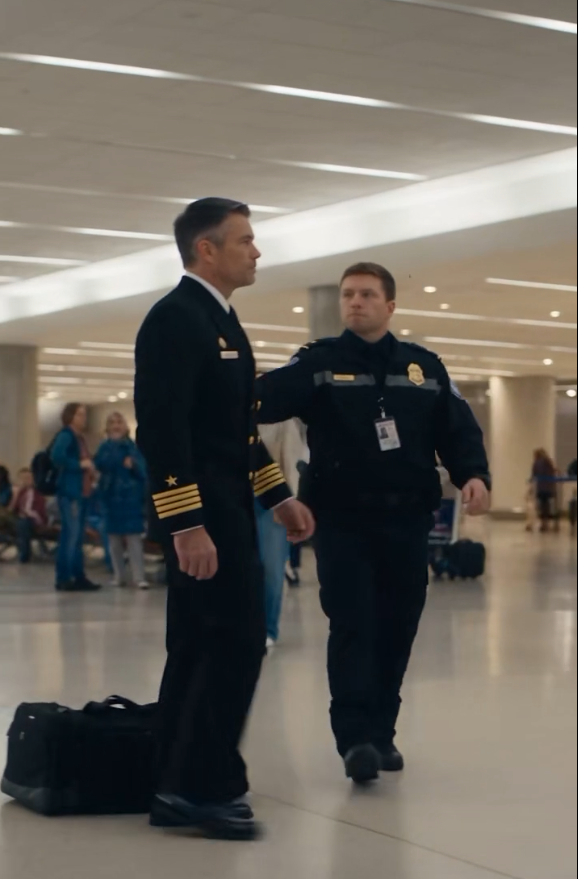
I was standing near Concourse B at Hartsfield-Jackson Atlanta International Airport in Navy Service Dress Blues, my dark sea bag beside my polished shoes, when Officer Bradley Vance took hold of my arm.
“Stop right there.”
I stopped.
The command itself wasn't unusual. Airports teach you to respond quickly to uniforms, barriers, alarms, instructions. I had been traveling for close to eighteen hours, and fatigue had reduced the world to practical things: the weight of my bag, the stiffness in my shoulders, the dry taste of bad coffee, the need to reach the people waiting for me without being late.
I turned toward him.
Vance was younger than I was by more than a decade, square-faced, clean-cut, wearing the dark uniform of airport police. His attention moved over my ribbons, shoulder boards, name tag, shoes, then back to my face.
There was no question in his expression.
Only a conclusion.
“Identification.”
“My military ID is in my bag.”
I nodded toward the sea bag at my feet.
He shifted between me and it.
“Don't reach for anything.”
“I wasn't going to.”
“What are you doing dressed like that?”
I looked down at my uniform and back at him.
“Traveling.”
“In that?”
“Yes.”
“Name?”
“Captain Marcus Hayes. United States Navy.”
He stared at me for another second.
Then he said, “Take off the costume.”
Those four words stayed with me longer than the pressure of the handcuffs did.
At first, I thought I had misunderstood him. I had been awake too long, moving from aircraft to terminal to holding area and back again. Exhaustion can distort an ordinary sentence until it sounds absurd.
“Excuse me?”
“You heard me.”
A man passing with a rolling suitcase slowed. A woman holding a paper coffee cup looked over.
Vance stepped closer.
“I'm not doing this with you in the middle of the terminal. If you're impersonating military personnel, we're going to straighten it out now.”
I looked at the badge on his chest, then at his face.
“My identification is in the dark sea bag directly behind you. Verify it.”
His eyes never left mine.
“What's your unit?”
“Officer, my identification will answer the question you're actually trying to ask.”
“What unit?”
There were things I could tell him. There were things I could not. My destination and reporting instructions were contained in a sealed travel packet inside the bag. Some of the material was restricted. None of it needed to be exposed in a public concourse to prove my name, my branch of service, or my rank.
So I kept my voice even.
“My military ID is available. Use it.”
That should have ended the argument.
Instead, something in him hardened.
Maybe it was my tone. Maybe he mistook restraint for evasion. Maybe he had already committed himself so completely to the idea of me as a fraud that every calm answer sounded rehearsed.
Whatever the reason, he stopped gathering information.
He started building a case in his head.
“You people always have an explanation.”
“People?”
“Turn around.”
I stayed where I was.
“Before you do this, verify my identification.”
“Hands where I can see them.”
“They are where you can see them.”
“Turn around.”
His voice was louder now.
Not quite a shout.
Loud enough.
I became aware of phones.
They appeared the way they always do when something public begins turning ugly. One was held chest-high by a teenager near a charging station. Another came up over a man's shoulder. The woman with the coffee took two steps back but did not leave.
I had spent years watching people under pressure.
I knew what happened next mattered more than what had happened before.
A single movement could be stripped of context.
A raised voice could become the clip.
A hand pulled away from an officer could become the entire story.
I was furious.
That did not mean I had the luxury of behaving like it.
So I turned around.
Vance took my left wrist first.
The cuff closed with a metallic click.
Someone behind us whispered, “Oh my God.”
My right arm followed.
The second cuff snapped shut.
Vance tightened them enough that the edges pressed hard against the bones of my wrists.
My sea bag tipped and hit the floor.
For the first time since he stopped me, I looked down.
Black leather shoes.
Dark trousers.
The edge of my sea bag.
My hands restrained behind me.
Ribbons across my chest that I could no longer see but could feel there, pinned carefully into place before dawn.
For a second, I saw the scene the way the crowd must have seen it.
A middle-aged man dressed as a Navy captain being arrested in a major American airport.
Some of them probably believed Vance.
Why wouldn't they?
People tend to assume the person in handcuffs is the one who has explaining to do.
“We take stolen valor seriously,” Vance said.
I turned my head enough to see him.
“So do I.”
The small smile at the corner of his mouth disappeared.
Then he took my upper arm and started walking.
The crowd opened.
I had been in situations where men shouted orders over alarms, where metal moved underfoot, where one bad judgment could place lives at risk. None of that prepared me for the peculiar helplessness of walking through an airport in dress uniform with my hands cuffed behind my back while strangers filmed.
A little boy standing beside his father looked at my ribbons, then at the handcuffs.
His father pulled him closer.
I looked away.
“You still have time to verify this,” I told Vance.
He gave my arm a harder tug.
“You'll have plenty of time to explain yourself.”
I almost laughed.
Not because anything was funny.
Because he had no idea what he had just said.
We made it perhaps forty yards before I saw another uniform coming toward us.
Sergeant Elena Ruiz.
I did not know her name yet, but I noticed the way she looked at the scene.
Not at me first.
At the details.
My shoulder boards.
My ribbons.
My shoes.
The handcuffs.
The sea bag sitting abandoned behind us.
Then Vance.
She stopped.
“What happened?”
“He's claiming Navy captain,” Vance said.
Claiming.
One word.
Nothing more.
I had carried responsibility for ships, sailors, operations, families waiting at home, decisions people would never hear about because the best outcomes in my profession often looked like nothing happening at all.
And now all of that had been reduced to a claim.
Ruiz looked at me.
“Sir, what's your name?”
“Captain Marcus Hayes.”
Vance gave a short breath through his nose.
Ruiz ignored it.
“Do you have identification?”
“In the bag Officer Vance would not allow me to access.”
She looked past us.
The sea bag remained where it had fallen.
Ruiz started to say something.
Every police radio near us crackled at once.
Static burst from her shoulder.
Then a dispatcher's voice came through with an urgency that changed the posture of every officer who heard it.