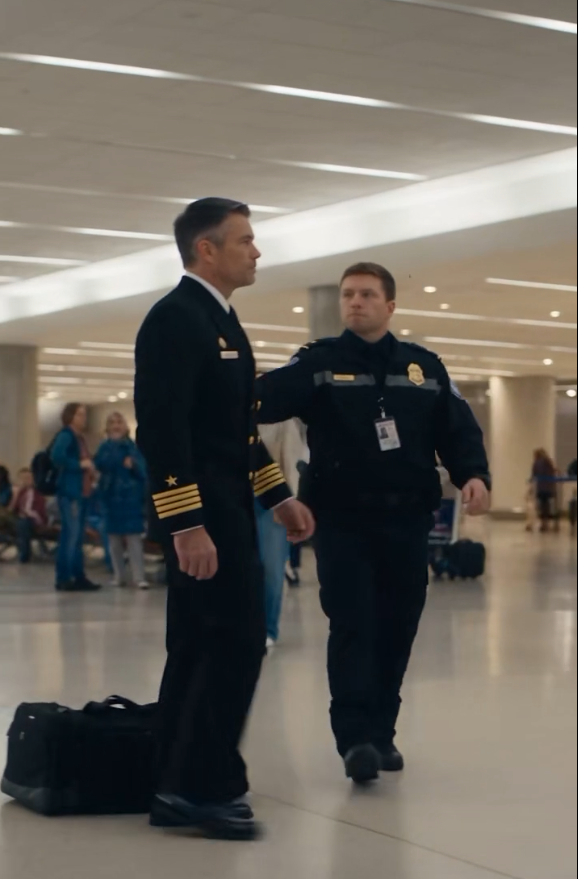
“All Concourse B units, confirm status and location of Captain Marcus Hayes.”
Nobody spoke.
The terminal noise continued around us—wheels over tile, gate announcements, distant engines—but inside the small circle we had created, everything seemed to narrow.
Vance turned his head toward me.
Slowly.
Ruiz's expression changed first.
She touched her radio.
“Dispatch, Concourse B supervisor. Repeat the name.”
“Captain Marcus Hayes, United States Navy. Confirm whether any unit has made contact.”
Ruiz looked directly at me.
I held her gaze.
Vance's hand was still around my arm.
For the first time that morning, his grip loosened.
Ruiz pressed the transmit button.
“Dispatch, stand by.”
Then to Vance, quietly:
“Don't move him.”
Vance's face tightened.
“I already have him detained.”
“I can see that.”
“He's possibly impersonating—”
“I said don't move him.”
It was the first time anyone had interrupted Vance's certainty.
He did not like it.
Ruiz turned to me.
“Captain, I'm going to ask you one question. Were you expected here this morning?”
“Yes.”
“By whom?”
“I can provide that information through the appropriate verification channel.”
Vance shook his head.
“There. That's what he's been doing.”
Ruiz didn't look at him.
“What channel?”
“Contact the Navy duty office using an independently obtained number. Give them my full name and service information from my military ID. Do not use a number I provide.”
That stopped her.
It was a basic principle.
If you suspected someone's documents were false, you did not verify the person through a phone number supplied by the same person.
You built your own chain.
Ruiz looked again toward the sea bag.
Then she keyed her radio.
“Dispatch, I may have contact with the individual you're seeking.”
The reply came immediately.
“Confirm condition.”
Vance's face shifted.
Just slightly.
Ruiz glanced at the handcuffs.
“Individual is detained. No medical issue.”
A pause.
Longer than before.
Then:
“Sergeant, hold position. Command desk is calling you directly.”
Vance released my arm.
Not the cuffs.
Just my arm.
Ruiz's phone began vibrating at her belt.
She looked at the screen.
Whatever she saw made her step away before answering.
I stood beside Vance without speaking.
He avoided looking at me.
The people nearby had stopped pretending not to listen.
Ruiz returned less than a minute later.
Her voice was lower.
“Officer Vance, retrieve the bag.”
Vance stared at her.
“You want me to search it?”
“No. I want you to retrieve it.”
“Sergeant—”
“Now.”
He walked back toward the place where it had fallen.
Ruiz moved closer to me.
“Captain, before anyone opens anything, tell me exactly where your military identification is located.”
“Outer document compartment. Zippered section on the front. Black card case.”
“And the sealed packet?”
“Main compartment. Do not open it.”
She nodded.
“Understood.”
That one word mattered.
Not because it cleared me.
It didn't.
But it meant someone had finally started listening to the difference between verification and assumption.
Vance returned carrying the bag.
He placed it on a row of empty seats.
Ruiz looked at me.
“Do I have your permission to retrieve only the card case?”
“Yes.”
She opened the front compartment.
Vance stood beside her.
She found the black case almost immediately.
My Common Access Card was inside with my other identification.
Ruiz removed it.
Her eyes moved over the card.
Then over me.
Then back to the card.
Vance leaned closer.
“These can be forged.”
Ruiz's expression did not change.
“Yes,” she said. “Which is why we're going to verify it.”
It was the first time all morning that anyone had said the word as if it actually meant something.
Verify.
Not assume.
Not accuse.
Not perform.
Verify.
Ruiz looked toward me.
“Captain, we're going to move somewhere private.”
“Am I under arrest?”
Vance answered before she did.
“You're detained.”
Ruiz turned her head.
“I asked the captain.”
Vance went quiet.
She looked back at me.
“You are being detained while we verify your identity and determine what happened. I'm going to have the restraints removed once we're in a controlled area unless circumstances change.”
I held her eyes for a moment.
“That's your decision.”
“Yes, sir.”
Vance flinched almost imperceptibly at the sir.
We started walking again.
This time, Ruiz carried my sea bag.
And this time, the crowd watched Vance instead of me.
Part II — Verification
The room they brought me to had no windows.
There was a table bolted to the floor, four chairs, a wall-mounted camera, and the flat institutional lighting common to places designed for people who are not supposed to stay long.
Ruiz closed the door.
Vance remained standing.
I stayed near the table.
“Turn around, please,” Ruiz said.
I did.
She removed the cuffs.
The relief was immediate, though I did not rub my wrists. I had no intention of giving Vance the satisfaction of seeing how badly the metal had pressed into them.
Ruiz placed the cuffs on the table.
“Have a seat if you want.”
“I'll stand.”
Vance folded his arms.
Ruiz set my identification beside the cuffs.
My sea bag stayed on the floor near her chair.
The sealed packet remained untouched.
That detail mattered more to me than either officer could have known.
Ruiz took out a notebook.
“Let's start over.”
Vance gave a short laugh.
“We don't need to start over.”
Ruiz looked up.
“Yes, we do.”
She turned to me.
“Full name.”
“Marcus Daniel Hayes.”
“Rank.”
“Captain. O-6.”
“Branch.”
“United States Navy.”
“Current duty status?”
“Active.”
“Purpose of travel?”
“Official travel.”
Vance moved.
“There it is again.”
I looked at him.
“There what is?”
“You won't say where you're going.”
“Because you do not require that information to verify who I am.”
“If you're legitimate, why hide it?”
“I am not hiding my identity.”
“You're hiding your orders.”
“Officer Vance, sealed orders are not public identification.”
His mouth tightened.
Ruiz held up a hand.
“That's enough.”
She wrote something down.
“Captain, can your identity be confirmed through the Navy without accessing the packet?”
“Yes.”
“How?”
“Through the Department of Defense personnel verification process or through the duty office responsible for my travel coordination.”
“You said we should obtain the number independently.”
“Yes.”
Ruiz nodded once.
Vance walked to the far side of the table.
“Or we open the packet and settle this in thirty seconds.”
“No,” I said.
His eyes came back to me.
“No?”
“You do not have my consent to open that packet.”
He put both palms on the table.
“You're detained by law enforcement.”
“That does not automatically authorize you to open restricted military travel material.”
“You expect me to believe there's classified material in a duffel bag?”
“I said restricted.”
“So now it's not classified?”
“I said from the beginning that the packet contains material that may be classified or restricted depending on the section. You do not need it.”
He looked at Ruiz as if I had just proven something.
“Listen to this.”
Ruiz closed her notebook.
“I am listening.”
Her tone had changed.
Not in my favor.
Not in his.
Toward the facts.
Her phone rang.
She answered.
“Yes.”
A pause.
“No, we're in Interview Two.”
Another pause.
“Yes, his identification is in front of me.”
She read my name, card information, and expiration date.