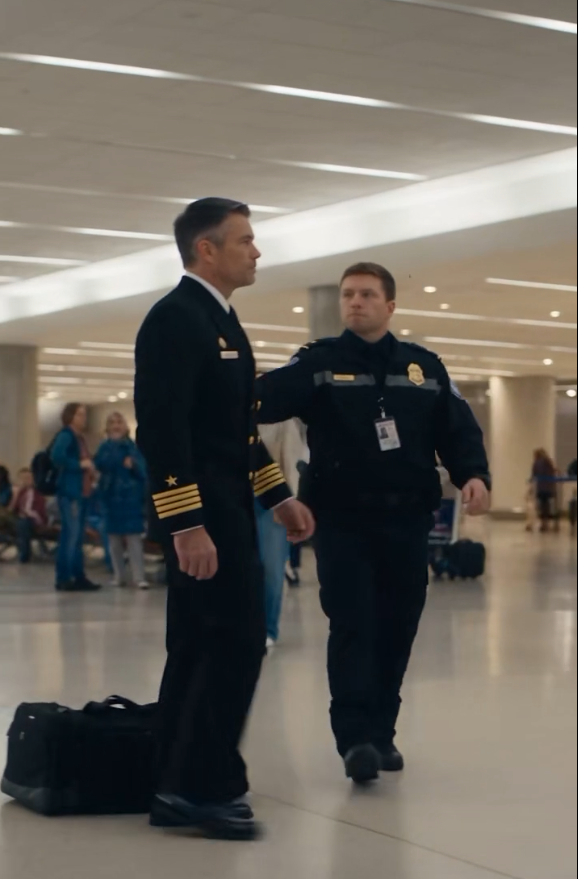
I didn't give her one.
The people waiting for me were in a secure administrative area beyond the public concourse.
By the time I arrived, I was thirty-seven minutes late.
That bothered me more than I expected.
Punctuality in the military is rarely about the clock itself. It is about what your delay does to everyone else's planning.
A federal security coordinator met me first. Behind him were two officials attached to the travel and operations team responsible for my onward movement.
One took a look at me and stopped.
“Captain, what happened to your wrists?”
“Airport police.”
The coordinator stared.
“What?”
“There was a question about my identity.”
“A question?”
“It has been answered.”
He looked past me toward the watch commander.
“What kind of question leaves cuff marks?”
The commander spoke.
“We're conducting an internal review.”
The coordinator's attention returned to me.
“Sir, we called the Navy coordination desk when you didn't arrive at the checkpoint.”
“I know.”
“We thought your inbound itinerary had changed.”
“It hadn't.”
“We had airport operations looking for you.”
“I know that too.”
His expression tightened.
“You know because—”
“I heard the radio call.”
He understood.
“Oh.”
The room went quiet.
I set the sea bag beside a chair.
One of the officials pointed toward it.
“Packet intact?”
“Yes.”
“You confirmed?”
“Airport police did not open it.”
That was important.
Whatever else happened that morning, restricted material had remained protected.
The coordinator exhaled.
“We need to decide whether to delay the onward movement.”
“No.”
“Captain—”
“No. We're already late.”
“You've just been detained.”
“And released.”
“You may need medical documentation.”
“For red wrists?”
“For the record.”
“The record can wait.”
He studied me.
“You're sure?”
I looked down at my uniform.
It was still clean.
My shoulder boards were straight.
One ribbon had shifted slightly.
I adjusted it.
“I'm sure.”
The meeting I had traveled for was not dramatic in the way people imagine when they hear words like restricted or coordinated. There were no secret agents waiting beside black vehicles, no weapons cases, no crisis unfolding behind locked doors.
Most serious work does not look serious from the outside.
It looks like schedules.
Folders.
Encrypted systems.
People who know when to speak and when not to.
My presence was required because I represented a Navy command in a closed interagency session involving transportation continuity, military movement, and federal coordination procedures.
That was all Vance would have needed to know if the proper people had asked the proper way.
It was also far more than he had any reason to learn in the middle of a concourse.
The irony was not lost on anyone when the first agenda item involved failures of communication between organizations that believed they were operating from the same information.
I sat at the table with a paper cup of coffee warming my hands.
One of the officials glanced at my wrists before beginning.
“Captain Hayes, we can reschedule your portion.”
“No.”
“You've had an unusual morning.”
“That doesn't change what we came here to do.”
He nodded.
The meeting began.
For the next ninety minutes, I did my job.
I listened.
Asked questions.
Challenged assumptions.
Pointed out gaps.
Made notes.
Nobody mentioned the airport incident.
That courtesy lasted until the first break.
My phone, which had been secured during the meeting, showed twenty-seven messages.
Then thirty-one.
Then thirty-four.
I didn't need to open them to know what had happened.
Someone had uploaded the video.
Probably several someones.
The first message I read was from a fellow officer.
Call me before you look at social media.
That was enough.
I didn't look.
The federal coordinator walked into the break room holding his own phone.
“You're online.”
“So I've gathered.”
“It's spreading.”
“Is the footage complete?”
“No idea.”
“Then I don't have anything to say yet.”
He lowered the phone.
“Airport public affairs is asking if you will participate in a joint statement.”
“Already?”
“They want to get ahead of it.”
I took a drink of coffee.
“There is no getting ahead of video that is already public.”
“They want to call it a misunderstanding.”
I set the cup down.
“Was I handcuffed?”
“Yes.”
“Was my identification available?”
“Yes.”
“Was I prevented from accessing it?”
“According to you.”
“According to his body camera.”
He paused.
“You're assuming it recorded.”
“I'm assuming procedure was followed in at least one area.”
The coordinator almost smiled.
Almost.
“What do you want them to say?”
“The truth.”
“Which version?”
That question made me look at him.
He lifted one hand.
“I don't mean that the way it sounds. I mean they will have an account. You will have an account. There may be facts neither side knows yet.”
“Then say an incident occurred, my identity was verified, I was released, and the matter is under review.”
“No blame?”
“Not before the review.”
“You're being generous.”
“No.”
I picked up my coffee again.
“I'm being precise.”
That afternoon, the precision became harder.
A thirty-two-second video showed me in handcuffs while Vance said, “We take stolen valor seriously.”
Another clip showed me replying, “So do I.”
A third showed Ruiz approaching moments before the radio call.
But the most widely shared clip began earlier.
It caught Vance saying:
“Take off the costume.”
The person recording had been close enough that my answer was clear.
“My identification is right there. Verify it.”
Then Vance:
“Turn around.”
That was the video people chose.
Because it had an obvious villain.
An obvious victim.
A beginning and an ending that fit inside half a minute.
Real life was less convenient.
By midafternoon, strangers had found Vance's name.
That concerned me.
The coordinator did not understand why.
“He made the arrest.”
“He made a bad decision.”
“Public employees get criticized.”
“Criticism is one thing.”
I turned my phone so he could see the messages circulating beneath one repost.
Some were angry.
Some were ugly.
Some were threats.
“He has a family?” I asked.
“I don't know.”
“Neither do they.”
The coordinator watched me.
“You want to defend him?”
“No.”
“Then what?”
“I want the investigation to determine consequences. Not an online mob.”
He leaned back.
“You know he didn't give you that courtesy.”
“I noticed.”
“Doesn't that matter?”
“It matters.”
I locked my phone.
“It does not get to decide who I become next.”
Part IV — The Record
At 4:10 that afternoon, I returned to airport police headquarters voluntarily.
My official obligations were complete.
The incident was not.
Ruiz met me at the entrance.
She was no longer in the hurried posture of a supervisor trying to stabilize a scene. Her uniform looked exactly as it had that morning, but there was more fatigue in her face.
“Captain.”
“Sergeant.”
“Thank you for coming back.”
“You said you needed a formal statement.”
“We do.”
She led me to a conference room.
This one had windows.
The runway was visible in the distance beyond layers of glass, aircraft moving steadily as if nothing unusual had happened anywhere in the building.
The watch commander sat at the far end of the table with an internal-affairs investigator and an airport attorney.
Vance was not there.
I preferred it that way.
The investigator explained the process.
Then she started with the simplest question.