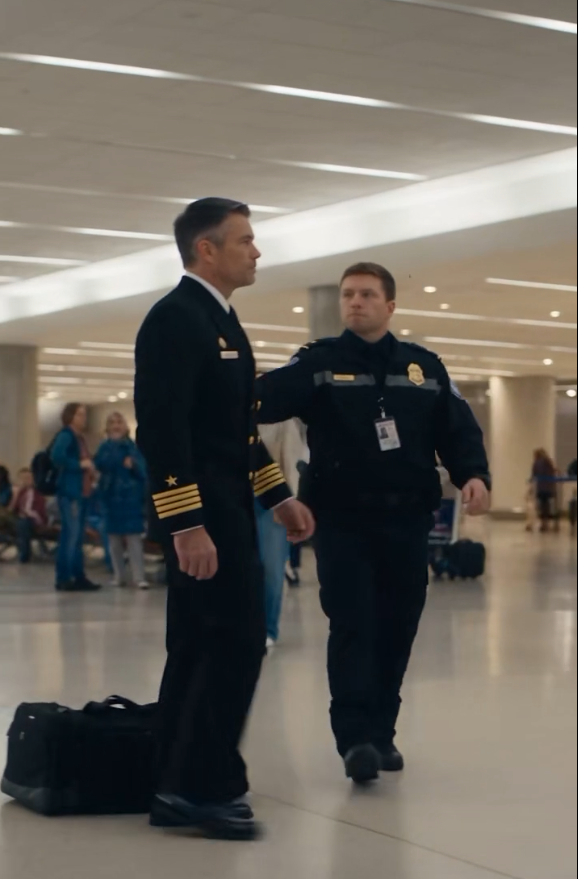
“What first drew Officer Vance's attention to you?”
“I don't know.”
“You didn't have any interaction before he approached?”
“No.”
“Were you behaving unusually?”
“Not that I'm aware of.”
“Did you make any statements regarding your rank before he asked?”
“No.”
“Were you displaying a weapon?”
“No.”
“Did you possess one?”
“Not in the concourse.”
She nodded and moved on.
Every question forced the morning into smaller pieces.
Where was the bag?
Where were your hands?
How far was the officer from you?
Did he ask permission to inspect your identification?
Did you refuse?
Did you raise your voice?
Did you make physical contact?
Did you attempt to leave?
Did you tell him the contents of your orders were classified?
“Not exactly.”
The investigator looked up.
“What did you say?”
“That the sealed travel packet contained material I could not disclose publicly and that my identity could be verified without opening it.”
“Officer Vance's preliminary statement says you repeatedly claimed the bag contained classified material.”
“His body camera should answer that.”
She made a note.
The watch commander looked uncomfortable.
I continued.
“I was careful with the word because classification has specific meaning. Some of the material was restricted. Some information within my orders was controlled. None of that was relevant to who I was.”
The attorney spoke for the first time.
“Captain, did Officer Vance ever tell you what specific feature of your uniform caused him to believe it was false?”
“No.”
“Did he challenge any ribbon, insignia, rank device, name tag, or regulation?”
“No.”
“Did he claim your identification looked fraudulent?”
“He never looked at it before restraining me.”
The room settled around that sentence.
The investigator flipped a page.
“Sergeant Ruiz's body camera confirms that.”
I looked toward Ruiz.
She said nothing.
The investigator continued.
“Officer Vance's camera also confirms that you directed him toward your identification twice before the restraints were applied.”
“Three times.”
She checked her notes.
“Three?”
“The first was when he asked for identification. I told him it was in my bag. The second was when I said, ‘My identification is right there. Verify it.’ The third was immediately before he ordered me to turn around.”
She rewound footage on her laptop.
Listened through headphones.
Then removed them.
“You're correct.”
The watch commander shifted in his chair.
The investigator made another note.
I looked through the window toward a departing aircraft.
Facts matter.
Small facts especially.
People often expect truth to arrive dramatically.
Most of the time it arrives one detail at a time.
At 8:07, where were his hands?
At 8:08, what did he say?
At 8:09, what did the officer refuse to check?
A career could turn on a sentence somebody thought nobody would remember.
So could a reputation.
The investigator reached the radio traffic.
“Sergeant Ruiz, explain the dispatch call.”
Ruiz sat straighter.
“At approximately 8:12, command received an elevated inquiry from airport operations regarding Captain Hayes's location. His scheduled contact window had passed. A coordination message had been entered earlier, but it was not distributed as a patrol alert because there was no reason to treat it as an incident.”
“What information was in the message?”
“Name, branch, rank, approximate arrival window, concourse, and a note that he might be traveling in formal service uniform.”
The attorney stopped writing.
I turned toward Ruiz.
“Formal service uniform?”
“Yes.”
The words stayed in the room.
The investigator looked at the watch commander.
“Was Officer Vance expected to have seen that?”
“No.”
“Why not?”
“It was entered at the operations level.”
“So his failure to know Captain Hayes was expected was not itself misconduct?”
“Correct.”
I appreciated that answer.
There was enough fault without manufacturing more.
The investigator turned back to Ruiz.
“What changed at 8:12?”
“The receiving team reported Captain Hayes overdue. Airport operations asked whether police had any contact matching his description.”
“That produced the all-units call?”
“Yes.”
“Why all units?”
“Because no one initially knew whether he'd missed the connection, gone to the wrong checkpoint, experienced a medical issue, or encountered some other problem.”
“Such as being detained.”
Ruiz's expression tightened.
“Yes.”
The investigator looked at me.
“What did you think when you heard the call?”
“That the people expecting me had realized I had not arrived.”
“You didn't think it proved your identity?”
“No.”
That surprised her.
“Why not?”
“Because a radio call repeating my name was not independent proof that I was Captain Hayes. Officer Vance was still entitled to verify who I was.”
The watch commander looked at me.
“You still believe that?”
“Yes.”
“After everything?”
“Especially after everything.”
Nobody spoke.
I continued.
“The problem wasn't that he questioned me.”
I looked at the investigator.
“The problem was that he stopped questioning.”
That sentence became the center of the room.
The attorney wrote it down.
The investigator did too.
Ruiz looked at the table.
The watch commander leaned back slowly.
I had not planned the line.
It was simply the cleanest description I had.
Vance was not wrong to notice something.
Not wrong to ask.
Not wrong to verify.
He was wrong when suspicion became certainty before evidence entered the process.
The investigator closed one file and opened another.
“There is one more matter.”
She turned the laptop.
“Officer Vance submitted a written initial account at 9:03 this morning.”
I read the visible portion.
He had written that I became “evasive and noncompliant” when asked to establish my identity.
I read it again.
“Noncompliant?”
The investigator said, “That's his wording.”
“He ordered me to turn around.”
“Yes.”
“I turned around.”
“Yes.”
“He ordered me to keep my hands visible.”
“Yes.”
“They were visible.”
“Yes.”
“What order did I fail to comply with?”
The investigator did not answer immediately.
“That is one of the issues under review.”
I looked at Ruiz.
Her face told me she had already seen the report.
“And evasive?”
“He cites your refusal to state your destination and your refusal to allow the travel packet to be opened.”
“That information was not necessary to establish identity.”
“We understand your position.”
“It isn't a position.”
The words came out harder than I intended.
The room tightened.
I took a breath.
Then I continued more quietly.
“My identity was confirmed without opening it. That fact answers the question.”
The investigator nodded.
“Yes.”
I sat back.
For the first time that day, I felt tired rather than angry.
There is a difference.
Anger gives you a direction.
Fatigue just takes things away.
The investigator closed the laptop.
“Captain, do you want to file a formal complaint?”
The question was inevitable.
Still, I did not answer immediately.
The watch commander watched me.
Ruiz watched me.
The attorney's pen stopped moving.
Outside the window, an aircraft lifted from the runway and climbed through afternoon haze.
“What happens if I don't?” I asked.
“The internal investigation continues.”
“So the body-camera footage, reports, radio traffic, and witness statements are reviewed regardless?”
“Yes.”
“And policy violations, if found, are addressed?”
“Yes.”
“Then what does my complaint add?”
“Your formal allegation and requested review of Officer Vance's conduct.”
I looked at my wrists.
The marks had faded but were still visible.
Then I remembered the boy beside his father.
The woman lowering her coffee.
The phones.
The word costume.