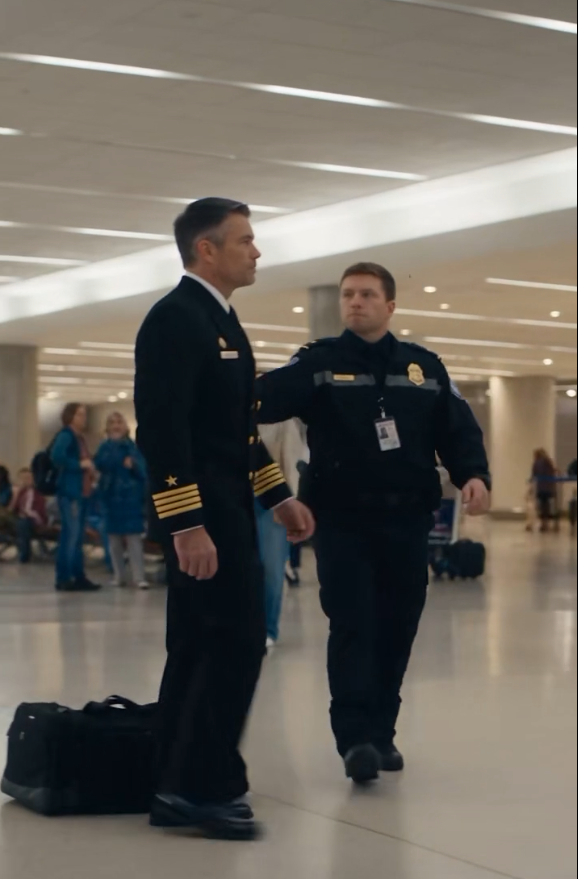
No information had been compromised.
Operationally, the result was clean.
Personally, it was more complicated.
I found myself noticing police officers in airports in a way I had not before.
Not with fear.
With attention.
Who they watched.
How they approached people.
Whether their hands rested near their belts.
Whether they began with questions or commands.
Once you have been misread by authority, you become aware of how much power exists in the first thirty seconds of an encounter.
Ruiz emailed me two months after the hearing.
Not about Vance.
About training.
Her department had developed a scenario for supervisors based on the incident.
They wanted permission to use portions of the body-camera footage internally.
I called instead of emailing back.
“You don't need my permission for department footage,” I told her.
“No,” she said, “but we're asking.”
“Why?”
“Because the scenario is built around your decisions too.”
“My decisions?”
“The instructor pauses the video at different points.”
I could hear papers moving on her end.
“First pause: officer challenges identity. What information is relevant? Second pause: subject identifies available credential. What are the safe verification options? Third pause: subject refuses to disclose travel purpose. Is that evidence of impersonation? Fourth pause: supervisor arrives. What should change?”
I leaned back in my office chair.
“And the handcuffs?”
“That's the fifth pause.”
“What question?”
“What fact changed between the initial contact and the decision to restrain?”
I already knew the answer.
“Nothing.”
“Exactly.”
I was quiet.
Ruiz continued.
“We're not teaching that officers should believe every uniform.”
“Good.”
“We're teaching them not to confuse suspicion with proof.”
“Better.”
“So?”
“You can use it.”
“Thank you.”
“Elena.”
“Yes?”
“How's Vance?”
There was a short silence.
“You said you didn't want to know.”
“I said I didn't need to watch the punishment.”
She considered that.
“He finished retraining.”
“And?”
“He's back under supervision.”
I waited.
“He asked to participate in the credential-verification block.”
That surprised me.
“Why?”
“He says he's qualified to teach the part about what not to do.”
I laughed.
The sound caught me off guard.
Ruiz laughed too.
Then she said, “He isn't teaching it.”
“Probably wise.”
“But he sits in.”
“That may be wiser.”
We ended the call.
I thought about that conversation more than I expected.
Not because it made Vance heroic.
It didn't.
He had made a preventable mistake.
He had used authority badly.
Then he had written a report that tried to make the facts fit his decision.
Those things remained true.
So did something else.
When evidence cornered him, he eventually stopped defending the version of himself that needed to be right.
That was not redemption.
It was a beginning.
Months later, I passed through Atlanta again.
Tuesday morning.
Different time.
Same concourse.
I was in Service Dress Blues.
That part was coincidence.
The Navy had scheduled a ceremony later that day, and travel requirements made changing beforehand impractical.
I noticed the looks.
Not because people thought the uniform was false.
Because some recognized me.
A man near a restaurant glanced at his phone, then at me, then whispered something to his wife.
I kept walking.
My sea bag rested over one shoulder.
Near the security corridor, I saw Sergeant Ruiz speaking with two officers.
She noticed me.
Her eyebrows lifted.
I stopped.
“Well,” she said, looking at the uniform. “You're brave.”
“I've been told.”
One of the younger officers looked between us.
Ruiz said, “Captain Hayes.”
Recognition landed on his face.
“Oh.”
I looked at Ruiz.
“You using me as a cautionary tale now?”
“Training material.”
“That sounds worse.”
She smiled.
Then someone approached from behind her.
Bradley Vance.
For half a second, none of us moved.
He looked older than he had months before.
Or maybe simply less certain.
There was no visible sign of the disciplinary process except that he was walking beside another officer rather than alone.
His eyes moved over my uniform.
Then to the sea bag.
I could see the memory reach him.
“Captain.”
“Officer.”
Ruiz looked between us.
The younger officer suddenly found something interesting across the concourse.
Vance gave a restrained smile.
“Official travel?”
“Yes.”
He glanced at the bag again.
“Identification in there?”
I looked at him.
Ruiz closed her eyes for one second.
Then Vance smiled properly.
I did too.
“Yes.”
“Good place for it.”
Ruiz shook her head.
“That isn't funny.”
“It is a little funny,” I said.
She pointed toward Vance.
“Don't encourage him.”
The tension went out of the moment.
Not all of it.
Enough.
Vance's expression became serious.
“We changed the procedure.”
“I heard.”
“Had a guy last week claiming to be Air Force.”
“How did it go?”
“We checked his ID.”
“And?”
“He was Air Force.”
I nodded.
“Good.”
Vance looked toward the flow of passengers.
“The old me would've probably made it complicated.”
“The old you made things complicated.”
“Yeah.”
No defensiveness.
Just fact.
An announcement sounded overhead.
My boarding time was approaching.
Ruiz extended her hand.
I shook it.
“Safe travels, Captain.”
“Thank you, Sergeant.”
Vance stepped slightly aside to clear my path.
I started walking.
After several steps, he called after me.
“Captain.”
I turned.
He did not salute.
That would have been too much, and both of us knew it.
Instead he said, “For what it's worth, I don't call uniforms costumes anymore.”
I looked at him for a moment.
“That's worth something.”
Then I kept walking.
At the gate, I placed my sea bag beside my feet and looked through the glass at the aircraft waiting outside.
Months earlier, the sight of that same bag on an airport floor had come to represent helplessness.
Proof within reach.
Truth ignored.
A life reduced to an accusation because someone had decided looking was the same as knowing.
Now it was just a bag again.
That mattered.
My phone vibrated.
A message from Ruiz.
She had sent a photograph.
Not of me.
Not of Vance.
A photograph of a laminated card attached beside the supervisor desk at airport police headquarters.
At the top, in large plain letters, were three words:
IDENTIFY. VERIFY. THEN ACT.
Beneath them were procedures for military credentials, federal identification, restricted travel documents, and supervisory review.
At the bottom was a final note:
Uncertainty is a reason to check. It is not evidence of guilt.
I read that line twice.
Then I put the phone away.
Boarding began.
I lifted the sea bag onto my shoulder and joined the line.
A few travelers recognized me.
Most did not.
That was fine.
I had never needed strangers to know who I was.
I had only needed one officer, on one Tuesday morning, to be willing to find out.
And months later, as I walked down the jet bridge in the same Navy blue he had once called a costume, I realized the part of the story that mattered most had never been that Bradley Vance was wrong about me.
It was what happened after he learned he was wrong.
Because authority is not proven by never making a mistake. It is proven by what you do when the facts tell you that you made one.