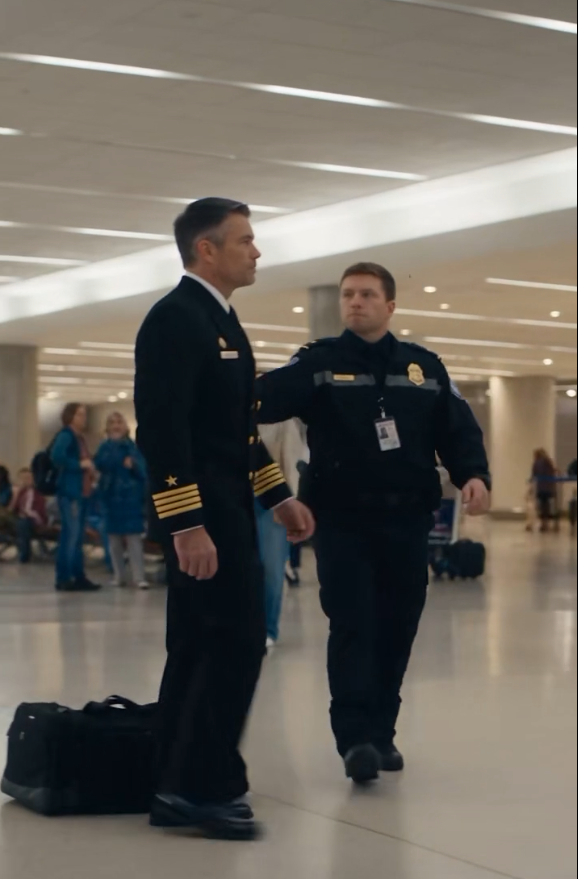
“I want the record to say what happened.”
“Nothing else?”
“I want procedures changed so that officers have a clear method for independently verifying military credentials without relying on public internet searches, appearance, or a traveler's willingness to disclose unrelated official information.”
One member looked down at his notes.
“That recommendation is already under consideration.”
“Good.”
“And Officer Vance?”
The question had come.
Not from a reporter.
Not from the internet.
From people who could actually affect him.
I looked at Vance.
He met my eyes.
I remembered the cuffs.
The smirk.
Claiming.
Costume.
I also remembered the moment in the interview room when he said he had once let a real impersonator walk.
A previous mistake had followed him into the next encounter and turned caution into overcorrection.
That explanation mattered.
It did not erase responsibility.
I turned back to the panel.
“Officer Vance should be held accountable for what he did.”
He did not move.
“But I am not asking you to fire him.”
The panel chair studied me.
“Why?”
“Because accountability and destruction are not the same thing.”
I glanced at Ruiz.
“She questioned what she saw, asked for evidence, and changed course when the facts changed. That's what authority is supposed to look like.”
Ruiz looked down.
I continued.
“Officer Vance did the opposite. If the department believes that can be corrected through discipline, retraining, and supervision, that's your judgment. If you believe the conduct meets the standard for termination, that's also your judgment.”
I closed my folder.
“But do not decide because a video went viral. Decide because of the record.”
The panel chair nodded slowly.
“Thank you, Captain.”
I thought that was the end.
Then Vance spoke.
“I have something to say.”
His representative leaned toward him.
Vance shook his head.
The panel chair looked at him.
“Go ahead.”
Vance turned toward me.
The room felt suddenly smaller.
“I wrote that you were noncompliant.”
“Yes.”
“You weren't.”
Nobody reacted.
“I wrote that because when I sat down after everything happened, I was trying to explain why I'd done what I did.”
His voice was steady, though his hands were locked together.
“I kept thinking there had to be something you did that made my decision make sense.”
I said nothing.
“There wasn't.”
He looked toward the table.
“I saw the uniform and thought about the guy I'd missed before. Then when you didn't answer the way I wanted, I decided that was proof.”
His representative shifted again.
Vance continued anyway.
“When you told me to verify the ID, I thought you were challenging me.”
“I was.”
That earned the smallest movement at the corner of his mouth.
“Yeah.”
Then it vanished.
“But you were also telling me exactly how to solve the problem.”
“Yes.”
He nodded.
“I know that now.”
The panel chair asked, “Officer Vance, are you changing any portion of your written statement?”
“Yes.”
“Which portion?”
“The description of Captain Hayes as noncompliant. And the part where I said he was obstructing identification.”
“Why?”
“Because he wasn't.”
The investigator slid a form toward him.
“You understand this amendment becomes part of the permanent file?”
“Yes.”
“You understand it may affect the disciplinary finding?”
“Yes.”
Vance picked up the pen.
That was the moment I understood the hearing had changed.
Until then, I had assumed the decisive evidence would be the videos.
The radio traffic.
The timestamps.
The ID verification.
It wasn't.
Those things established what happened.
Vance's correction established whether he was still willing to lie to himself about it.
He signed.
The panel recessed.
Ruiz and I stepped into the hallway.
Neither of us spoke for a while.
Finally she said, “You know everyone's going to ask what they decided.”
“I know.”
“What are you going to say?”
“That the department handled it.”
“You won't know the final discipline today.”
“I don't need to.”
She looked at me.
“You really don't want to know?”
“I'll read the final report.”
“That isn't what I meant.”
I knew.
“No,” I said. “I don't need to watch the punishment.”
She leaned against the wall.
“Most people would.”
“Most people wouldn't have spent three weeks being told by strangers what they should want.”
She smiled.
“Fair.”
I looked through the glass doors at the terminal beyond.
Travelers moved in every direction.
Different uniforms.
Different bags.
Different stories.
Most passed one another without ever knowing anything important about the person three feet away.
Maybe that was part of the problem.
We are constantly asked to make fast decisions about people we barely understand.
The speed is unavoidable.
The certainty is not.
The panel called us back in.
Their final administrative findings were read into the record.
Vance had lacked sufficient objective basis to escalate the encounter when he did.
He had failed to make a reasonable attempt to verify readily available identification before applying restraints.
His initial report had contained unsupported characterizations contradicted by video evidence.
The department would impose formal discipline, remove him temporarily from public-facing patrol duties, require retraining and supervised evaluation, and review his reinstatement after completion.
He was not fired.
I looked at him.
He looked relieved.
Then ashamed of being relieved.
Both reactions made sense.
The panel also announced changes to procedure.
Airport police would receive a standardized military-credential verification guide.
Supervisors would be required to distinguish refusal to disclose unrelated travel information from refusal to identify oneself.
Formal service uniforms alone would not constitute reasonable grounds for suspicion.
Most important to me, restricted documents would not be treated as ordinary identification when other independent verification methods were available.
The panel chair finished.
“Captain Hayes, is there anything further?”
I shook my head.
“No.”
Then Vance looked at me.
“Captain?”
The room waited.
He stood.
So did I.
He took one step forward and stopped at a respectful distance.
No cameras.
No crowd.
No one holding up a phone.
“I owe you an apology.”
I waited.
“I embarrassed you publicly. I put you in restraints before I checked the proof you were offering me. And then I wrote the report like you caused it.”
His voice remained level.
No performance.
No excuses.
“I was wrong.”
I studied him.
An apology does not erase an event.
People sometimes treat forgiveness as if it means declaring the damage imaginary.
It does not.
“You were,” I said.
He nodded.
“I know.”
I let the silence stay between us.
Then I said, “Do better with the next person.”
His eyes lifted.
“Yes, sir.”
I almost told him not to call me sir.
I didn't.
Part VI — What Remained
The airport incident followed me longer than I wanted it to.
For several weeks, someone recognized me almost every time I traveled in uniform.
Some wanted photographs.
Some wanted to tell me what they would have done to Vance.
Most versions involved shouting.
A surprising number involved lawsuits.
One man at a gate told me he would have “put that cop in his place.”
I asked what place that was.
He did not have an answer.
The Navy had its own review because my official travel had been interrupted and restricted material had temporarily been outside my direct control.
The packet had remained sealed.
Chain of custody was reconstructed.