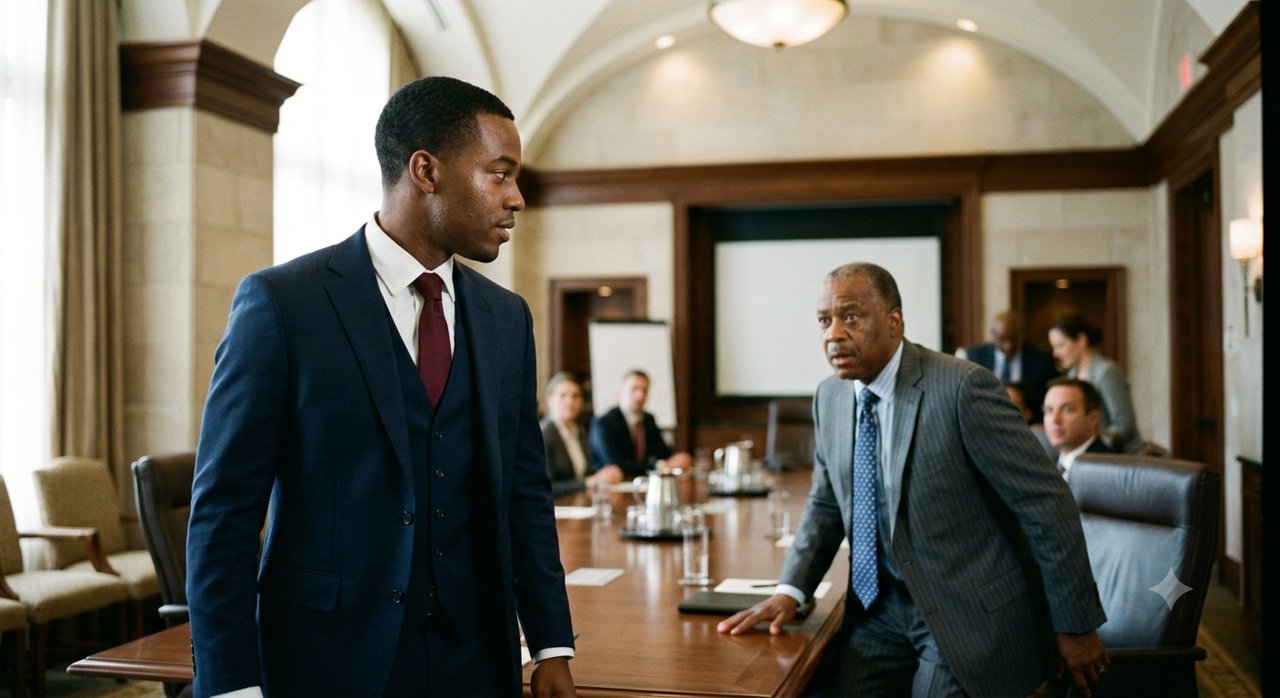
Patricia Odom answered on the second ring, which told Andre she had been expecting the call.
Her voice was direct and unhurried — the voice of someone who had learned long ago that urgency and speed were not the same thing.
"Walter told me about you six months ago," she said.
"I'm glad you came."
"He said you've been following Clifton Greer for two years."
"Longer than that, if you count the background work.
Clifton has been doing variations of the same thing since the early nineties.
He identifies elderly property owners — usually people with limited family support, sometimes with health issues — and he inserts himself into the estate process.
Sometimes through a relationship.
Sometimes through a lawyer he controls.
Sometimes through a combination."
"And nobody's stopped him."
"Three families tried.
Two of them ran out of money before it got to trial.
One of them settled.
Clifton has never been formally charged with anything." A brief pause.
"Until now, he's never had a witness who was both credible and willing."
"Marcus says Eunice has dementia."
"Eunice has mild short-term memory difficulty that affects her recall of recent events.
Her long-term memory — including everything she witnessed thirty years ago — is sharp and consistent.
I have three recorded conversations with her over the past eight months.
Her account has not varied once." Patricia's voice was steady.
"Marcus knows that.
He's hoping you don't."
Andre was sitting at Walter's kitchen table.
Walter was across from him, listening to one side of the conversation.
"Marcus offered me fifty thousand dollars today," Andre said.
"He offered you fifty thousand dollars because the estate is currently valued at approximately one point four million.
The house, the land, and two investment accounts that were part of your grandfather's original holdings." She paused.
"He also offered it because he knows what I know — that if Eunice testifies and I put the pattern of behavior in front of a jury, Clifton doesn't just lose the estate.
He faces criminal exposure.
And so does Marcus."
"Marcus is exposed too?"
"Marcus filed the motion three weeks ago to transfer Rose's remaining personal property.
He did it knowing the original will was fraudulent.
That makes him part of it." Her tone didn't change.
"I want to be honest with you, Andre.
This will not be fast.
It will not be simple.
Clifton will fight every step.
Marcus will try to discredit Eunice, delay proceedings, and make the cost of continuing feel higher than the cost of stopping."
"He already tried that."
"He'll try harder.
At some point he may try to approach Eunice directly.
That's why I need to get her formal protective status through the court as a material witness before we file."
"Can you do that quickly?"
"I filed the motion this morning," Patricia said.
"I've been waiting for you to make this call."
Andre looked at Walter.
Walter was watching him with an expression that was difficult to read — something between hope and the careful management of hope, the look of a man who had been disappointed enough times to be afraid of wanting something too much.
"What do you need from me?" Andre said.
"A formal declaration of your status as Walter's biological son and legal heir.
A DNA confirmation, which we can do quickly.
And your willingness to be a named plaintiff alongside Walter."
"You have all of it," Andre said.
"Good." For the first time, something warmer entered her voice.
"One more thing.
I need you to understand that Clifton will find out you've retained me.
Probably within forty-eight hours.
When that happens, Marcus's approach will change.
He may become less polite."
"I can handle less polite."
"I believe you," Patricia said.
"But I want you to be prepared.
He may also try to go around you and approach your parents.
He may try to find something — anything — that creates doubt about Walter's claim or your legitimacy as an heir."
Andre thought about his mother's face in the kitchen two nights ago.
The years she had spent with that envelope in a drawer.
"Let him try," Andre said.
He ended the call.
Walter poured two glasses of water and set one in front of Andre without being asked.
"Well?" Walter said.
"She filed the protective motion this morning." Andre picked up the glass.
"She's been ready."
Walter sat down.
He looked at the table for a moment.
"Andre," he said.
"I need to tell you something.
Not about the case."
Andre waited.
"I know I don't have the right to ask anything from you.
I know I wasn't there.
I know James Robinson raised you and that means something real — it means everything, actually." He looked up.
"I'm not trying to replace what you have.
I'm not trying to make you choose.
I just want you to know that whatever happens with Clifton and the estate — I didn't reach out because of the money."
Andre looked at him.
"I know," he said.
"You can't know that yet."
"I know because of how you talked about Eunice," Andre said.
"And because of what you said about Rose." He set the glass down.
"A man who was only after money doesn't spend thirty years trying to prove his mother was wronged."
Walter didn't say anything.
The kitchen was quiet.
Outside, the evening had come down fully, and the neighborhood had gone still.
"Get some rest," Andre said.
"We have a lot of work to do."
He didn't know yet that when he woke up the next morning, there would be a message on Walter's doorstep.
Not a letter this time.
A photograph of Eunice's care facility.
Taken from outside the front entrance.
Timestamped 11:47 PM.
No note.
No name.
Just the photograph.