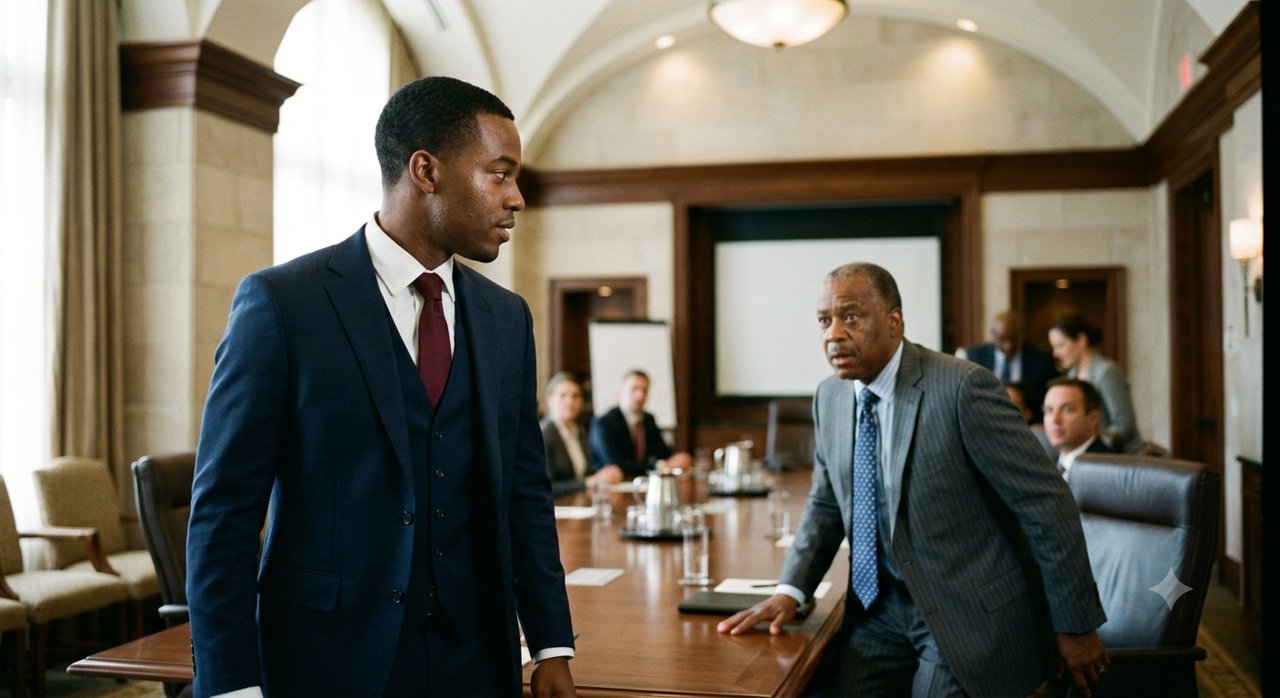
Andre found it first.
He had come downstairs early to make coffee and saw the envelope on the front mat when he opened the door for air.
Plain white.
No writing on the outside.
He picked it up and knew before he opened it that it wasn't good.
He stood in the doorway and looked at the photograph for a long moment.
Then he called Patricia.
"He's escalating faster than I expected," she said.
She didn't sound surprised.
She sounded like someone updating a calculation.
"That photograph is a message.
He wants you to know he can get to Eunice."
"Can he?"
"Not anymore.
The protective order came through at six this morning.
The facility has been notified.
There will be a staff protocol in place by the time they open at eight." A pause.
"But I want you to take that photograph to the Raleigh police this morning and file a report.
Don't characterize it as a threat — just report it as an anonymous item left at a private residence.
We want it on record."
"Understood."
"Andre, this is actually useful to us.
He's rattled.
Clifton doesn't rattle easily — I've watched him for two years and he's always been controlled.
The fact that he moved this fast means he's more afraid of Eunice's testimony than we knew."
Walter had come downstairs.
He stood in the hallway and Andre held up the photograph.
Walter looked at it for three seconds.
Then he looked at Andre.
"Clifton," he said.
"Patricia thinks he's scared."
"Clifton is never scared," Walter said.
"He's calculating." He moved past Andre into the kitchen.
"When Clifton does something like this, it's not emotion.
It's a test.
He wants to see if you'll run."
"I'm not running."
"I know." Walter filled the kettle.
"But now he knows it too.
Which means the next move will be harder."
The police report took forty minutes.
The officer who took it was professional and noncommittal — he logged it, gave Andre a case number, and said someone would follow up.
Andre didn't expect much from it.
That wasn't the point.
By noon, he and Walter were in Patricia's office — a clean, spare space in a building near the courthouse, with filing cabinets that went floor to ceiling and a desk that held nothing unnecessary.
Patricia spread three folders across the desk.
"This is what we're filing," she said.
"A formal challenge to the original will based on lack of testamentary capacity and undue influence.
Eunice's testimony is the cornerstone, but it's not the only support." She opened the first folder.
"I have the original medical records from Harold's final months.
His attending physician documented significant cognitive decline.
That physician is d*ad, but the records are admissible."
She opened the second folder.
"I have financial records showing that within sixty days of Harold's d*ath, Clifton liquidated two of the investment accounts and transferred the funds to a holding company he controlled.
That's not the behavior of someone who expected the will to be challenged."
Third folder.
"And I have statements from two of the other families.
They won't testify — they settled and signed agreements — but their statements establish a pattern.
A judge can consider pattern evidence."
Andre looked at the three folders.
"When do we file?"
"Monday.
I want the weekend to make sure everything is airtight." She looked at him.
"Once we file, it becomes public record.
Clifton will know within hours.
Marcus will know within minutes."
"Let them know," Andre said.
Patricia almost smiled.
"There's one more thing." She pulled a single sheet from the first folder.
"I found a second witness."
Walter looked up sharply.
"His name is Douglas Pratt.
He was the notary on the original will.
He's seventy-four, lives in Charlotte, and he has been trying to find a way to come forward for years." She set the sheet on the desk.
"He told me he was pressured by Clifton's lawyer to certify the signature.
He said Harold's hand was guided.
He said he knew it was wrong and he stamped it anyway because he was told his business license would be pulled if he didn't."
The room was quiet.
"Two witnesses," Andre said.
"Two witnesses," Patricia confirmed.
"Eunice saw what happened to Harold.
Douglas certified something he knew was false under coercion.
Together, they don't just support each other — they corroborate each other on specific details they couldn't have coordinated."
Walter set both hands flat on the desk.
He didn't say anything.
He didn't need to.
Andre looked at Patricia.
"Is there anything Clifton can do to stop this now?"
"He can try to discredit both witnesses.
He can delay.
He can file countermotions.
He can make it expensive." She gathered the folders.
"But he cannot make Douglas Pratt and Eunice Patton un-exist.
And he cannot un-sign those financial transfer records." She looked at Andre directly.
"He had thirty years of quiet.
That's over now."
Andre's phone buzzed on the desk.
Marcus.
He let it ring.
It went to voicemail.
He didn't listen to the message.
He looked at Walter.
Walter looked back at him with those familiar eyes — the same shape, the same quiet depth — and for the first time since Andre had walked into that care facility and watched an eighty-one-year-old woman close her Bible and say *you look like Rose*, something settled in his chest.
Not peace.
Not yet.
But the feeling that the ground beneath him was solid.
"Monday," Andre said.
"Monday," Patricia said.