Part I — The First Eight Minutes
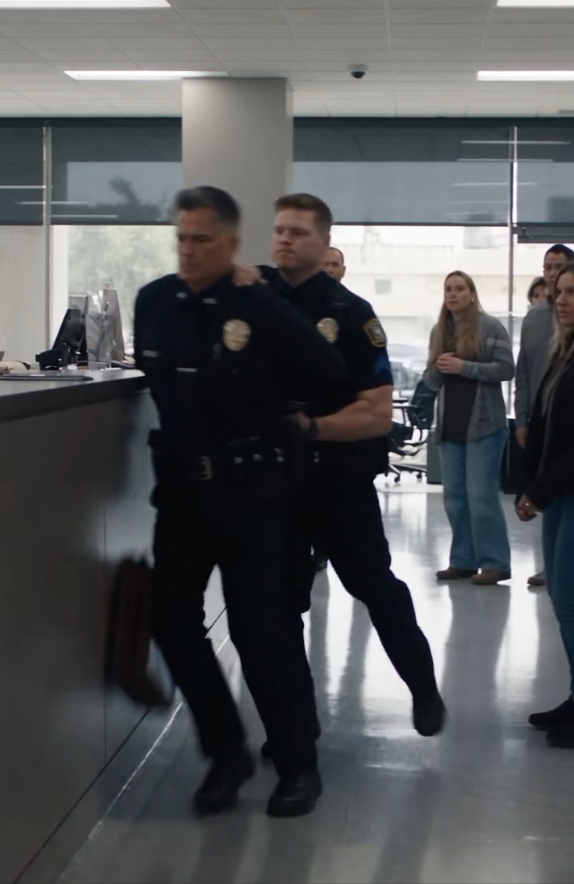
At 8:50 on Monday morning, Marcus Reed learned more about the Riverside Police Department with his face pressed against its front desk than he could have learned from a month of briefings.
His leather briefcase hit the tile first.
The brass clasp sprang open. A folder marked PERSONNEL REVIEW skidded beneath a row of molded plastic chairs. A sealed city envelope spun twice before stopping beside the shoe of an elderly man waiting to file a property report.
Marcus had just enough time to register those details before Sergeant Garrett Caldwell forced his right shoulder down against the polished counter.
“Hands where I can see them.”
“They’re already where you put them.”
“Don’t get smart.”
The handcuffs closed around Marcus’s wrists with practiced speed.
Too tightly.
He felt the metal bite into the bone below his left thumb.
Caldwell leaned in from behind, breathing hard through his nose. He was thick through the shoulders, close to fifty, gray beginning to show above his ears. His uniform was clean. His boots were polished. His duty belt had been arranged with the kind of precision that suggested habit mattered deeply to him.
Marcus noticed all of it.
He also noticed that Caldwell had not asked for his name.
Not once.
A thin warmth slipped beneath Marcus’s chin. When Caldwell had shoved him forward, the edge of the desk had caught him just below the jaw. He tasted blood where his teeth had clipped the inside of his cheek.
In the waiting area, nobody moved.
A woman near reception had frozen with both hands around her purse. A patrol officer at a terminal continued typing. Another officer lifted a telephone and turned his back toward the desk as if privacy had suddenly become important.
Marcus kept his voice even.
“My identification is in my inside jacket pocket.”
Caldwell gave a short laugh.
“I’m not reaching into your coat because you tell me to.”
“Then ask another officer to remove it.”
“Or you can stop trying to run the show.”
Marcus let his eyes close for half a second.
He had spent twenty years learning how quickly control could become theater.
A person with authority made a decision. The decision felt right because he had made it. Anyone who challenged it became proof that the decision had been necessary.
Marcus had seen that cycle in interrogation rooms, traffic stops, internal investigations, and once, years earlier, in himself.
That memory had stayed with him longer than any commendation.
“You should’ve stopped when I told you,” Caldwell said near his ear. “You don’t walk into this building dressed like somebody important and expect everybody to play along.”
Marcus turned his head as far as the pressure against his shoulder allowed.
“Check my identification.”
Caldwell’s grip tightened.
“Save the performance.”
Marcus went still.
At breakfast that morning, his son had watched him knot his tie.
“You nervous?”
Marcus had looked at seventeen-year-old Jordan through the mirror.
“No.”
Jordan had raised one eyebrow.
“You do that thing with the tie when you’re nervous.”
“What thing?”
“You tighten it, loosen it, then tighten it again.”
Marcus had looked down at his hands.
Jordan grinned.
“Third time means really nervous.”
Marcus had laughed then, but only because his son was right.
Riverside had not hired him for stability.
The city had spent eighteen months defending itself against complaints involving missing property, evidence transfers with incomplete signatures, arrest reports containing nearly identical language, and cases that collapsed when prosecutors discovered paperwork nobody could explain.
Nothing had been proven to be department-wide corruption.
That was precisely the problem.
No single scandal had been large enough to force a reckoning, yet too many smaller problems had survived too long.
Marcus had been brought in from outside because nobody inside the chain of command could credibly investigate the chain of command.
He had refused the ceremony city officials suggested for his first morning.
No lobby banner. No row of supervisors. No photographs of handshakes beneath the department seal.
He wanted to see the building as it existed when nobody was performing for the chief.
Now, bent across the front desk in handcuffs, he almost admired the efficiency of the answer.
The dispatcher behind the counter glanced toward him.
Their eyes met.
She looked away.
That bothered him more than Caldwell.
Aggression could be investigated.
Silence was harder.
Silence had no report number.
A radio crackled somewhere behind reception.
“Unit Twelve, copy.”
A patrol officer walking through the lobby stopped.
The dispatcher turned toward her computer.
Marcus heard rapid typing.
Caldwell still had one hand near the back of his neck.
Another burst of radio traffic followed, sharper this time.
“Riverside units, confirming arrival of newly appointed Chief Marcus Reed. Scheduled arrival: eight-fifty a.m.”
For a moment, nobody reacted.
Then the dispatcher looked at her screen.
Her mouth opened slightly.
A city notification had populated beside Marcus’s official photograph.
She looked from the monitor to the man in cuffs.
“Oh my God.”
Caldwell’s hand lifted from Marcus’s neck.
Not quickly.
Slowly.
As though distance might somehow alter what had happened.
The officer on the telephone lowered the receiver without hanging up. The typing at the terminal stopped.
Marcus straightened carefully.
The cuffs made that awkward.
Caldwell stared at the gold badge on Marcus’s chest.
He had seen it before.
He had simply decided it did not mean what it appeared to mean.
Marcus looked around the lobby.
Nobody spoke.
He noticed the woman with the purse again. She was watching him now with an expression less surprised than relieved, as if reality had finally caught up with something she had understood before the officers had.
Caldwell swallowed.
“Chief—”
“Take the cuffs off.”
The words were quiet.
That made them heavier.
Caldwell reached for the key.
His fingers missed the keyhole the first time.
Marcus said nothing.
When the cuffs opened, he brought his arms forward slowly and rubbed the red indentation around his left wrist.
Caldwell stepped back.
“Sir, I—”
Marcus turned.
For the first time, they faced each other directly.
Caldwell was slightly taller, but Marcus had spent too many years in interview rooms to confuse size with control.
“What did I do?”
Caldwell blinked.
“Sir?”
“What did you observe me doing before you grabbed me?”
“You entered the secure—”
“The lobby.”
Caldwell stopped.
Marcus waited.
“You were approaching the front desk.”
“Yes.”
“You didn’t respond when I told you to stop.”
Marcus studied him.
“You said, ‘Hold it right there,’ from behind me while I was walking toward reception.”
Caldwell’s jaw shifted.
“That is a lawful direction inside a police facility.”
“It can be. What made it necessary?”
Caldwell looked toward the other officers.
Nobody rescued him.
Marcus did not enjoy that.
He had no interest in humiliating Caldwell to balance the scales.
He wanted the truth.
“Did you recognize the uniform?” Marcus asked.
“I recognized it as a command uniform.”
“The badge?”
“I saw a badge.”
“Did you ask to inspect it?”
“No.”
“Did you ask my name?”
“No.”
“Did you ask why I was here?”
Caldwell hesitated.
“No.”
Marcus nodded once.