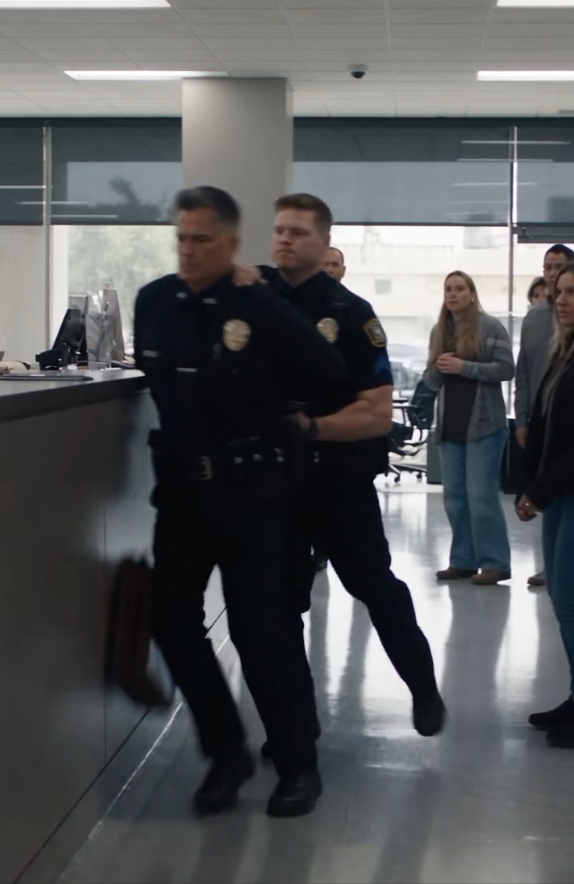
“Then don’t explain this to me yet.”
Caldwell looked confused.
Marcus bent and began gathering the scattered papers.
Two officers moved instinctively to help.
“Leave them.”
They stopped.
Marcus collected each sheet himself.
The sealed envelope. The personnel folder. A handwritten page Jordan had slipped into the briefcase before Marcus left home.
He had not noticed it until now.
Good luck, Chief. Try not to fix the whole place before lunch.
Marcus stared at it a second longer than he intended.
Then he folded it and put it inside his coat.
He closed the briefcase.
When he stood, blood had reached the edge of his collar.
The dispatcher noticed.
“Sir, we should have medical—”
“I’ll take care of it.”
He looked across the room again.
“I want the lobby security footage preserved immediately. Every camera angle. No copies deleted, overwritten, exported, edited, or reviewed outside normal procedure until further notice.”
The dispatcher nodded quickly.
Marcus turned to Caldwell.
“You’ll finish your shift assignment for the moment, but you will have no access to the video system, evidence management, or personnel records.”
Caldwell’s face hardened slightly.
It was the first familiar expression Marcus had seen since the radio call.
Not anger.
Defensiveness.
“Am I being suspended?”
“Not yet.”
“Then what am I accused of?”
Marcus looked at him for a long moment.
“That is exactly the question you should have asked me.”
He picked up his briefcase and walked toward the hallway.
Nobody stopped him this time.
His office was on the second floor.
He found it without asking for directions.
The door had already been unlocked. Someone had placed a clean legal pad on the desk, two unopened pens beside it, and a ceramic mug bearing the city seal.
Marcus set the briefcase down.
Only then did he go into the private restroom, wet a paper towel, and press it beneath his chin.
The cut was small.
His reflection looked almost unchanged.
That was useful.
He heard a knock.
“Come in.”
A woman in a dark suit entered, carrying a thick binder. She was in her early forties, compact, composed, with reading glasses resting on top of her head.
“Chief Reed. I’m Ellen Price. City legal liaison.”
Marcus remembered the name from briefing emails.
“You were supposed to meet me at nine-fifteen.”
“I was.”
She saw the blood.
Her expression changed.
“I heard.”
“That was fast.”
“The entire building heard.”
“Good.”
Price closed the door.
“City Manager Hart wants to know whether you intend to place Sergeant Caldwell on immediate administrative leave.”
Marcus discarded the paper towel.
“No.”
Price studied him.
“That answer is going to surprise people.”
“Let them be surprised.”
“He handcuffed the new police chief.”
“Yes.”
“In the lobby.”
“I was there.”
Price almost smiled, then did not.
Marcus sat behind the desk for the first time.
“Tell the city manager I’m reviewing the incident.”
“He’s concerned about exposure.”
“Legal exposure?”
“Political exposure. Civil exposure. Public exposure.”
Marcus leaned back.
“Then he hired the right person.”
Price opened the binder.
“These are the complaints you requested.”
Marcus looked at its thickness.
“Only substantiated?”
“All formal complaints from the past thirty-six months involving evidence handling, arrest procedures, use-of-authority concerns, or supervisor review.”
“How many name Caldwell?”
Price hesitated.
“Nine.”
Marcus looked up.
“Of how many total?”
“Forty-three.”
That was higher than he expected.
“Outcomes?”
“Seven unsubstantiated. One policy clarification. One unresolved.”
“Who reviewed them?”
Price looked down at the binder.
“Mostly supervisors inside Riverside.”
“Mostly?”
“Four were reviewed by Deputy Chief Thomas Vale.”
Marcus had read Vale’s personnel summary the night before.
Thirty-one years in the department. Highly decorated. Acting chief twice. Finalist for the permanent chief position three years earlier.
Still serving as deputy chief.
Marcus had not yet met him.
“Where is Vale?”
Price glanced at the wall clock.
“He’s due in at nine-thirty.”
Marcus looked at the time.
9:11.
Twenty-one minutes since Caldwell grabbed him.
Marcus opened the binder.
“Then we have nineteen minutes.”
“To do what?”
“To see what Riverside looks like before he gets here.”
Deputy Chief Thomas Vale entered Marcus’s office at 9:34 carrying coffee and an apology that sounded prepared.
He was sixty, broad-faced, silver-haired, and perfectly measured in his movements.
“Chief Reed. Hell of a first morning.”
Marcus remained seated.
“That’s one way to describe it.”
Vale closed the door behind him.
“I want you to know immediately that Garrett Caldwell’s conduct does not represent this department.”
Marcus looked at the binder on his desk.
“Doesn’t it?”
Vale’s gaze flicked toward it.
“I know what that looks like.”
“What does it look like?”
“A collection of complaints. Complaints aren’t findings.”
“No. They’re warnings.”
Vale sat without being invited, then seemed to realize it.
He shifted slightly.
“Garrett’s old-school.”
Marcus said nothing.
Vale continued.
“Too direct sometimes. Too quick to take control. I’ve counseled him.”
“Documented?”
“Not every conversation gets written down.”
Marcus tapped one finger against the binder.
“Nine complaints.”
Vale’s face remained composed.
“Over thirty years?”
“Caldwell has twenty-four.”
“Still a long career.”
“Three of the nine were within the last fourteen months.”
Vale took a sip of coffee.
“You’ve done your homework.”
“I got here early.”
For the first time, Vale seemed uncertain whether Marcus was joking.
Marcus leaned forward.
“I’m not interested in destroying Sergeant Caldwell.”
Vale nodded.
“Good.”
“I’m interested in understanding why he believed what he did this morning was normal.”
Vale’s expression cooled by a degree.
“He made a bad call.”
“A bad call is taking the wrong exit.”
Marcus opened the binder.
“He physically restrained a uniformed command officer in a public lobby without asking for identification, then several officers watched and did nothing.”
Vale set his coffee down.
“What exactly are you suggesting?”
“I’m not suggesting anything yet.”
Marcus turned a page.
“I’m observing.”
Vale sat back.
Marcus looked at him.
“People tell the truth most clearly before they understand they’re being examined.”
Neither man spoke for several seconds.
Then Vale smiled faintly.
“I think Riverside is going to find you interesting, Chief.”
Marcus closed the binder.
“I didn’t come here to be interesting.”
Vale stood.
“No. I imagine you didn’t.”
At the door, Marcus stopped him.
“Deputy Chief.”
Vale turned.
“Who knew my exact arrival time?”
“City manager. Me. Command staff. Dispatch should’ve had the notice.”
“Should have?”
Vale’s eyes narrowed slightly.
“You weren’t in the morning system bulletin?”
“My photograph appeared after I was already in handcuffs.”
“That sounds like a dispatch delay.”
“Maybe.”
Vale waited.
Marcus said, “Find out.”
Vale nodded once.
“I will.”
When the door closed, Marcus looked again at the complaint binder.
Nine complaints against Caldwell.
Four reviewed by Vale.
All closed.
For the first time that morning, the handcuffs stopped being the most interesting thing that had happened.
Part II — Pressure
By noon, the story had escaped the building.
Marcus knew because Jordan texted him.
IS THIS TRUE?
Marcus stared at the message.
A second appeared.
Dad.
A third.
Please tell me you did not get arrested on your first day as police chief.
Marcus rubbed his forehead and called.