Kim sat back.
“I’m still getting used to you calling complaints good.”
“They tell us where people are looking.”
“Sometimes people look for reasons to be angry.”
“Sometimes.”
Marcus closed the file.
“That doesn’t mean we stop looking too.”
Kim nodded.
He stood to leave.
At the door, he paused.
“Chief.”
“What?”
“I was in the lobby that morning.”
Marcus looked at him.
Kim rarely mentioned it.
Marcus had known.
Kim had been the officer in the hallway with folded arms.
“Yes.”
“I never told you why I didn’t step in.”
“You don’t have to.”
“I want to.”
Marcus waited.
Kim looked down at the folder in his hand.
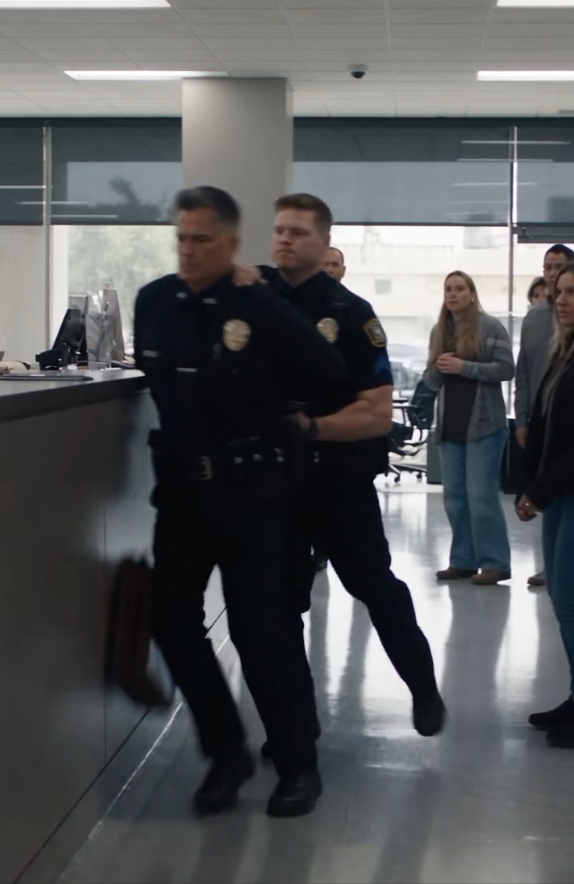
“I saw Caldwell grab you. I thought it looked wrong. Then I thought, Garrett’s a sergeant. He probably knows something I don’t.”
Marcus said nothing.
Kim continued.
“Then I saw your badge. And I still thought maybe he knew something.”
He gave a humorless smile.
“That’s the part that bothers me. I didn’t trust what I was seeing because rank told me somebody else must understand it better.”
Marcus folded his hands on the desk.
“What would you do now?”
Kim looked at him.
“Ask a question.”
Marcus nodded.
“Then we got something out of it.”
Kim opened the door.
“Cost us enough.”
“Yes.”
After he left, Marcus remained at the desk.
Outside his office, phones rang. Officers moved through hallways. Someone laughed near the elevators. A printer jammed and a voice complained about it.
Ordinary sounds.
That was what Marcus had wanted from the beginning.
Not perfection.
A department where ordinary days did not depend on everyone agreeing to ignore the same wrong thing.
He took Caldwell’s letter from the drawer once more.
The worst thing was that by the time I deleted them, it felt normal.
Marcus folded the paper carefully.
That sentence would stay with him.
Not as an excuse.
As a warning.
At 8:50 on his first morning, Riverside Police Department had made a mistake nobody inside the building would forget.
Months later, Marcus understood the mistake had never simply been that officers handcuffed the wrong man.
The greater mistake had happened much earlier, in hundreds of smaller moments—when someone changed a sentence because the original sounded bad, when another person looked away because intervention was inconvenient, when a supervisor called dishonesty “clarification,” when an officer convinced himself that tomorrow would be the day he finally stopped.
Institutions rarely failed all at once.
They failed by teaching good people which small things no longer counted.
Marcus stood and walked to the window.
Below, morning sunlight reached across the lobby tiles.
A visitor stepped through the front doors carrying a folder under one arm.
The desk officer looked up.
“Good morning. How can I help you?”
The visitor approached.
The officer listened.
Then asked his name.
Marcus rested one hand against the glass.
Eight months earlier, nobody had asked his.
Now the question sounded almost insignificant.
That was why it mattered.
Before authority decided who someone was, Riverside had finally learned to ask.