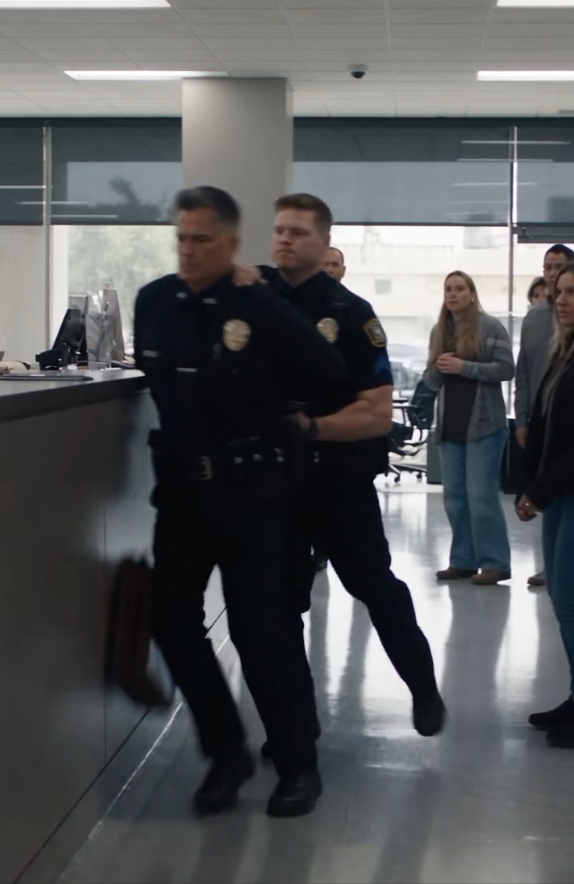
Marcus was quiet.
“And Vale?”
“If Caldwell corroborates the records, we have a much stronger case.”
Marcus looked at the reflection of his own uniform in the glass.
This was the harder choice.
Punish the man who had become the visible face of the problem as severely as possible—or use his testimony to reach the structure that had trained and rewarded him.
Marcus opened his eyes.
“Take the cooperation.”
The attorney paused.
“You’re sure?”
“No.”
“But?”
Marcus watched two officers walk toward the station entrance below.
“But the point was never Caldwell.”
Part VI — Aftermath
Thomas Vale retired before the city could fire him.
The retirement did not protect him.
Six months after Marcus’s first morning in Riverside, Vale pleaded guilty to official misconduct and tampering with public records. Criminal evidence-tampering charges tied directly to the deleted videos were not sustained because investigators could not prove he personally deleted the files.
Marcus accepted that.
Justice was not the same thing as getting every answer he wanted.
Garrett Caldwell pleaded guilty to falsifying public records and official misconduct under the cooperation agreement.
He surrendered his law-enforcement certification.
He testified for seven hours before an independent commission.
He did not ask for Marcus’s forgiveness.
Marcus respected him slightly more for that.
The department changed slowly.
Much more slowly than the headlines implied.
Marcus eliminated the practice of complaint reviews being handled by a supervisor within the same direct chain of command.
Body-camera evidence connected to complaints was mirrored automatically to a city-controlled archive.
Report-writing training was rewritten around factual sequence rather than “protective articulation.”
Supervisors could no longer alter another officer’s narrative without leaving a visible audit trail.
Those were the easy changes.
Culture was harder.
For months, officers hesitated before speaking around Marcus.
They feared anything they said might become part of the next investigation.
Marcus began attending roll calls without giving speeches.
Sometimes he simply listened.
Sometimes he asked why a policy existed.
Often nobody knew.
One afternoon, Captain Brooks stopped him in the hallway.
“You’re making people nervous.”
Marcus smiled faintly.
“I’ve heard.”
“You know what I mean.”
“Yes.”
“They think every mistake is going to become a scandal.”
“Then I’ve communicated badly.”
Brooks looked surprised.
Marcus continued.
“I don’t want people afraid of mistakes.”
“What do you want them afraid of?”
“Getting comfortable hiding them.”
Brooks nodded.
“That’s harder.”
“Yes.”
She walked away.
Marcus watched her go.
That had become the lesson of Riverside.
The important work was almost always harder.
Nearly eight months after the morning in the lobby, Marcus arrived at the department at 8:47.
No ceremony.
No escort.
He still preferred it that way.
The lobby had been renovated slightly. New chairs. Better lighting. The same polished front desk.
The scar beneath Marcus’s chin had faded to a pale line.
Most people never noticed it.
He did.
As he entered, a young patrol officer he barely knew was speaking with a man near reception.
The man wore a dark jacket and carried a large backpack.
His voice had begun to rise.
“I told you, I’m here to see someone.”
The officer held up one hand.
“Okay. Who are you here to see?”
“I don’t have to tell you everything.”
“No, you don’t. But I can’t let you into the secured hallway until I know where you’re going.”
The man shifted impatiently.
A second officer approached.
Marcus slowed.
Eight months earlier, the second officer would have been another opportunity for escalation.
Instead she stopped several feet away.
“Everything okay?”
The first officer nodded.
“I think so.”
The visitor looked between them.
“I’m not trying to cause trouble.”
The second officer said, “Nobody said you were.”
The words stopped Marcus.
Nobody said you were.
Simple.
Ordinary.
A question before an accusation.
The first officer asked the man’s name.
He gave it.
Reception checked the appointment list.
Thirty seconds later, the misunderstanding was resolved.
No handcuffs.
No shouting.
No report.
No story anyone would remember by lunch.
Marcus stood near the entrance watching.
The second officer noticed him.
“Morning, Chief.”
“Morning.”
She looked uncertain.
“Something wrong?”
Marcus shook his head.
“No.”
He walked toward the stairs.
At his office, he found an envelope under the door.
No return address.
Inside was a single folded page.
The handwriting was familiar.
Garrett Caldwell.
Marcus almost put it down without reading.
Then he opened it.
Chief,
I spent a long time thinking the worst thing I did was delete those videos.
It wasn’t.
The worst thing was that by the time I deleted them, it felt normal.
That morning in the lobby was the first time in years I saw myself from the other side of the desk.
I wish it had happened before you got there.
I know that doesn’t change anything.
It shouldn’t.
— G.C.
Marcus read the letter twice.
Then he placed it in the bottom drawer of his desk beside Jordan’s note from his first morning.
Good luck, Chief. Try not to fix the whole place before lunch.
Marcus smiled.
His phone buzzed.
Jordan.
Now eighteen and finishing his first semester at college, he had developed a habit of calling when he knew Marcus would be busiest.
Marcus answered.
“You in class?”
“Walking to class.”
“Then why are you calling me?”
“Because I need advice.”
“That sounds expensive.”
Jordan laughed.
“There’s a guy in my dorm everyone thinks stole somebody’s laptop.”
Marcus leaned back.
“Did he?”
“No idea.”
“Then why does everyone think he did?”
“Because he was in the room.”
“That’s evidence of being in a room.”
“See, this is why I called.”
Marcus smiled.
“What do you want from me?”
“What should I do?”
Marcus looked through the office window toward the lobby below.
The same desk.
The same building.
Not the same department.
Not yet what he wanted it to become either.
Maybe institutions were never finished.
Maybe the best you could do was keep asking whether today’s habits deserved to survive tomorrow.
“Ask him what happened,” Marcus said.
“That’s it?”
“Start there.”
Jordan was quiet for a second.
“Before deciding?”
“Before deciding.”
“Very Chief Reed.”
“Go to class.”
“Yes, sir.”
“And Jordan?”
“Yeah?”
“Don’t call me sir.”
Jordan laughed and ended the call.
Marcus set the phone down.
At nine o’clock, Lieutenant Kim entered carrying the morning review packet.
“We’ve got a problem.”
Marcus looked at the thickness of the folder.
“Of course we do.”
Kim sat.
Marcus opened the first page.
A complaint.
An officer had stopped a teenager the previous evening after receiving a vague description connected to a store theft. The officer had detained him for six minutes before confirming he was not the person they were looking for.
Marcus read the report.
Then the complaint.
Then the supervisor notes.
“The officer documented the mistake himself?”
Kim nodded.
“Body camera matches his account. He apologized at the scene. Teen’s mother still filed a complaint.”
“Good.”
Kim raised an eyebrow.
“Good?”
“She should.”
Marcus turned the page.
“And the officer should document exactly what happened.”
“He did.”
Marcus looked up.
“Then the system worked.”