“No.”
Marcus leaned forward.
“If you had asked my name, checked my identification, or listened for thirty seconds, none of this would have happened the way it did. But the missing files would still be missing.”
Caldwell stared down at the table.
Marcus watched his right hand.
The thumb rubbed slowly over a pale groove on his wedding band.
“You knew I was coming,” Marcus said.
“No.”
“Your account says otherwise.”
“I told you people use terminals.”
“Then tell me who.”
Caldwell’s eyes lifted.
Something had changed.
Not guilt.
Fear.
Marcus recognized it because guilty people usually watched the evidence.
Afraid people watched the exits.
Caldwell glanced once toward the interview-room door.
Marcus sat back.
“Who are you protecting?”
Caldwell laughed.
It sounded forced.
“You came here one day ago and now you think you know everybody.”
“I know you’re more afraid of answering that question than you were of handcuffing me.”
The union representative intervened.
“We’re done.”
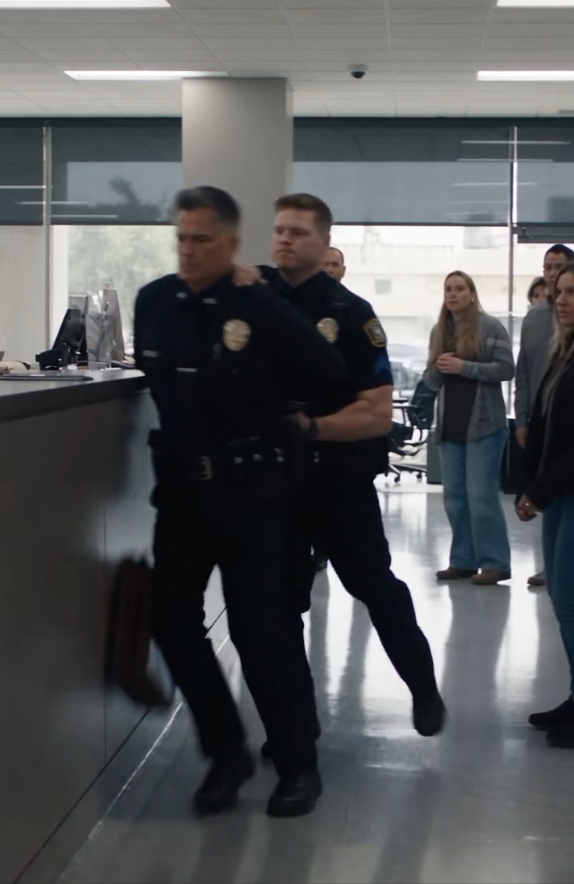
Caldwell stood quickly.
Marcus did not stop him.
At the door, Marcus said, “Garrett.”
Caldwell paused.
Marcus used his first name deliberately.
“If somebody else used your account, your silence is protecting them at your expense.”
Caldwell kept his back turned.
“Maybe you should ask why people around here learned silence was cheaper.”
Then he left.
Kim stared after him.
“That sounded like a confession.”
Marcus shook his head.
“No.”
“What, then?”
Marcus looked at the closed door.
“A warning.”
The next morning, Marcus kept his steak promise.
Not at dinner.
At 6:15 a.m.
Jordan came downstairs and found Marcus at the stove searing two steaks in a cast-iron pan.
“You have officially lost your mind.”
Marcus flipped one.
“Breakfast.”
“That is not breakfast.”
“Protein.”
“That is a steak.”
“You said I owed you steak.”
Jordan sat at the counter.
“Are you going to work after this?”
“Yes.”
“You sleep?”
“Enough.”
Jordan watched him.
“You always say ‘enough’ when the answer is no.”
Marcus turned off the burner.
He divided the steaks between plates and sat.
For a while, they ate without talking.
Then Jordan said, “Is the guy who handcuffed you fired?”
“No.”
“Why not?”
“Because I don’t know everything yet.”
“He grabbed you for walking into work.”
“Yes.”
“So?”
Marcus cut another piece.
“So if I decide the answer before I know the facts, then I’m doing the same thing he did.”
Jordan considered that.
“Annoying.”
“What?”
“That makes sense.”
Marcus smiled.
Jordan looked at the cut under his father’s chin.
“You hate him?”
Marcus set the fork down.
“No.”
“Really?”
“I don’t know him well enough.”
“You don’t need to know somebody to hate what they did.”
“No.”
Marcus looked at his son.
“But if I make this about whether I hate him, I’ll miss why it happened.”
Jordan was quiet.
Then he said, “Mom would say you’re turning this into homework.”
“She said that about everything.”
“She was usually right.”
Marcus looked toward the chair where Leah used to drink coffee in the mornings.
“Usually.”
His phone vibrated.
Kim.
Marcus answered.
“Chief, we recovered one of the deleted videos.”
Marcus stood.
“What does it show?”
A pause.
“You need to see it.”
Part IV — Reckoning
The recovered video lasted eleven minutes and forty-three seconds.
Marcus watched it twice.
On the first viewing, he focused on Caldwell.
On the second, he watched the supervisor standing twenty feet away.
The incident had taken place eighteen months earlier beside a convenience store.
Daniel Ruiz sat behind the wheel of an aging sedan while Caldwell stood outside the open driver’s window.
Ruiz was frustrated.
His hands were visible.
He asked three times why he had been stopped.
Caldwell told him to step out.
Ruiz asked again for the reason.
Caldwell opened the door.
Ruiz pulled his left arm inward reflexively.
Caldwell seized him.
The struggle was brief and ugly but not catastrophic. Ruiz ended up against the car, then on the pavement, then in cuffs.
The report had called his movement aggressive.
The video showed confusion.
That alone was serious.
It was not what held Marcus’s attention.
At minute nine, after Ruiz had been placed in another officer’s cruiser, Deputy Chief Thomas Vale walked into frame.
He was wearing captain’s bars then.
He spoke with Caldwell.
There was no audio for the first ten seconds because the microphone had been obstructed.
Then Vale’s voice became clear.
“You writing resistance?”
Caldwell answered, “He pulled away.”
Vale looked toward the cruiser.
“Then write resistance.”
Caldwell said something Marcus could not hear.
Vale stepped closer.
“Garrett, don’t make this complicated. You gave commands. He failed to comply. He pulled away. Write what protects the stop.”
The video ended three minutes later.
Marcus replayed that exchange.
Kim sat beside him.
“Could be interpreted as report guidance.”
Marcus looked at him.
“Could it?”
Kim exhaled.
“No.”
“Who deleted this?”
“Forensics can’t establish that yet.”
“Who had access?”
“Caldwell. Vale. Two professional standards users.”
“Who reviewed the complaint?”
“Vale.”
Marcus paused the video on Vale’s face.
The pieces were changing shape.
Caldwell had behaved badly.
Caldwell had also been taught how bad behavior was converted into acceptable paperwork.
That did not excuse him.
It explained the confidence.
The phrase from the report came back to Marcus.
Immediate control was necessary for safety.
Twenty-seven reports.
Different officers.
Same language.
Not a few bad decisions.
A template.
Marcus turned to Kim.
“Pull every arrest report using those repeated phrases.”
“All of them?”
“All.”
“That could be hundreds.”
“Then start with five years.”
Kim nodded.
Marcus looked at Vale frozen on the screen.
“And don’t tell him.”
Vale came to the chief’s office at 10:30.
He did not knock.
“I hear professional standards is pulling historical arrest reports.”
Marcus looked up.
“That traveled fast.”
“I’m deputy chief.”
“You keep reminding me.”
Vale closed the door.
“You’re opening five years of cases because of one recovered video?”
Marcus gestured toward the chair.
Vale stayed standing.
“You’ve seen it?”
Vale’s eyes narrowed.
Marcus answered the question for him.
“You know which one.”
Vale said nothing.
Marcus continued.
“Daniel Ruiz.”
Now Vale sat.
“I remember the case.”
“You told me complaints weren’t findings.”
“They aren’t.”
“The video contradicts material parts of Caldwell’s report.”
“His judgment may have been imperfect.”
“You advised him to write what protected the stop.”
Vale leaned back.
“So this is about language now?”
“No. It’s about whether supervisors trained officers to describe incidents according to what was defensible instead of what happened.”
“That’s a loaded interpretation.”
“Then unload it.”
Vale looked toward the window.
Marcus waited.
Finally Vale said, “You want to know what patrol looked like ten years ago?”
“I want to know what that video means.”
“It means I had a sergeant coming off a messy stop where a driver pulled away from him. I reminded him to document the reason for his actions.”
“You said, ‘Write what protects the stop.’”
“I said a lot of things over thirty years.”
“That one survived.”
Vale’s voice lowered.
“You are dangerously close to treating imperfect wording as evidence of corruption.”
Marcus opened a drawer and removed a stack of reports.