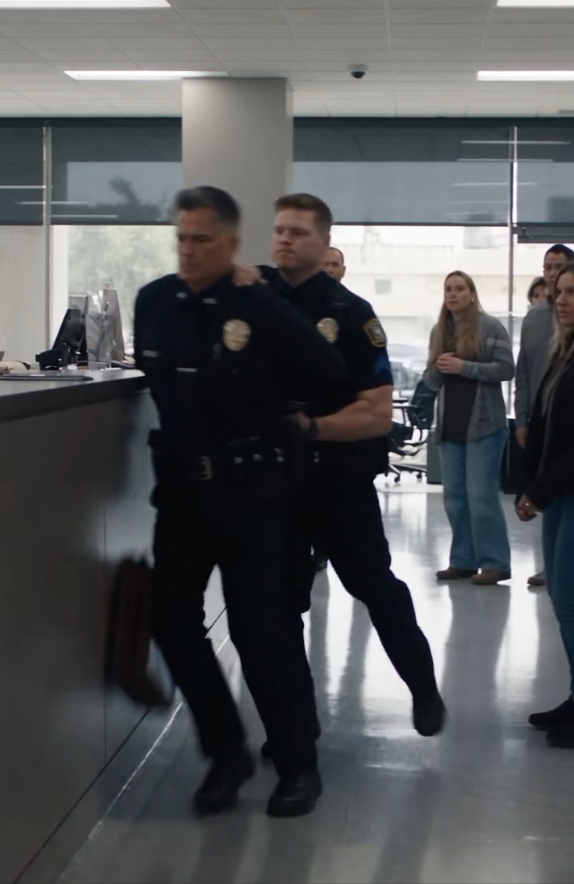
“You have summaries.”
“I asked for originals.”
Vale’s tone sharpened.
“You think somebody changed them?”
Marcus looked at him.
“I think I asked for originals.”
Vale left without another word.
At four that afternoon, Lieutenant Kim came to Marcus’s office carrying a gray archival box.
“This is everything professional standards has on Caldwell.”
Marcus looked at the box.
“All nine?”
“Should be.”
Should.
Marcus opened the first file.
Then the second.
By the fourth, he stopped.
“Where’s the body-camera disc?”
Kim leaned over.
“There should be a digital reference.”
“There is.”
Marcus pointed.
“File location says supplemental evidence archive.”
Kim opened his laptop.
A minute later, his face tightened.
“What?”
“The video reference is there, but the file is blank.”
“Blank how?”
“Zero-byte placeholder.”
Marcus looked at him.
“Meaning?”
“Meaning something created a record that a file should exist, but the actual file isn’t there.”
“Could it be corrupted?”
“Yes.”
“Could it have been deleted?”
Kim did not answer immediately.
“Yes.”
Marcus pulled the next complaint.
Another missing video.
Then another.
Three complaints.
Three missing video files.
Each had been reviewed by Thomas Vale.
Marcus sat back.
Kim said, “This is not good.”
“No.”
“We need to notify Vale.”
Marcus looked at him.
“Why?”
“He’s deputy chief.”
“And a reviewer on all three.”
Kim understood.
Marcus closed the box.
“Do not tell anyone what we found.”
Kim shifted.
“Chief, if this turns into evidence tampering—”
“It already might be.”
“You think Vale deleted them?”
“I think assumptions got me handcuffed this morning.”
Kim looked at the box again.
“So what do we do?”
Marcus stood.
“We stop assuming.”
Part III — Reversal
Marcus did not go home for dinner.
At 7:18, Jordan sent him a photograph of an empty plate with a fork placed across it like a grave marker.
Marcus texted back: I owe you.
Jordan replied: You owe me steak.
Marcus almost typed a promise.
He stopped.
Then wrote: Tomorrow. No speeches.
The reply came quickly.
Third-time tie promise?
Marcus looked at his reflection in the dark office window.
Yes.
He turned back to the computer.
Lieutenant Kim had gone downstairs to pull archive-access records. Marcus had spent the previous two hours reviewing complaint summaries one by one.
The pattern was not dramatic.
That was what made it dangerous.
No single file said corruption.
They said delay.
Incorrect classification.
Policy ambiguity.
Insufficient evidence.
Supervisor discretion.
Technical issue.
Every problem had a harmless name.
Every harmful result had a procedural explanation.
Marcus opened the seventh complaint.
A man named Daniel Ruiz had been arrested eighteen months earlier after a traffic stop. The report said Ruiz had made a threatening movement toward Sergeant Caldwell and refused repeated commands to show his hands.
The case was later dismissed.
The complaint alleged Caldwell had pulled Ruiz from the vehicle after Ruiz questioned why he had been stopped.
Body camera: unavailable due to upload failure.
Supervisor review: Deputy Chief Thomas Vale.
Disposition: unsubstantiated.
Marcus opened the arrest report.
Certain phrases felt familiar.
Subject ignored clear lawful commands.
Officer reasonably perceived escalating threat.
Immediate control was necessary for safety.
Marcus opened another report from Caldwell.
The same phrases.
Not similar.
Identical.
He searched the department report system.
Twenty-seven hits.
Different officers.
Different years.
Same wording.
Marcus stared at the screen.
Then Kim knocked and entered without waiting.
“Chief.”
Marcus turned.
Kim was pale.
“What?”
“I pulled access logs for the professional standards archive.”
“And?”
“Three missing videos were accessed after their complaints were closed.”
“By whom?”
Kim put a printout on the desk.
Marcus read it.
User: G. CALDWELL.
He looked up.
“All three?”
Kim nodded.
“Same account. Access occurred late evening, usually days or weeks after final disposition.”
Marcus felt the investigation pivot.
Caldwell had not merely been protected.
He had gone back into closed complaint files.
“Does Caldwell have archive access?”
“He did then. Sergeants with administrative review duties had broad permissions.”
“Why?”
“Old system. Nobody cleaned the permission groups after we migrated.”
Marcus looked again.
“Can we prove he deleted anything?”
“No. The system logs access, not the specific action. We’d need forensic recovery.”
“Do it.”
Kim nodded.
Marcus leaned back.
“What about the arrival bulletin this morning?”
Kim looked uncomfortable.
“What?”
“I checked that too.”
“And?”
“The approval record is Caldwell’s account.”
“We know that.”
“There’s more.”
Kim placed another page down.
“The bulletin wasn’t merely delayed.”
Marcus read.
“What am I looking at?”
“Someone changed its priority from immediate command notification to deferred administrative notice at 8:03.”
“Whose account?”
Kim did not answer.
Marcus looked up.
Kim tapped the page.
G. CALDWELL.
Marcus stood.
For a moment, neither man spoke.
At 8:03 that morning, forty-seven minutes before Marcus arrived, Caldwell had taken a notification containing the new chief’s name, photograph, and arrival time and downgraded it so the lobby terminal would not display it promptly.
Then at 8:50, Caldwell had intercepted Marcus before he could identify himself.
The coincidence was shrinking.
Kim said, “Chief, we need to bring him in now.”
Marcus picked up his jacket.
“Yes.”
Caldwell was sitting alone in an interview room at 8:02 p.m.
Marcus had asked Kim to summon him back to the station without explanation.
Caldwell wore civilian clothes now: jeans, work boots, dark flannel shirt.
Without the uniform, he looked older.
Marcus entered with Kim.
Caldwell stared at him.
“You want a union rep?”
Marcus asked.
“If this is disciplinary.”
“It may become disciplinary.”
“Then yes.”
Marcus nodded.
They waited twenty-three minutes for the representative to arrive.
Marcus did not speak during that time.
Neither did Caldwell.
When the interview began, Marcus placed no files on the table.
No dramatic photographs.
No accusations.
“Did you receive the command bulletin announcing my arrival this morning?”
Caldwell looked at the representative before answering.
“I receive a lot of bulletins.”
“That one.”
“I don’t remember reading it.”
Marcus nodded.
“Did you approve it?”
“Apparently.”
“Your account did.”
“Then I guess I did.”
“At 8:03, your account changed its priority level.”
Caldwell’s eyes moved toward Marcus for the first time.
“I don’t remember doing that.”
“Do other people use your login?”
“They shouldn’t.”
“That’s not an answer.”
Caldwell leaned back.
“Sometimes people stay logged in at shared terminals.”
“Which terminals?”
“Watch desk. Supervisor station.”
“Who had access this morning?”
“Half the shift.”
Marcus let the silence remain.
Then he changed subjects.
“Did you access three closed complaint files involving you?”
Caldwell’s face changed.
Very little.
Enough.
“What files?”
Marcus named the complainants.
The union representative shifted.
Caldwell said, “I may have reviewed old cases.”
“Why?”
“To understand the outcomes.”
“They were your complaints.”
“Yes.”
“Why would you need to understand the outcomes after they were closed?”
Caldwell’s jaw tightened.
“I wanted to know what had been said about me.”
“The actual video files are missing.”
Caldwell looked at Kim.
Then back to Marcus.
“I didn’t delete anything.”
“I didn’t say you did.”
“You’re implying it.”
“I’m telling you what we found.”
Caldwell pushed his chair back an inch.
“This whole thing is because of this morning.”
Marcus shook his head.
“This morning is why I looked.”
“That’s the same thing.”