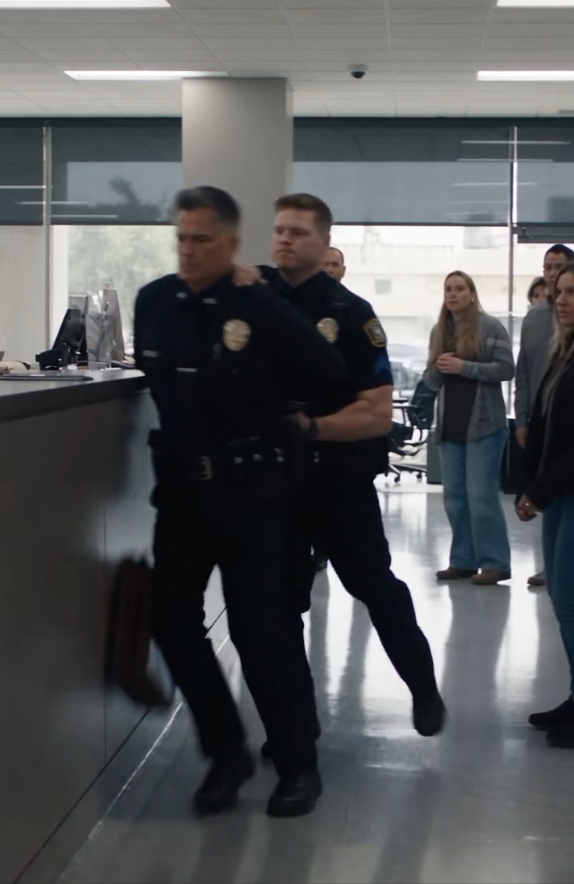
Always another crisis dressed as the one thing that could not wait.
He had spent years telling himself family understood because duty mattered.
Leah had understood.
That did not mean it had been fair.
Marcus took out his phone and called Kim back.
“Seal the system. Have city IT mirror the server. Nobody touches it until morning.”
Kim said, “You’re not coming in?”
“No.”
A pause.
“Okay.”
Marcus ended the call.
Jordan watched him.
“What?”
Marcus took off his coat.
“The department can survive until breakfast.”
Jordan tried not to smile.
“You sure?”
“No.”
Marcus went back toward the kitchen.
“That’s leadership.”
Part V — Final Confrontation
At 6:40 the next morning, Deputy Chief Vale was waiting outside Marcus’s office.
His face was controlled, but the control looked expensive now.
“You locked me out of the system.”
Marcus unlocked the door.
“Yes.”
“On whose authority?”
Marcus entered.
Vale followed.
“Mine.”
“You cannot restrict the deputy chief from department systems without cause.”
Marcus placed his briefcase on the desk.
“I have cause.”
“What cause?”
Marcus turned.
“An attempted remote login to a restricted archive last night after you learned we were reviewing historical complaint files.”
Vale’s face did not move.
“I work remotely all the time.”
“At 9:42 p.m.?”
“Yes.”
“Using a path you have not accessed in eleven months?”
Vale paused.
Marcus saw it.
Vale recovered.
“I heard the archive was being reviewed. I wanted to understand what you were doing.”
“You could have asked.”
“So could you.”
Marcus removed Caldwell’s notebook from his briefcase and placed it on the desk.
Vale looked at it.
For the first time since Marcus had met him, genuine concern broke through.
“Where did you get that?”
Marcus said nothing.
Vale’s gaze returned to his face.
“Caldwell.”
Marcus sat.
“Close the door.”
Vale did not.
“Close it.”
Vale pushed it shut.
Marcus opened the notebook to the middle.
“Six years of dates, file references, report amendments, evidence-entry changes, and instructions attributed to you.”
Vale’s mouth tightened.
“You’re taking Garrett Caldwell’s private notes as gospel now?”
“No.”
Marcus turned another page.
“I’m comparing them to system logs.”
Vale said nothing.
“Some match.”
“Then Caldwell wrote down events that happened. Congratulations.”
“Some include instructions you denied giving.”
“His version of instructions.”
Marcus looked up.
“And last night you tried to enter the archive after your credentials had been flagged in an active internal investigation.”
Vale leaned forward.
“You think this department functions because every line of every report is sacred? You think every time stamp reflects reality? Every officer remembers the order of events perfectly after a violent call?”
“No.”
“You think prosecutors want uncertainty?”
“No.”
“They want articulation. Courts want articulation. City attorneys want articulation. Review boards want a clean sequence of decisions that can be evaluated after the fact.”
Marcus closed the notebook.
“Truth can be evaluated.”
Vale laughed once.
“Truth? Which truth? The officer’s? The suspect’s? The bystander who saw ten seconds? The body camera pointed at a steering wheel?”
“The one we can support without inventing it.”
Vale walked to the window.
“You came in here believing the system failed because people stopped caring.”
Marcus watched him.
Vale continued.
“You’re wrong. People cared too much about keeping the system working.”
“By changing reports?”
“By translating chaos into language that survived review.”
“By deleting video?”
Vale turned.
“I never deleted a video.”
Marcus held his gaze.
“Then who did?”
“I don’t know.”
“Caldwell’s account accessed three missing files.”
“There you go.”
“After you reviewed them.”
Vale stared at him.
Marcus continued.
“You taught him the language. You closed the complaints. You instructed him to change at least one evidence time. He says you told him to delay my arrival bulletin.”
Vale’s face sharpened.
“He told you that?”
“Yes.”
“And you believe him?”
“I believe logs showing his account changed it. I believe the call record showing you contacted him Sunday night. I believe the message metadata showing your supervisor account sent him a private instruction at 8:01 Monday morning.”
Vale went still.
Marcus had not told Caldwell that message had been recovered.
The system retained deleted supervisor-chat metadata even when message bodies were removed.
City IT had reconstructed enough of it overnight.
Marcus read from the printout.
“Hold chief notice. Let him identify himself. No ceremony.”
Vale looked toward the door.
Marcus stood.
“I don’t think you expected Caldwell to put me against the desk.”
“I didn’t.”
“I believe you.”
Vale turned back.
Marcus continued.
“But you wanted my first contact with Riverside to be a test.”
Vale said nothing.
“You wanted me frustrated. Off balance. Maybe angry enough to suspend someone publicly on day one.”
Vale’s expression hardened.
“That’s fantasy.”
“Then tell me what the plan was.”
“There was no plan.”
Marcus waited.
Vale walked back toward the desk.
“You want the truth?”
“Yes.”
“I wanted you to see what happens when someone walks in assuming a title means everyone else rearranges themselves.”
Marcus almost smiled.
“That sounds like a plan.”
Vale ignored him.
“You were hired because city hall wanted a reformer. Fine. Reform. But you were going to come in here with your audits and dashboards and outside consultants and tell people who have buried friends that they’ve been doing the job wrong.”
Marcus said, “So you withheld my notice.”
“I delayed it.”
“And told Caldwell to let me identify myself.”
“Yes.”
“Why Caldwell?”
Vale said nothing.
Marcus answered.
“Because you knew he would overreact.”
Vale’s eyes changed.
There it was.
The thing Marcus had been trying to find since the lobby.
Not a conspiracy to have him asNextlted.
Something more ordinary.
More believable.
Vale had known Caldwell’s weakness and used it because that weakness served a purpose.
“Garrett made his own choice,” Vale said.
“He did.”
“You can’t put that on me.”
“I’m not.”
Marcus stepped around the desk.
“I’m putting your choice on you.”
Vale looked tired suddenly.
“You think removing me fixes this?”
“No.”
“Suspending Caldwell?”
“No.”
“Reopening cases?”
“No.”
Vale spread his hands.
“Then what do you want?”
Marcus thought of the lobby.
The officer who kept typing.
The dispatcher who looked away.
The folded arms in the hallway.
The woman who lowered her eyes when Caldwell glanced toward her.
“I want a department where the next person does not need to be the police chief before somebody asks a question.”
Vale stared at him.
For several seconds, neither spoke.
Then Vale said quietly, “You will tear this place apart.”
Marcus looked at the notebook.
“No.”
He picked it up.
“I’m going to stop pretending the cracks aren’t already there.”
Vale moved toward the door.
Marcus said, “You’re being placed on administrative leave effective immediately.”
Vale stopped.
“Pending what?”
“An independent investigation into report alteration, evidence-record manipulation, supervisory misconduct, improper access to protected files, and interference with the chief’s arrival notification.”
Vale turned.
“You’re making a mistake.”
“Possibly.”
“You don’t have enough.”
“I have enough to remove your access while outside investigators determine the rest.”
Vale looked at him for a long time.
Then he removed his badge.