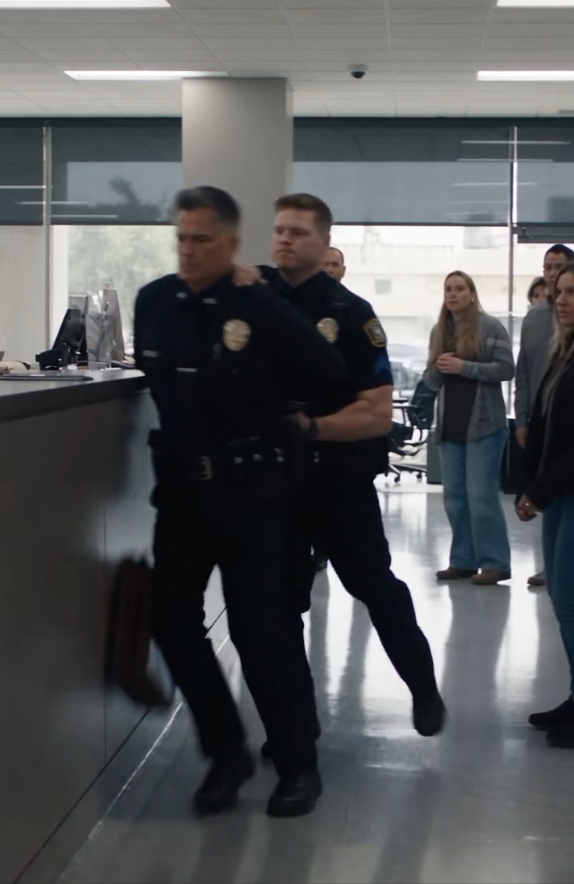
Not the departmental badge on his uniform.
His access credential.
He placed it on Marcus’s desk.
“You’ll regret what comes after.”
Marcus looked at the credential.
“That may be true.”
Vale seemed surprised.
Marcus continued.
“Doing the right thing does not guarantee a pleasant result.”
Vale left.
The department learned within twenty minutes.
The press learned within forty.
By noon, Riverside Police Department had three news vans outside, two city council members demanding answers, and a union statement accusing city leadership of conducting “an unprecedented internal purge based on incomplete information.”
Marcus read the statement once.
Then he went downstairs.
The lobby felt different.
Not safer.
Self-conscious.
Officers stood straighter when he passed.
Conversations stopped.
That was not the culture Marcus wanted either.
Fear could produce good behavior for a while.
Only character produced it when nobody was watching.
He found Caldwell in a second-floor conference room with his union representative.
Marcus had ordered him back for a formal interview.
Caldwell looked at him.
“Vale’s out.”
“Administrative leave.”
Caldwell nodded.
“Guess he finally ran out of people to stand behind.”
Marcus closed the door.
“Don’t enjoy this.”
Caldwell’s expression tightened.
“I’m not.”
“Good.”
Marcus sat across from him.
“Forensics recovered a second complaint video.”
Caldwell looked down.
“It contradicts your report too.”
“I figured.”
“You accessed the file after closure.”
“Yes.”
“Why?”
Caldwell rubbed his forehead.
“Vale told me the complainant’s attorney was requesting records. Said we needed to make sure the file package was complete.”
“And?”
“The video was bad.”
“Bad for whom?”
“For me.”
Marcus waited.
Caldwell looked at the union representative, then back.
“I removed it.”
The room became very still.
Marcus did not move.
Caldwell continued.
“I deleted the file from the active archive. I thought backups would still exist.”
“Did Vale tell you to?”
“No.”
“Did he know?”
Caldwell’s voice dropped.
“Yes.”
“How?”
“I told him.”
“What did he say?”
Caldwell looked toward the table.
“He said, ‘Then make sure the file reflects what remains.’”
Marcus closed his eyes briefly.
Not because he was surprised.
Because some truths became heavier when a person finally spoke them aloud.
“How many?”
“Videos?”
“Yes.”
“Three.”
“All three missing?”
“Yes.”
“You deleted them.”
“Yes.”
Marcus looked at him.
“Why keep the notebook if you were actively destroying evidence?”
Caldwell’s face twisted in something close to disgust.
“At myself, mostly.”
“Answer.”
Caldwell took a slow breath.
“Because every time I changed something, I wrote down what it had been first.”
“Why?”
“So there was still one place where the truth existed.”
Marcus stared at him.
“That is not integrity.”
“I know.”
“It is not insurance either. You participated.”
“I know.”
“People were charged based on reports you knew were misleading.”
“I know.”
Marcus leaned back.
Caldwell looked exhausted.
“I kept thinking there would be one last time. One last fix. One last report. One last favor. Then I’d stop.”
“And this morning?”
Caldwell looked at him.
“This morning you walked in wearing a uniform I knew I should respect, and all I could think was that you were another outsider coming to judge us.”
Marcus said nothing.
“I wanted to knock you down a little.”
“You did.”
Caldwell nodded.
“And then that radio call came through and I knew exactly what I’d done.”
Marcus looked at him.
“No.”
Caldwell frowned.
Marcus continued.
“You knew who I was and regretted what would happen to you.”
Caldwell looked away.
“That is different from understanding what you did to me.”
The words landed without force.
That made them harder to evade.
Caldwell sat very still.
Then he nodded.
“Yes.”
Marcus opened the formal notification in front of him.
“Sergeant Garrett Caldwell, effective immediately, you are suspended from duty pending termination proceedings and criminal review related to destruction of departmental evidence and falsification of official records.”
The union representative began to speak.
Caldwell raised a hand.
“No.”
The representative stopped.
Caldwell looked at Marcus.
“Do it.”
Marcus slid the paper across the table.
Caldwell signed.
Before he left, he removed his badge and set it down.
Marcus looked at it.
The same gold shield shape as his own.
For twenty years, that symbol had meant something to Marcus because people had agreed it should.
He understood now how fragile that agreement was.
The outside investigation lasted eleven weeks.
Marcus hated almost every day of it.
Cases reopened.
Prosecutors reviewed convictions and dismissals connected to officers whose reports contained suspiciously repeated language.
Some cases survived scrutiny.
Others did not.
Three people received formal findings that their arrests had been supported by materially inaccurate reports.
Two civil suits were settled.
One officer resigned before an interview.
Another admitted that supervisors had encouraged “defensive articulation” after questionable stops but denied knowingly lying.
Captain Brooks turned over emails Marcus had not known existed.
Lieutenant Kim worked fourteen-hour days until Marcus finally ordered him home.
The department’s reputation suffered.
Morale dropped.
City council meetings became hostile.
Vale’s attorney described Marcus publicly as an inexperienced outsider staging a “morality campaign.”
Marcus did not respond.
Then investigators recovered the third deleted video.
It was not dramatic.
That mattered.
A handcuffed woman sat on a curb while an officer argued with Caldwell about whether the arrest had actually been lawful.
Caldwell said, “Vale wants it booked. Write obstruction.”
The officer replied, “She didn’t obstruct.”
Caldwell looked directly toward him.
“Then write what gets us through the night.”
That sentence became the center of the investigation.
Not because it was the worst act uncovered.
Because it captured the culture perfectly.
Write what gets us through the night.
Deal with tomorrow later.
Protect the stop.
Protect the officer.
Protect the supervisor.
Protect the department.
One night at a time.
Until protecting the institution required betraying the reason it existed.
Three days after investigators authenticated the recording, the city attorney called Marcus.
“We have enough to offer Caldwell cooperation.”
Marcus stood in his office looking out at the parking lot.
“In exchange for what?”
“Full testimony against Vale and anyone else involved.”
“And his charges?”
“Reduced.”
“How reduced?”
“No felony evidence-destruction count if he pleads to official misconduct and falsification.”
Marcus said nothing.
The attorney continued.
“He’s the bridge to Vale. Without him, Vale’s lawyers will characterize everything as rogue conduct by one sergeant.”
“He was not rogue.”
“I agree.”
Marcus looked toward the lobby entrance below.
Eleven weeks earlier, he had walked through those doors believing the difficult part of the job would be uncovering what happened.
He had been wrong.
The difficult part was deciding what justice looked like when guilty people could still tell necessary truths.
The attorney said, “Chief?”
“I’m here.”
“The city manager wants your view.”
Marcus closed his eyes.
Caldwell had asNextlted him.
Humiliated him.
Deleted evidence.
Falsified records.
Helped sustain the very culture Marcus had been hired to dismantle.
Part of Marcus wanted the fullest penalty available.
That part was not noble.
It was human.
But leadership did not become ethical simply because anger had a good reason.
“What does the agreement require?” Marcus asked.
“Admission under oath to every known alteration, full cooperation on affected cases, surrender of certification, permanent separation from Riverside, and no law-enforcement employment during the probationary period.”