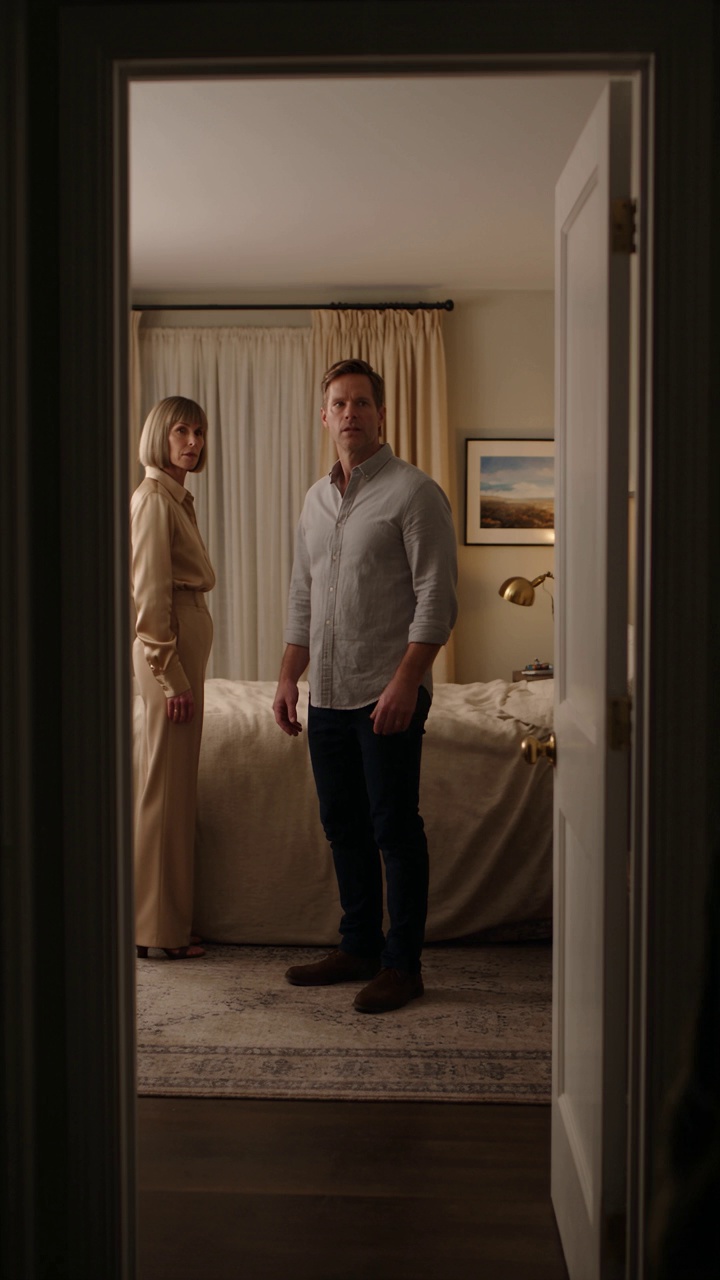
Chapter 10 — The Door Beyond the Courthouse
Ellis looked at the file until the screen dimmed beneath her thumb.
Around her, the courtroom was emptying in careful increments: chairs sliding back, low voices gathering at the doors, paper whispering into briefcases.
Dr. Keller remained at the counsel table, blonde head bent toward her attorney.
Mark stood near the side exit with the officials, his grey shirt wrinkled at the collar, as if the entire day had finally reached his skin.
The message was still there.
You played the recordings.
Now hear the rest.
Ellis did not press it immediately.
For months, every new fact had arrived like a hand at the back of her neck, forcing her deeper into something she had never chosen.
The bedroom.
The notes.
The calculations.
Mark’s admission.
Keller’s calm voice explaining how pressure could make a frightened person agree to anything.
She had spent so long chasing the truth that she had forgotten truth could also be a weapon.
Her hand lowered from the table.
“Ellis.”
Mark had separated from the group by the door.
He stopped several feet away, leaving the distance between them intact.
His face carried none of the pleading urgency she remembered from outside her home.
He looked smaller now, not because the room had changed him, but because there was nowhere left for him to hide.
“You don’t have to listen to that alone,” he said.
She met his eyes.
“You don’t get to decide what I have to do alone.”
He nodded once.
“You’re right.”
There was no apology that could make the sentence less true.
Ellis felt that realization settle quietly inside her.
It did not heal anything.
It only stopped asking her to pretend there was a version of Mark still capable of giving her what she had lost.
She put in one earbud and opened the file.
At first there was only a muffled scrape, then Mark’s voice, younger somehow, uncertain.
“If she sees the transfer draft, she’ll know.”
Dr. Keller answered, clear beneath the static.
“Then she must never see it.
She trusts me.
That is why this can work.”
Ellis closed her eyes.
The recording continued.
Mark asked whether Ellis would agree to move the inheritance.
Keller said they would make her feel too overwhelmed to resist, that marriage therapy could be made to look like concern, and that Ellis would doubt her own memory before she doubted her therapist.
Then the file ended.
No revelation was left in it.
No missing piece that transformed betrayal into something understandable.
It was simply the earliest proof of the same choice, made in two voices and carried forward through every false question, every confidential session, every time Ellis had been told she was overreacting.
Her throat tightened, but she did not cry.
She removed the earbud and held the phone toward the official still reviewing the record at the front table.
“This needs to be preserved too.”
Keller rose so quickly her chair struck the floor.
For the first time since Ellis had found her beside the unmade bed, Keller’s composure broke.
“That is not authenticated.
You have no idea who sent it.”
“I know your voice,” Ellis said.
Keller’s attorney began objecting, but the official raised a hand.
The file would be logged, reviewed, and handled through the same formal process as the rest.
The words were restrained.
Their meaning was not.
Keller’s influence over the story had ended at last.
Mark looked toward Keller, then down at the floor.
Ellis watched him absorb the fact that cooperation had not made him innocent.
It had only made him useful to a process larger than either of them.
The official asked Ellis to confirm that the financial materials and recordings represented her claim to the inheritance funds.
Her voice did not shake when she did.
The record already held the bank statements, the handwritten calculations, the transfer draft, the office footage, the threats, and Mark’s testimony.
Keller’s counsel conferred in a tight huddle.
After a long pause, they stopped arguing.
The determination that followed was not dramatic.
It did not arrive with music or shouting.
The disputed inheritance remained Ellis’s, beyond Mark’s reach and Keller’s scheme.
The attempted transfer was treated as exactly that: an attempt.
Her rights to her assets were restored without conditions, without a private bargain, without another demand that she prove she was sane enough to own her own life.
Ellis let out one breath, then another.
Mark stepped closer, but not too close.
“I’m sorry,” he said.
She believed he meant it.
That was different from forgiving him.
“I hope you tell the truth wherever they ask you to,” she said.
“Not for me.
For once, because it’s the only thing you have left to give.”
His eyes filled.
He nodded and turned back toward the officials.
Keller gathered her champagne-colored blouse at the wrists, folding herself into the silence of her attorney’s direction.
Ellis did not watch her leave.
Public justice had not made the bedroom disappear.
It had not restored the woman who entered it believing she was protected.
But it had stopped Keller from using that woman’s trust as a hiding place.
Outside, late afternoon light spilled across the courthouse steps.
Ellis paused at the doors, her green blazer warm across her shoulders.
The air smelled like rain on pavement.
Cars moved through the street below, indifferent and alive.
Her phone rested in her hand.
It contained evidence, messages, and a history she would not erase yet.
But it was no longer the thing directing her forward.
She walked down the steps alone.
Not abandoned.
Not defeated.
Alone in the clean, frightening sense of the word: unclaimed.
At the bottom, Ellis turned toward the city and kept going.