Chapter 9 — The Record Speaks
The courtroom was colder than the municipal corridor had been, though Ellis knew that was impossible.
Cold belonged to air, stone, metal.
What sat inside her was something else: the memory of Keller’s handwriting, the threat on her phone, Mark’s voice trying to turn his cowardice into a confession worthy of mercy.
Ellis stood behind the table with her green blazer buttoned tight, one hand braced against its edge.
Across the room, Mark sat with his shoulders folded inward.
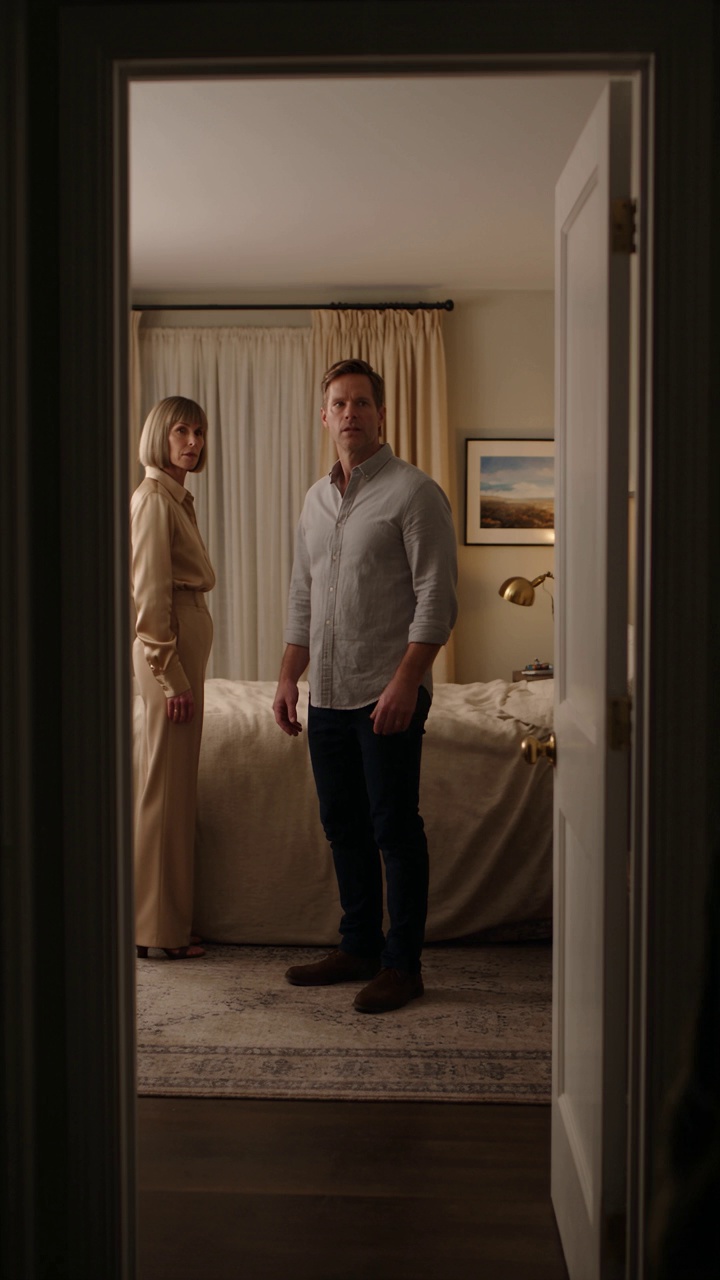
His grey shirt had been replaced, but she could still see him as he had been in their bedroom, fumbling at buttons beside the unmade bed.
Dr. Keller looked unchanged in a dark, tailored suit, blonde hair smoothed behind one ear.
She had worn calm like armor from the first moment Ellis opened that door.
Her counsel leaned toward her, murmuring.
Keller did not look at Ellis.
The official at the front of the room acknowledged the added material.
The threat, the photograph of the note, the financial records, the office footage.
Then Ellis’s phone, connected through a small speaker on the table.
Keller’s counsel rose.
“This is precisely the sort of spectacle we anticipated.
Private therapeutic material is being distorted by a person with an obvious personal grievance.”
Ellis felt the old reflex: apologize, soften, make the room comfortable.
Keller had trained that reflex into a language of self-doubt.
Mark had relied on it every time he told her she was overreacting.
She did not sit down.
“The recordings are not therapy,” Ellis said.
Her voice shook once, then held.
“They are what they said when they thought I would never hear them.”
Keller finally lifted her eyes.
The first recording began with the faint scrape of a chair and Mark’s breath too close to the phone’s microphone.
For one terrible second, Ellis wondered whether she could endure hearing either of them again.
Then Keller spoke.
“She is frightened of conflict,” she said, clinical and unhurried.
“If she sees the transfer as something already in motion, she will look for a way to keep the peace.”
Mark answered, “It’s her inheritance.”
“It is money she is emotionally attached to,” Keller said.
“That is not the same thing as understanding it.”
A murmur moved through the courtroom and died under the sharp request for silence.
Mark’s face drained.
He stared at the tabletop as if it might open beneath him.
The recording continued.
“What if she asks why the account is outside the country?” he said.
“Then you tell her it is temporary protection,” Keller replied.
“You do not give her time to call anyone.
You bring her in after.
I can help her work through the panic.”
Ellis closed her eyes.
Not because the words surprised her.
The bank statements, calculations, dates, and transfer draft had already built the shape of the truth.
But sound gave that truth breath.
Keller’s voice had once asked Ellis to name her fears.
Now it turned every answer into a weapon.
Keller’s counsel objected, but the objection came too late to put the words back inside the walls.
The official asked whether there was more.
Ellis nodded.
Her fingers found the phone.
“Yes.”
The second recording was shorter.
Mark’s voice came first, tense and raw.
“She went into your office.
She took pictures.”
Keller’s response held no surprise.
“Then make this about her state of mind.
She has been unstable for months.”
“She’s not unstable.”
“She is grieving a marriage she does not yet understand,” Keller said.
“Use the sessions.
Her fears, her anger, the things she said when she believed she was safe.
If she resists, pressure her until she wants the quiet more than she wants a fight.”
The speaker clicked off.
No one moved for a moment.
Ellis looked at Keller, and for the first time, Keller’s composure had a crack in it.
Not remorse.
Ellis did not mistake silence for remorse.
It was calculation failing to find a useful exit.
Mark raised his head.
“That’s what happened,” he said.
His voice was barely audible.
“She told me Ellis would forgive whatever made her afraid enough.
I listened.”
“You participated,” Keller said.
He flinched.
“Yes.”
The single word landed harder than every excuse he had offered in the hallway, outside Ellis’s home, or through unanswered calls.
He was not manipulated into innocence.
He had been weak, greedy, and willing.
Keller had given him language for it; he had chosen to speak it.
Ellis turned toward him.
“You knew I trusted her.”
Mark’s eyes filled, but he did not reach for her.
“I knew.”
That was all she needed from him.
Not forgiveness.
Not a better version of the past.
Just the truth, stated where it could no longer be privately revised.
Keller’s counsel stood again, urgency sharpening his voice.
He argued that the recordings had been stripped of context, that Ellis’s motives were personal, that confidential words could not be used as a public punishment.
But the room had heard Keller discuss using confidential disclosures as leverage before Ellis had ever tried to use them for protection.
Ellis stepped closer to the table.
“This was never about punishing anyone for hurting me,” she said.
“I could have left that bedroom and never said their names again.
But she used my trust to help take what was mine, then tried to use my fear to silence me.
That is not treatment.
That is betrayal with a file folder.”
Keller’s gaze dropped to the phone between them.
The official requested the recordings be preserved with the existing record and announced that the matter would proceed for formal determination.
The words were procedural, almost gentle.
Yet Ellis heard the consequence underneath them: Keller could no longer decide which version of Ellis would survive.
As people began gathering papers, Keller leaned toward her counsel, lips moving rapidly.
Mark was led away to speak with the officials who had been waiting near the door.
He looked back once.
Ellis did not follow him with her eyes.
Her phone vibrated against the table.
A new message appeared from an unknown number.
You played the recordings.
Now hear the rest.
Below it was an audio file with no description, no sender name, and a timestamp from before Ellis had ever walked into that bedroom.