BOY WITH A BLACK EYE BEGGED BIKERS TO BE HIS DAD FOR ONE DAY – THEN 32 OF THEM SHOWED UP AND UNCOVERED A DEADLY SECRET
The boy entered the biker clubhouse with a bruise around his eye and a question no child should ever have to ask.
He was eleven years old, thin from worry more than hunger, with a backpack hanging from his shoulders like it weighed more than his body could carry.
Outside, four Harley engines cooled in the January air, ticking softly beside the old brick building on Mill Street.
Inside, six grown men stopped moving at once.
Not because they were afraid.
Not because the boy had interrupted anything important.
They stopped because every man in that room recognized the look on his face.
It was the look of someone who had rehearsed his courage all the way there and was one wrong word away from losing it.
The clubhouse belonged to the Iron Revenants Motorcycle Club, a rough-edged group of veterans, mechanics, drifters, widowers, and men who had built a family out of wreckage because the world had not left them much else to build with.
Most of Harwick, Pennsylvania crossed the street when they saw the Iron Revenants patch.
People whispered about the bikes, the scars, the leather, and the long nights when the clubhouse lights stayed on until dawn.
But on that cold afternoon, the boy did not cross the street.
He stood outside the old union hall for three minutes, staring at the hand-painted sign above the door.
Then he went in.
The room smelled of coffee, motor oil, old smoke, and winter damp.
Photographs covered the walls.
There were men in desert uniforms, men beside motorcycles, men at gravesides, men laughing too hard at some memory that probably still hurt underneath.
Flags folded into triangles rested in shadow boxes.
Challenge coins sat under glass.
A dented coffee maker gurgled behind the bar as if it had been working longer than any man in the room.
At the head of the longest table sat Gideon Voss.
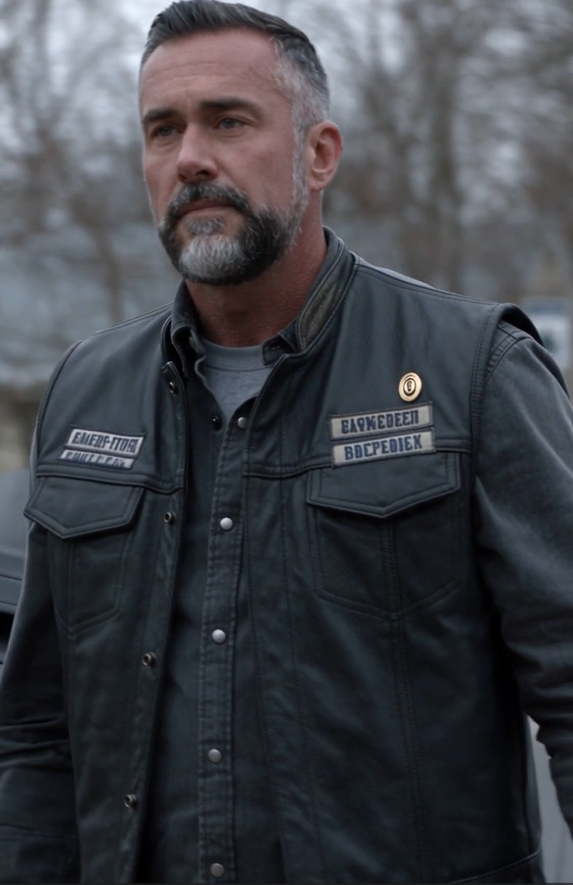
He was fifty years old, broad through the shoulders, gray in the beard, and still in the way some men became after years of learning that sudden movement could cost lives.
His hands were scarred across the knuckles.
His eyes were the kind that made excuses sound thin before they were even spoken.
The boy looked at the floor first.
Then he looked up.
Can one of you be my dad, he asked.
Just for one day.
The sentence landed so hard that no one knew what to do with the silence that followed.
Tommy Reyes, a former Army Ranger with a childhood he almost never talked about, lowered his coffee cup without drinking.
Duke Alrech stared at the table as if the grain of the wood had suddenly become important.
Cutter McKee, who had a son he had not seen in six years, blinked once and looked away.
Marcus Webb, the youngest of them, went rigid against the wall.
Priest closed the old Bible in front of him with both hands, quiet as a man shutting a door against a storm.
Gideon did not move.
He stared at the boy’s left eye, at the bruise that had gone from purple-black to greenish yellow around the edges, at the way the child’s chin lifted even while his body seemed to ask permission to disappear.
Then something inside him shifted.
It did not break loudly.
It simply gave way in a place he had spent nine years welding shut.
Sit down, son, Gideon said.
Tell me what happened.
The boy’s name was Elias Mercer.
He lived four blocks away on Ruddock Street, in a house where the curtains were usually drawn before sunset and the neighbors had learned the familiar cowardice of pretending not to hear.
His father, Corporal Daniel Mercer, had died when Elias was seven.
Daniel had been a soldier with oil under his nails, a laugh that filled kitchens, and a habit of pointing out constellations through the window even when the sky was too cloudy to see anything at all.
That one is the Big Dipper, he would say.
Dad, Elias would tell him, that is Mrs. Brenner’s porch light.
Could be both, Daniel would answer.
That was how Elias remembered him.
A man who could make room for two truths at the same time.
His mother, Renata, had been left with grief, debt, double shifts at the hospital laundry, and a child who kept growing in a house where the silence grew faster.
Then Travis Cole moved in.
Travis was charming in public.
He carried groceries for old women when people were watching.
He smiled at cashiers.
He told stories at the body shop in Mil Haven and made men laugh.
But inside the house on Ruddock Street, Travis was a pressure system.
He built slowly.
He drank.
He watched.
He found faults in rooms before he found people in them.
Elias had learned the weather of him.
A truck engine cutting off clean meant one kind of night.
A rough idle meant another.
One door slam meant caution.
Two door slams meant the house had already begun to shrink.
There were nights when Elias ate dinner quickly without tasting it.
There were nights when he did homework in the closet with a flashlight because the kitchen table had become unsafe territory.
There were nights when he heard his mother speaking softly in the kitchen, not because she was calm, but because she was trying to keep the storm from turning toward him.
The bruise around Elias’s eye was four days old by the time he walked into the clubhouse.
His teacher had seen it.
The school counselor had asked careful questions that were too indirect to require dangerous answers.
Elias had said he fell.
The adults had written things down.
Nothing had changed.
Then came career day.
Every student was supposed to bring a parent or guardian, someone who could stand in front of the class and talk about work, responsibility, and the bright open road of the future.
Elias had no one.
His father was buried beneath a military marker.
His mother worked double shifts until her hands cracked.
Travis would never walk into a school and stand under fluorescent lights where adults might look too closely.
So Elias sat on the front steps after school until his fingers went numb.
Then he stood up, turned left instead of going inside, and walked to the one building in town everyone warned children about.
The Iron Revenants listened.
Elias explained career day first because that was the safer part.
He said he needed someone to come.
Maybe one of them.
Only for the morning.
Only so he would not have to sit alone while the other children had fathers and mothers and uniforms and business cards and stories.
Gideon listened without interrupting.
Then he asked the question Elias had hoped no one would ask.
What about the eye.
Elias’s hands flattened against his jeans.
I fell, he said.
Gideon did not raise his voice.
That is not what I am seeing, he said.
The room became smaller.