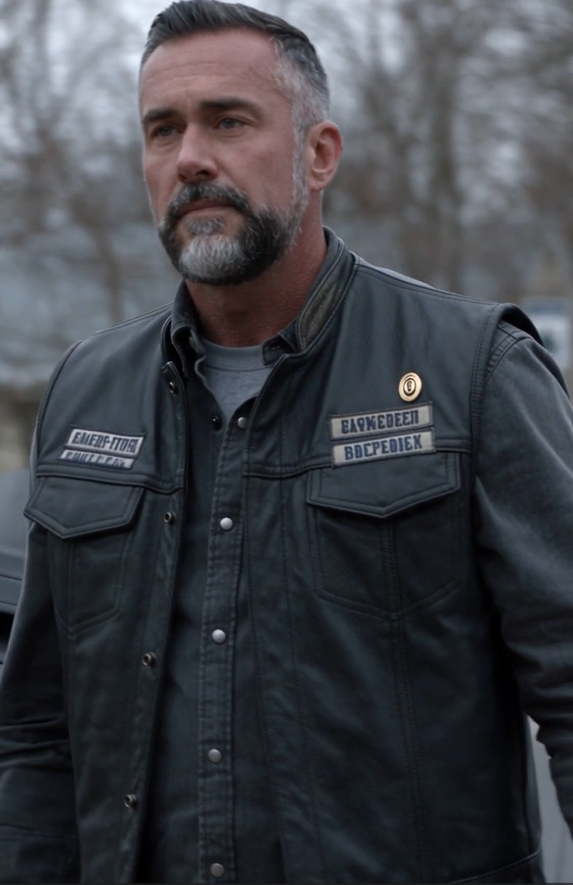
The coffee maker clicked.
Outside, a motorcycle popped once as the engine cooled.
Elias looked down at his shoes.
He does not do it all the time, he whispered.
No one spoke.
He had not meant to say it.
The words had escaped like something that had been locked too long.
My mom’s boyfriend, he said.
He gets like that when things are bad.
He swallowed hard.
I am not supposed to talk about it.
Who told you that, Gideon asked.
Elias did not answer for a moment.
Then he said one word.
Him.
The men around the table understood more than the boy had said.
They understood the bruise.
They understood the practiced lie.
They understood the way a child could become an expert in danger before he learned algebra.
Gideon leaned forward.
Your father’s name was Daniel Mercer, he said.
Elias nodded.
Third Infantry.
Died when I was seven.
Gideon’s face softened, but only slightly.
I am sorry, he said.
Elias gave the answer children give when grief has been sitting in the room too long.
It’s okay.
It was not okay.
It had never been okay.
Gideon knew it.
Every man in the room knew it.
Career day is in two weeks, Gideon said.
We will be there.
Elias blinked.
You will.
All of us who can make it.
Elias stared at him.
You do not have to.
I know, Gideon said.
That is not why we are doing it.
Why are you doing it.
Gideon thought of his own son, Aaron, seventeen years old forever, killed by a truck running a red light on a clear September afternoon.
He thought of the folded flag still hidden in a box because placing it in a shadow case felt too much like admitting the world had finished taking what it wanted.
Because someone should have done it for some of us, Gideon said.
And they did not.
Tommy stood and disappeared into the back room.
He returned with a plate of beans and rice that had been warming on the stove all day.
You eat today, he asked.
Elias considered lying.
Not since breakfast.
Tommy pushed the plate toward him.
Then eat.
That was how Elias spent one hour and forty minutes in the place he had been told to fear.
He ate at a table full of scarred men who asked real questions about his father.
What unit.
What did Daniel do on weekends.
Could he fix engines.
Was he funny.
Did he sing in the car.
For the first time in years, Elias talked about his father without feeling that the room might punish him for remembering.
Cutter took him out back and let him sit on an old Road King.
Elias placed both hands on the bars with such solemn concentration that Cutter had to bite back a smile.
Duke said almost nothing, but when Elias studied the photographs on the wall, Duke stepped beside him and pointed to a younger Gideon in desert gear.
Beluga, 2004, Duke said.
Three tours.
Were you there too, Elias asked.
Duke nodded.
Elias looked at the pictures, the flags, the coins, the faces of men who had gone away and come back with parts of themselves missing.
Do you like being in the club, he asked.
Duke thought before answering.
It is the first place I ever came back to, he said.
Elias did not fully understand, but he stored the sentence somewhere deep.
When he finally left, darkness had settled over Harwick.
Gideon walked him to the door and handed him a plain white card with a phone number written on it.
Any hour, Gideon said.
You understand me.
Yes, sir.
You do not have to call me sir.
Yes, sir.
Then Elias walked home.
He looked back half a block later and saw Gideon still standing in the clubhouse doorway, watching him until he turned the corner.
That night, Travis came home in the worst configuration.
Rough engine.
Two door slams.
Unsteady boots.
The argument began in the kitchen while Elias sat in his bedroom with the card hidden in his sock drawer.
He did not call.
Not yet.
But for the first time in eight months, sitting in the dark with a storm on the other side of his door, Elias had a number to call.
Across town, Gideon Voss sat at the clubhouse bar with cold coffee and his phone face up in front of him.
He did not sleep.
He had seen the bruise.
He knew storms did not wait for career day.
By morning, the Iron Revenants were moving carefully.
Not like vigilantes.
Not like men looking for an excuse.
Like men who understood that a wrong move could make a dangerous house even more dangerous for the child trapped inside it.
Tommy found Travis Cole’s record.
Two priors.
A domestic disturbance in 2019.
An asNextlt reduced after charges were dropped.
No active warrants.
Intermittent work at a body shop in Mil Haven.
Hector Vega, the club’s sergeant-at-arms, read the page and said nothing for a long time.
Carol Briggs, a nurse at Harwick Regional who knew the club through years of quiet community work, began gathering what she could through proper channels.
The school had noted the bruise.
The counselor had made a report.
But family services was buried under a caseload no human being could carry.
Non-emergency response could take weeks.
Marcus nearly slammed his hand on the table.
A kid with a black eye is non-emergency.
That is the system, Tommy said.
He did not say it as a defense.
He said it like a man naming a machine he hated and still knew how to operate.
Gideon laid out the rule.
No threats.
No contact with Travis.
No noise that could blow back on Elias or Renata.
They would document.
They would show up for career day.
They would make sure adults in official rooms could no longer pretend they had not seen.
The men agreed, but the agreement sat bitterly among them.
Two weeks felt like a long time when a child was counting nights.
Three days later, Duke challenged Gideon in private.
I need to know this is about the boy, he said.
Gideon looked up from the restoration ledger.
What else would it be about.
Duke held his eyes.
Aaron.
The name changed the room.
Gideon’s son had been dead nine years, but some names did not become softer with time.
They stayed sharp because love kept the edge polished.
Do not, Gideon said.
I am not accusing you, Duke replied.
I am asking because this kid is alive and in front of us, and I need to know you can see him clearly.
Gideon’s hands stayed on the table.
My head is clear.
Duke studied him for another breath.
Then he nodded.
I will be there career day, he said.
Full cut.
Bike polished.
When he left, Gideon sat alone with the ledger open and the old wound loose in the room.
Career day arrived cold and gray.
Elias stood outside Harwick Elementary in the cleanest jeans he owned and a flannel shirt that had belonged to his father.