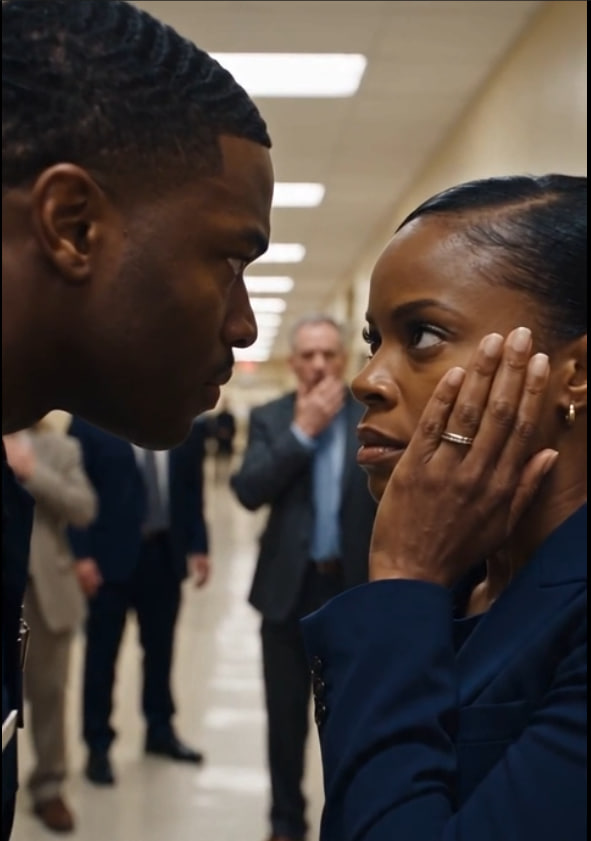
Dad read the back of the photograph.
Then he put it down and asked before reaching for me.
“May I hug you?”
I nodded.
His arms went around me.
I waited for him to deny the sentence so loudly that I wouldn't be allowed to admit it had hurt.
Instead, he said, “You have reasons to be angry with me. But I wanted you. I want you here.”
I held the back of his shirt.
“Then why didn't you see me?”
His breath caught.
“I don't have an answer that makes it acceptable.”
We stood in the kitchen until my legs stopped shaking.
Then we photographed the letter and preserved the envelope.
Dad didn't tear it up.
I didn't have to choose between comfort and evidence.
A few days later, Celia was formally charged in connection with the financial records and the attempted transaction.
Tessa explained the next steps.
I listened with Dad beside me.
There would be court dates.
There might be negotiations.
Nothing was guaranteed just because charges had been filed.
But Celia couldn't keep describing everything as a private disagreement without somebody asking about the account numbers.
That afternoon, I went to my old bedroom.
The guest furniture was still there.
Dad had offered to move it weeks earlier, but I hadn't been ready.
The room overlooked the maple tree Mom planted when I was ten.
I opened the window.
The air smelled like rain.
For years, I had passed this door as if the room belonged to somebody more important.
I turned toward Dad.
“I want it back.”
He nodded.
“When?”
“Today.”
We called Aunt June.
She arrived in old jeans and brought a roll of packing tape.
We moved the guest linens out.
Dad took apart the bed frame.
I carried my books in one armful at a time.
At the back of the closet, beneath a stack of empty gift boxes, I found my mother’s sewing tin.
I knew it by the dent in the lid.
Celia had told me she'd donated it.
I sat on the floor.
Inside were buttons, needles, a tape measure, and an envelope with my name on it.
My mother's handwriting.
Dad knelt beside me.
“What is it?”
“I don't know.”
I opened it carefully.
There were three photographs and a letter.
Mom had written it before her final surgery.
Not a formal goodbye.
Instructions about a sweater she wanted me to keep.
A reminder that Dad forgot to eat when he worried.
A joke about the terrible music I played in the car.
Then a paragraph that made my vision blur.
If growing up takes you somewhere far away, go. If you need to come home, come. You never have to earn your place with us.
I folded forward over the paper.
Dad put one hand on my back.
Aunt June sat in the doorway, crying quietly.
I read the letter again.
Then I read it aloud.
My voice broke on the last line.
I had spent three years earning a place that my mother had already promised me.
That night, I slept in my old room.
Not well.
But when I woke, I saw the maple tree.
I saw my books.
I saw the quilt at the foot of the bed.
I didn't reach for a rent envelope.
Winter came while the case continued.
I bought a new tire.
I went to the dentist.
Small things that felt embarrassingly large.
I opened a savings account in my own name and arranged automatic deposits.
Dad offered to replace the money immediately.
I told him I appreciated it, but I didn't want his savings to erase Celia’s debt.
Tessa helped us separate urgent support from the restitution we were seeking.
Dad paid for repairs around the house that he had neglected.
I paid my own personal expenses.
We talked about household contributions openly, without threats or secret rules.
Nobody made love depend on a receipt.
One evening, Dad put a calendar on the kitchen table.
His travel schedule.
“I asked for fewer trips.”
I studied it.
“You like your work.”
“I do.”
“I don't want you to give up everything because of me.”
He shook his head.
“I’m changing something because I finally understand what it cost us.”
I nodded.
Then I pointed to a Saturday.
“Could we go to Mom's grave?”
“Yes.”
We hadn't gone together in years.
At the cemetery, I brought white flowers.
Dad brought a cloth to clean the stone.
We worked side by side.
I told Mom, out loud, that I had found the letter.
Dad turned away for a moment.
Then he came back and stood beside me.
“I’m sorry, Ruth,” he whispered.
I didn't tell him she would forgive him.
That wasn't mine to give.
But when he reached for my hand, I took it.
On Monday, Tessa asked us to come into her office.
Celia’s lawyer had made a new proposal.
This time, it included a full accounting, repayment from identified funds, and an admission connected to the charges.
I sat across from Tessa.
“Would I have to say it didn't hurt me?”
“No.”
“Would I have to forgive her?”
“No.”
I looked at Dad.
Then at the letter folded in my bag.
“All right,” I said. “Tell me what happens next.”