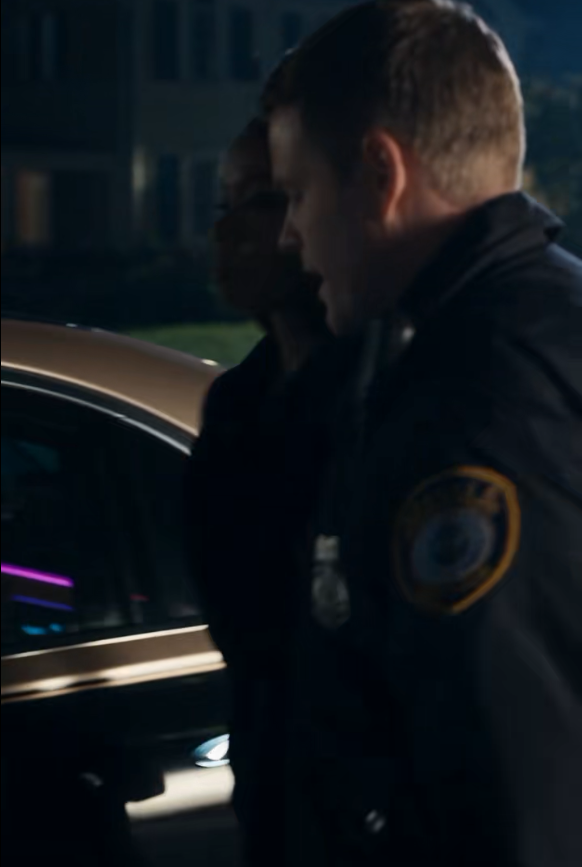
“You wrote the ticket after you knew who she was,” Price said.
“She told me to.”
“That’s not why you wrote it.”
Holloway looked up.
Price’s voice stayed quiet.
“You wrote it because letting her leave without one would have meant admitting you had nothing.”
Holloway’s face flushed.
“You don’t know what I thought.”
“No. I know what you did.”
Price left the folder on the desk and walked away.
Two weeks later, the U.S. Attorney’s Office filed notices in eleven criminal cases.
Potential impeachment evidence concerning Officer Derek Holloway.
Faith read about it in the newspaper like everyone else.
The article mentioned inconsistent stop descriptions, late body-camera activation, unsupported claims of evasive behavior, and one prior internal complaint that had been closed as “unsubstantiated.”
Then came the detail that stopped her.
The prior complaint involved a Black man driving a recently purchased luxury SUV.
Faith read the sentence twice.
The man’s name was Marcus Bell.
The defendant from the suppression hearing.
She closed the paper.
Maya entered with coffee.
“You saw it.”
Faith nodded.
“Holloway arrested Bell three months ago,” Maya said.
“I know.”
“The prior complaint was from two years earlier. Same person.”
Faith looked up sharply.
“What?”
Maya realized too late that she had crossed the line.
“I’m sorry.”
“Where did you get that?”
“It’s public now.”
Faith held out her hand.
Maya gave her the article.
There it was.
Marcus Bell had filed a civilian complaint against Holloway two years before the federal drug case.
The complaint alleged that Holloway had stopped him while Bell was driving an SUV registered to his employer, repeatedly questioned whether the vehicle was stolen, and searched it after Bell refused consent.
The department cleared Holloway.
Two years later, Holloway stopped Bell again.
That second stop led to federal charges.
Faith stared at the page.
A pattern did not prove fabrication.
But patterns mattered.
Especially when systems ignored them.
She picked up the phone.
“Get Chief Ames.”
Judge Moreno held the Bell suppression hearing the following week.
Faith did not attend.
She did not watch remotely.
She did not ask anyone what happened.
At 4:12 p.m., the ruling appeared on the docket.
Motion to suppress granted.
The opinion was forty-eight pages.
Faith read it after court.
Moreno found Holloway’s testimony unreliable in several material respects.
The patrol-car GPS contradicted his account of Bell’s lane violation.
Store surveillance contradicted his description of where the stop began.
Body-camera audio cast serious doubt on his claim that Bell consented to the search.
And a previously undisclosed disciplinary file showed Holloway had been counseled twice for failing to activate his camera before vehicle stops.
Faith reached the final paragraph.
The evidence was suppressed.
Without the evidence, the federal case collapsed.
But Moreno added a final sentence.
The court expresses no opinion regarding Officer Holloway’s motivations. The issue before the court is credibility, constitutional compliance, and the government’s burden.
Faith closed the opinion.
Precise.
Limited.
Devastating.
Exactly as law was supposed to be.
Part IV — The Cost of Being Right
The city placed Derek Holloway on unpaid suspension the next morning.
He appealed.
His union supplied counsel.
Public debate intensified.
Half the country seemed determined to decide whether he was a monster.
The other half wanted Faith to be one.
Neither version interested her.
What interested her was the growing number of cases.
State prosecutors began reviewing Holloway’s arrests.
Federal defenders filed motions.
Civil attorneys requested records.
Then Marcus Bell filed a lawsuit.
The complaint named Holloway, Sergeant Price, and the city.
Faith saw one sentence quoted in the press:
“The unlawful treatment of Judge Sullivan did not create Officer Holloway’s conduct; it exposed conduct that had previously been discounted when the victims lacked her institutional power.”
Faith stared at that sentence for a long time.
Her mother called that evening.
“You all right?”
“Yes.”
“That means no.”
Faith smiled despite herself.
“I’m fine.”
“You sound like your father.”
“He said he was fine?”
“Constantly. Usually while bleeding.”
Faith leaned against her kitchen counter.
“Mom, did Dad ever file complaints?”
Silence.
“Against police?”
Evelyn exhaled.
“Once.”
“What happened?”
“They said the officer acted appropriately.”
“What had happened?”
“He was coming home from a job in Westbridge. They stopped him because somebody reported tools stolen from a construction site.”
Faith waited.
“He had tools in the truck.”
“His tools.”
“Yes.”
“And?”
“They made him sit on the curb for nearly an hour.”
Faith closed her eyes.
“How old was I?”
“Eleven.”
“Why didn’t you tell me?”
“Because the next morning he still put a legal term beside your cereal.”
Faith said nothing.
“He didn’t want your lesson to be that the law was a lie,” Evelyn continued. “He wanted your lesson to be that people could fail it.”
Faith looked at the Bible on her shelf.
“What was the word that morning?”
Her mother laughed softly.
“You remember those?”
“Most.”
A pause.
“Due process.”
Faith sat down.
Of course it had been.
Three months passed.
Winter settled over Ridgefield.
The story faded from daily headlines but not from courtrooms.
Six defendants received new hearings.
Two convictions were vacated.
Three prosecutions were dismissed.
In one case, prosecutors concluded the evidence remained independently sufficient.
The review became what Faith had hoped it would become.
Specific.
Case by case.
Not a slogan.
Not a spectacle.
Facts.
Records.
Consequences.
Then the grand jury subpoena arrived.
Faith was called as a witness.
The Department of Justice had opened a civil-rights investigation into Holloway’s traffic enforcement practices and possible false reporting.
Faith read the subpoena twice.
The date was printed at the bottom.
January 14.
Her father’s birthday.
She almost laughed at the absurdity of it.
Instead, she placed the document beside his Bible.
The federal prosecutor interviewing her was careful.
He did not ask what she believed about Holloway.
He asked what happened.
Exact words.
Sequence.
Movements.
Timing.
Faith answered everything.
Then came the question she had expected.
“Judge Sullivan, did Officer Holloway use a racial slur?”
“No.”
“Did he explicitly mention your race?”
“He said, ‘People like you always have paperwork.’”
“What did you understand that to mean?”
Faith paused.
“I understood it as a statement about who he believed I was.”
“Based on race?”
“I can’t testify to what was inside his head.”
The prosecutor nodded.
“What can you testify to?”
Faith looked at him.
“That he doubted I owned the car before checking. That he described me as uncooperative before I refused any lawful instruction. That he claimed a possible stolen vehicle before determining whether the vehicle was stolen. That he laughed when I stated my occupation. And that after my identity was confirmed, he issued a citation for conduct later contradicted by traffic footage.”
The prosecutor waited.
Faith added, “Those are facts. The government can decide what they prove.”
He looked down at his notes.
“Why didn’t you identify yourself as a federal judge immediately?”
“I shouldn’t have had to.”
He looked back up.
Faith continued.
“I gave my license. I offered the registration. Ownership did not become more valid because I had a title.”
The prosecutor nodded slowly.