Part I — The Hallway
The first thing Officer Bradley Miller took from me was not my dignity.
It was the assumption that the courthouse would protect me simply because I belonged there.
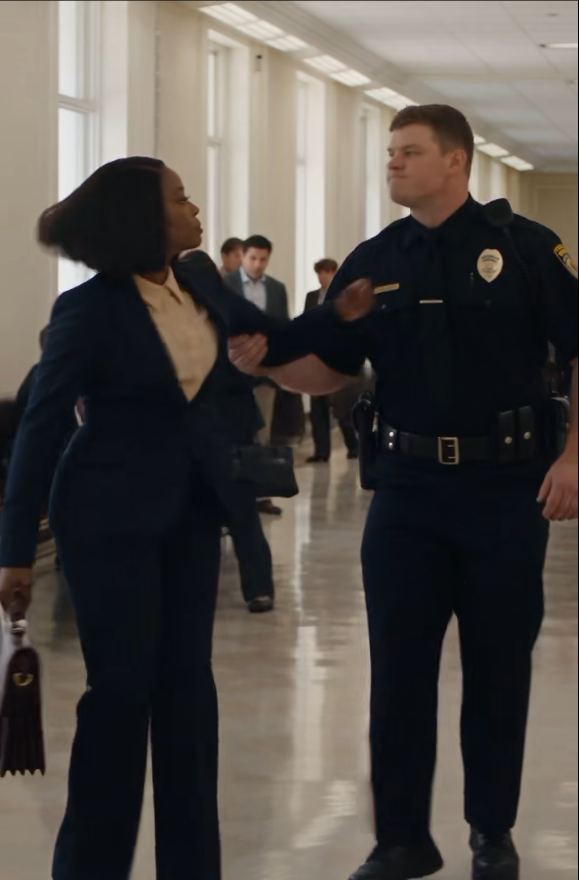
His palm struck the left side of my face hard enough to turn my head and send my briefcase to the floor. Papers slid across the polished hallway tile, some stopping beneath benches, others catching against the shoes of people who had been pretending not to watch.
For one second, the world narrowed to three things: the metallic taste of blood, the ringing in my left ear, and Miller reaching for his handcuffs.
“AsNextlting an officer,” he said.
His fingers closed around my arm again.
“Turn around.”
I looked at him.
He was close enough that I could see the pale line beneath his patrol cap where the sun normally reached his forehead. Close enough that I could smell coffee on his breath. Close enough to understand that he was not afraid of me.
That mattered.
People later asked whether I had been frightened.
Not then.
Fear came later, when I understood how casually it had happened.
At that moment, I was furious.
“You have absolutely no idea what you’ve just done.”
Miller gave me a thin, dismissive smile.
“I know exactly what I did.”
Heavy footsteps sounded behind him.
“Get your hands off her!”
Senior Bailiff Thomas Gallagher came around the corner at a speed I would not have believed possible for a man in his late sixties.
Thomas had worked in the Monroe County courthouse longer than some judges had practiced law. His gray hair was thinning, his shoulders had rounded over the years, and one knee made him descend stairs sideways when he thought nobody was looking.
None of that slowed him now.
He pushed between us.
Miller’s free hand moved instinctively toward his Taser.
“Back off, Tommy.”
Thomas ignored him.
He turned toward me.
His face changed.
“Your Honor…”
Miller stopped moving.
Thomas looked at my swelling cheek, then at the blood along my lower lip.
“Oh, dear God.”
The corridor went quiet in a way it had not been quiet when Miller struck me.
That was the part I remembered most.
Not the slap.
Not the handcuffs.
The silence after Thomas identified me.
Before those two words, people had watched a police officer grab a Black woman, accuse her of lying, and hit her.
After those two words, they understood something serious had happened.
I was the same woman in both moments.
Thomas turned slowly toward Miller.
“What did you do?”
Miller released my arm.
“I—”
“What did you do?”
“She told me she was—”
“A judge?” Thomas said.
Miller swallowed.
“She said she was Judge Caldwell.”
Thomas stared at him.
“And then?”
Miller looked at me.
His expression had already begun changing shape, certainty turning into calculation.
“She resisted.”
A young attorney near the elevator spoke before I could.
“No, she didn’t.”
Miller looked toward him.
Another voice came from farther down the corridor.
“He grabbed her first.”
Then another.
“She told him to let go.”
A courthouse clerk stepped out from beside the wall.
“He hit her.”
Miller’s gaze moved through the crowd.
Minutes earlier, he had seemed strengthened by an audience.
Now he appeared to be counting witnesses.
I bent and picked up one of my papers.
Thomas immediately crouched beside me.
“Leave it, Judge.”
“I can pick up paper, Thomas.”
“Your face—”
“My face can wait.”
I gathered another page.
My hand was steady until I saw a small red drop appear on the white margin.
Blood from my lip.
That made my fingers tremble.
Not much.
Enough.
Thomas saw it.
He stopped collecting papers.
“Judge Caldwell.”
“I’m fine.”
“No, ma’am.”
I looked at him.
His eyes were wet.
That nearly undid me.
Thomas had spent decades around crime scenes, grieving families, handcuffed teenagers, furious attorneys, frightened witnesses, and judges who believed volume was a substitute for authority. I had never seen him close to tears.
“I’m all right,” I said more quietly.
He stood.
“No. You’re standing. That’s different.”
Miller shifted behind him.
“Judge, I apologize. There was obviously a misunderstanding.”
I straightened.
The side of my face was beginning to throb.
“A misunderstanding?”
“I was given a description of a defendant who failed to report to 4B.”
“Maya Reynolds.”
“Yes.”
“And what was the description?”
Miller hesitated.
I waited.
Thomas looked at him too.
Finally Miller said, “Black female. Mid-forties. Dark coat.”
I glanced down at my charcoal suit jacket.
“No height?”
“I don’t remember.”
“No photograph?”
“I was told—”
“You called me Maya Reynolds before asking my name.”
He said nothing.
“You accused me of lying when I gave you my name.”
“Judge—”
“You demanded identification. I challenged your basis for detaining me. You grabbed me. When I tried to remove your hand, you called it resistance.”
Miller’s face reddened.
“That’s not exactly how—”
“And then you struck me.”
His jaw moved.
“Your Honor, I believed you had asNextlted—”
“No.”
I did not raise my voice.
That made him stop.
“You believed you could define whatever happened after the fact because you were the one wearing the badge.”
The hallway remained silent.
I became aware of how many people were there.
Defendants.
Attorneys.
Clerks.
Two deputies.
People with cases waiting.
People who had likely spent their lives adjusting their behavior around authority.
This was no longer just my humiliation.
I suddenly felt exposed in a different way.
Every word I spoke would matter because I was a judge.
Every angry gesture could become a headline.
Every accusation could later be characterized as an abuse of my position.
I had spent fifteen years telling clients not to give angry people with authority anything extra to use against them.
Now the advice belonged to me.
I turned to Thomas.
“Is there a supervisor on this floor?”
“Yes, Your Honor.”
“Get one.”
Miller spoke.
“Judge Caldwell, can we talk privately?”
I looked at him.
“No.”
His mouth closed.
“I want this handled exactly the way it would be handled if I were Maya Reynolds.”
Something shifted in the faces around me.
Miller understood it too.
“Judge—”
“Do not call me that because you’re scared now.”
He flinched.
“I told you who I was before you hit me.”
Thomas left to find a supervisor.
I crouched again and finished collecting my papers.
A woman in the hallway handed me the last page.
She looked about thirty. She wore a county-issued visitor badge and held a folder against her chest.
“You okay?” she asked.
It was not the careful question of someone speaking to a judge.
It was the ordinary question one stranger asks another after witnessing something ugly.
“Yes,” I said automatically.
Her gaze moved to my face.
Then back to my eyes.
“No, you’re not.”
She walked away before I could answer.
I stood there holding my scattered papers.
For the first time that morning, I wondered where Maya Reynolds was.
Twenty minutes later, I sat in my chambers with an ice pack wrapped in a white courthouse towel pressed against my cheek.
The county medical nurse had examined me.