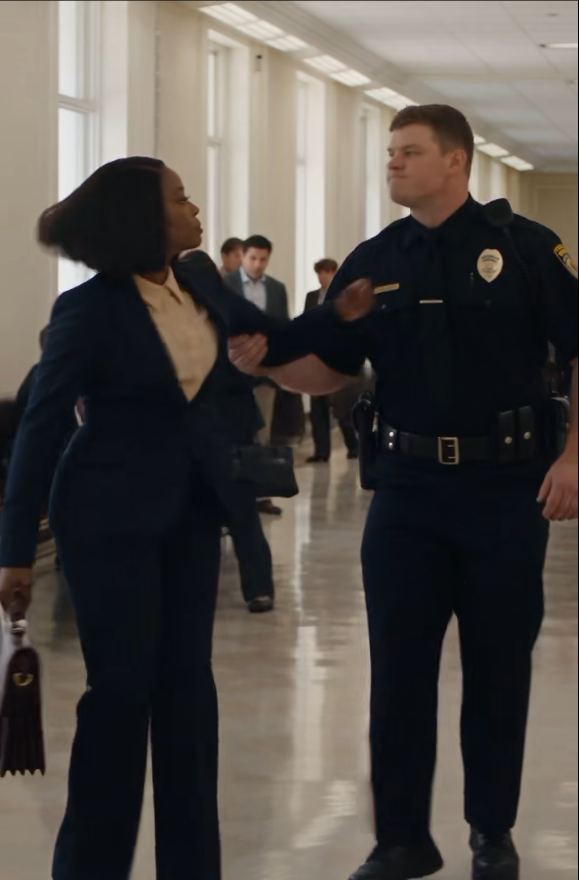
No broken jaw. No serious injury. Swelling, bruising, a split lip, mild ringing in my ear.
She recommended further evaluation if the ringing continued.
The chief administrative judge stood near my desk while a command officer from the police department occupied the chair opposite me.
Miller was no longer on the sixth floor.
He had been relieved of courthouse duty pending review.
The command officer had said that quickly, as though speed itself demonstrated seriousness.
I knew better than to confuse procedural movement with accountability.
“We will conduct a full investigation,” he said.
“I expect you will.”
“Body camera footage will be preserved.”
“Was his camera recording?”
A pause.
“We’re determining that.”
I lowered the ice pack.
“What does that mean?”
“We haven’t reviewed the device yet.”
“Was it activated?”
“I don’t want to speculate.”
Neither did I.
But I had spent enough time in courtrooms to recognize careful language.
The chief judge rested both hands on the back of a chair.
“Josephine, your calendar can be reassigned today.”
“I have arraignments at ten.”
“You were asNextlted less than an hour ago.”
“I’m aware.”
“You have a visible injury.”
“I’m aware of that too.”
He looked at me for several seconds.
“This isn’t about proving something.”
“No.”
“Then go home.”
I turned toward the window.
November rain moved in slanted sheets against the glass.
Below us, people hurried across the courthouse plaza beneath umbrellas, shoulders hunched, heads lowered.
Some of them were coming here because the government had accused them of crimes.
Some were here because they had been harmed.
Some were here to testify.
Some hoped to leave with custody of their children, restraining orders, probation terms, dismissed cases, convictions, second chances, or answers.
The building required all of them to believe that procedure meant something.
“I’m taking twenty minutes,” I said.
“Josephine.”
“Then I’m going to court.”
The command officer looked surprised.
The chief judge did not.
He knew me better.
“Why?”
I put the ice pack down.
“Because if I disappear for the day, the only thing people in that hallway will remember is that once someone important got hit, the entire building stopped.”
“And if you go out there looking like that?”
“They’ll remember the judge still had a docket.”
He watched me.
Then he nodded once.
“Twenty minutes.”
When they left, Thomas remained by the door.
“You can say it,” I told him.
“I’m not saying anything.”
“You’re thinking loudly.”
He looked offended.
“I have never thought loudly in my life.”
Despite myself, I smiled.
Pain pulled at my split lip.
I stopped.
Thomas’s expression softened.
“I should’ve been there.”
“You were.”
“Earlier.”
“You were doing your job.”
“So was he, apparently.”
I looked up.
Thomas immediately regretted the words.
“Sorry.”
“No. Don’t be.”
He lowered himself into the chair across from me.
For a moment, neither of us spoke.
Then he said, “You know what scares me?”
“What?”
“If he’d realized you were a judge five seconds earlier, none of this would’ve happened.”
I looked at him.
“That scares me too.”
“No.” Thomas shook his head. “Not what I mean.”
He rubbed his palm over one knee.
“What scares me is that he didn’t become a different man when I called you ‘Your Honor.’ He just realized he’d picked the wrong person.”
The ringing in my ear seemed louder.
Thomas looked toward the closed door.
“I’ve been in this building thirty-two years. You see enough people come through, you learn who changes depending on who’s watching.”
“Did you know something about Miller?”
He did not answer immediately.
That was answer enough.
“What?”
“I knew he was rough.”
“Rough how?”
“Short temper. Likes compliance.”
“Have you seen him hit someone?”
“No.”
“Threaten someone?”
“I’ve heard him talk.”
“What does that mean?”
Thomas rubbed his jaw.
“He talks different to defendants than lawyers. Different to young guys than old ones. Different when supervisors are around.”
“Did you report it?”
His eyes met mine.
“No.”
The honesty stung more than an excuse would have.
“Why?”
“Because I never had anything concrete.”
“You just said you heard him.”
“I heard attitude. Sarcasm. Things you can explain away one by one.”
“And together?”
Thomas looked down.
“Together, maybe they were something.”
I leaned back.
A knock sounded.
My courtroom clerk stepped inside.
“Judge?”
“Yes?”
“There’s a problem with your docket.”
“What problem?”
She held up a file.
“The Reynolds matter.”
I looked at the label.
STATE v. MAYA REYNOLDS.
For several seconds, no one spoke.
My clerk continued carefully.
“It was transferred from 4B this morning. The assigned judge had an emergency. It was supposed to come before you after arraignments.”
I stared at the folder.
Maya Reynolds.
The woman Miller believed I was.
“What’s the hearing?”
“Motion to suppress.”
“Basis?”
She hesitated.
“Alleged unlawful detention and excessive force during arrest.”
Thomas closed his eyes.
I held out my hand.
“Give me the file.”
Part II — Pressure
Maya Reynolds was not waiting in my courtroom.
She was in a consultation room with her public defender when I came downstairs in my robe.
The robe covered the suit Miller had mistaken for a defendant’s clothes.
It did not cover my face.
People noticed.
I saw them looking when I entered from the side door and climbed the two steps to the bench.
Nobody spoke about it.
That was appropriate.
For forty-seven minutes, I handled arraignments.
A shoplifting case.
A probation violation.
A man charged with breaking a car window during an argument.
A woman accused of possessing a controlled substance.
The work forced me into its familiar rhythm.
Names.
Rights.
Conditions.
Dates.
Arguments.
Records.
Every person before me deserved a judge who was listening, not replaying a hallway confrontation.
So I listened.
But details landed differently.
When an assistant prosecutor described one defendant as “uncooperative during contact,” I asked what that meant.
When an officer’s report stated a suspect had “pulled away,” I asked whether the officer had been holding him first.
The prosecutor noticed.
So did I.
I had asked those questions before.
Now I heard the language differently.
At eleven fifteen, my clerk handed me the Reynolds file.
I opened it.
Maya Reynolds was forty-one, not forty-three.
Five foot six.
Black.
Dark hair.
No violent criminal history.
She had been arrested three weeks earlier on a charge involving alleged theft from an employer. She maintained that the disputed money had been authorized reimbursement and that internal records would prove it.
That question was not before me.
The motion concerned her arrest.
According to Officer Bradley Miller’s report, he had approached Reynolds outside her apartment building after receiving confirmation of a warrant. Reynolds had “become argumentative,” “attempted to walk away,” and “physically resisted lawful detention.”
According to Reynolds, Miller had not identified himself before grabbing her arm. She had pulled away instinctively. He had twisted her against a vehicle and threatened to add charges if she did not stop “acting like a lawyer.”
I read that phrase twice.
Acting like a lawyer.
My clerk stood silently beside the bench.
“Bring counsel in,” I said.