Limited access.
Auditable searches.
Clear categories distinguishing allegations from sustained findings.
Mandatory notification when repeated similar complaints met defined thresholds.
Independent review.
No automatic discipline.
No secret judicial access.
No shortcut around evidence.
Six months after Miller struck me, the county approved a pilot program.
Not because I demanded it.
Because enough people finally accepted that information existing in separate rooms was not the same as an institution knowing it.
Miller was sentenced to probation, community service, and anger-management requirements. His law-enforcement certification later became the subject of a separate administrative process.
He appealed his convictions.
That was his right.
I made no public comment.
Maya Reynolds’s record relating to the dismissed theft charge was cleared through the appropriate process.
Leon Price received a written acknowledgment that his complaint had not been adequately reviewed.
Thomas began counting the weeks until retirement.
The bruise disappeared.
The ringing in my ear stopped.
Life became ordinary again.
Then, almost nine months after the hallway incident, I received a sealed internal review summary concerning the courthouse reporting pilot.
Not details from criminal cases.
Aggregate information.
Three officers had generated repeat alerts.
Two involved procedural issues resolved through supervision.
The third involved a deputy from another agency who had received multiple complaints about unnecessarily aggressive searches.
The complaints had occurred over fourteen months.
Before the pilot, they had existed in three separate places.
Now they appeared together.
An independent review began.
No conclusion yet.
No assumption of guilt.
Just attention.
I read the report twice.
Then folded it closed.
A knock sounded.
Thomas entered without waiting.
His final day.
He wore a navy suit instead of his bailiff uniform.
I had never seen him without the uniform inside the courthouse.
He looked uncomfortable.
“You clean up terribly,” I said.
“Respect your elders.”
“You’re retired in twenty-two minutes.”
“Then I can finally tell you what I think of your rulings.”
“You’ve been doing that for three years.”
“Quietly.”
“No.”
He placed his old courthouse identification badge on my desk.
“I’m supposed to turn this in downstairs.”
“Then why are you giving it to me?”
“Wanted you to see something.”
The badge was worn around the edges.
Thomas Gallagher.
Senior Bailiff.
Thirty-two years.
He turned it over.
On the back was a handwritten list of numbers.
Dates.
“What is this?”
“Times I should’ve said something.”
I looked up.
He shrugged.
“Not all Miller. Different things. Some small. Some probably nothing. Started writing them down after your incident.”
“Why?”
“So I wouldn’t turn forgetting into forgiveness.”
I looked again at the dates.
“You reported these?”
“Every one that needed reporting.”
“And the others?”
“Things I handled. Things I realized weren’t what I thought. Couple times I was wrong.”
He took the badge back.
“That’s important too.”
“Yes.”
He slipped it into his pocket.
“I used to think the job was knowing who the good guys were.”
“And now?”
“Now I think the job is building a place where it matters less.”
I smiled.
“That is annoyingly profound.”
“Been saving it.”
We walked downstairs together.
At the fourth-floor hallway, Thomas slowed.
The same corridor.
The same western stairwell.
New paint had covered a scuff near the wall.
People moved around us carrying files, coffee, umbrellas.
No one stopped.
Thomas looked toward the place where he had found me with blood on my lip.
“You ever avoid this hallway?”
“No.”
“Never?”
“First few weeks.”
He nodded.
“Me too.”
“You weren’t the one who got hit.”
“No.”
His voice softened.
“But I was the one who finally saw how much I’d trained myself not to see.”
We stood there for a moment.
Then a uniformed officer approached from the elevator.
Young.
I did not know him.
He looked at me, then at Thomas.
“Excuse me, ma’am.”
For the briefest instant, my body reacted before my mind did.
Shoulders tightening.
Breath shortening.
Memory arriving faster than reason.
The officer stopped several feet away.
“Are you Judge Caldwell?”
“Yes.”
He held up a folder.
“Clerk downstairs asked me to bring this to your courtroom. I wanted to make sure I had the right person.”
I looked at the folder.
Then at him.
“Yes. You do.”
He handed it over.
“Thank you, Your Honor.”
He walked away.
Thomas watched him go.
“That feel weird?”
“A little.”
“Progress?”
“Don’t ruin it.”
He smiled.
We reached the main lobby.
People had gathered near security to say goodbye.
Clerks.
Lawyers.
Bailiffs.
A few judges.
Thomas immediately became embarrassed.
“I specifically told them not to do this.”
“Nobody listens to you.”
“Apparently.”
He received handshakes.
A framed photograph.
A cheap cake.
A speech he pretended not to enjoy.
When it was over, he stood beside the courthouse doors holding a cardboard box containing thirty-two years reduced to a coffee mug, two photographs, an old flashlight, and a retirement card everyone had signed.
“You need help?” I asked.
“I carried drunk defendants up these stairs before you passed the bar.”
“So no?”
“No.”
He pushed open the door.
Sunlight entered the lobby.
After months of winter and rain, spring had finally reached the city.
Thomas stepped outside.
Then stopped.
“Judge.”
“Yes?”
He looked back at me.
“That morning.”
I waited.
“When I called you ‘Your Honor’…”
“Yes.”
“I’ve wished a hundred times I’d said your name instead.”
I frowned.
“Why?”
“Because Miller needed to hear your title.”
He adjusted the box in his arms.
“But everybody else should’ve only needed to hear you say who you were.”
Then he walked down the courthouse steps.
I stood there long after he disappeared into the crowd.
That afternoon, my last case involved a twenty-two-year-old man charged with obstruction during a traffic stop.
The prosecutor called the arresting officer.
The young man sat beside his public defender.
The officer testified that the defendant had become argumentative and pulled away when instructed to place his hands behind his back.
The defense attorney rose.
“Was your body camera operating?”
“Yes.”
“Entire encounter?”
“Yes.”
The footage played.
It did not show brutality.
It did not show innocence.
It showed something more complicated.
The officer gave an instruction.
The young man asked why he was being detained.
The officer repeated the instruction.
The young man stepped backward.
The officer reached for him.
The young man pulled away.
Both sides had described true pieces.
Neither description alone captured the whole event.
I watched it twice.
Then heard argument.
Then ruled.
The detention had been lawful.
The young man’s movement met the statutory standard for obstruction.
But I also found that some language in the police report overstated his physical aggression.
That did not erase the offense.
It mattered anyway.
I said so.
The defendant looked disappointed.
His lawyer whispered to him.
The officer gathered his papers.
Before he stepped down, I addressed him.
“Officer.”
He stopped.
“Yes, Your Honor?”
“Your report says the defendant ‘violently jerked away.’”
“Yes.”
“The video shows him pulling his arm backward once.”
The officer shifted.
“Yes.”
“Words matter.”
He nodded.
“Yes, Your Honor.”
I looked at the defendant.
“So do actions.”
He nodded too.
No speeches.
No dramatic reversal.
No easy heroes.
Just a record made more accurate than it had been before.
When court ended, I returned to chambers.
Maya’s card remained in the top drawer of my desk.
I took it out.
He believed you when someone important spoke.
Now make that part matter.
For months, I had thought the second sentence was a demand.
That day, I finally understood it differently.
It was not asking me to use my importance.
It was asking me to build something that depended on it less.
I placed the card inside a small wooden box with a handful of things I intended to keep long after I left the bench.
Then I removed my robe.
The charcoal suit underneath had been repaired where a button loosened during Miller’s grip.
I had almost thrown it away.
Instead, I kept wearing it.
Not as armor.
Not as a symbol.
Because it was mine.
I picked up my briefcase and walked toward the public elevator.
The doors opened.
Inside stood defendants, lawyers, two courthouse employees, and a mother holding the hand of a teenage boy.
Nobody moved to make special room for me.
Good.
I stepped inside.
The doors closed.
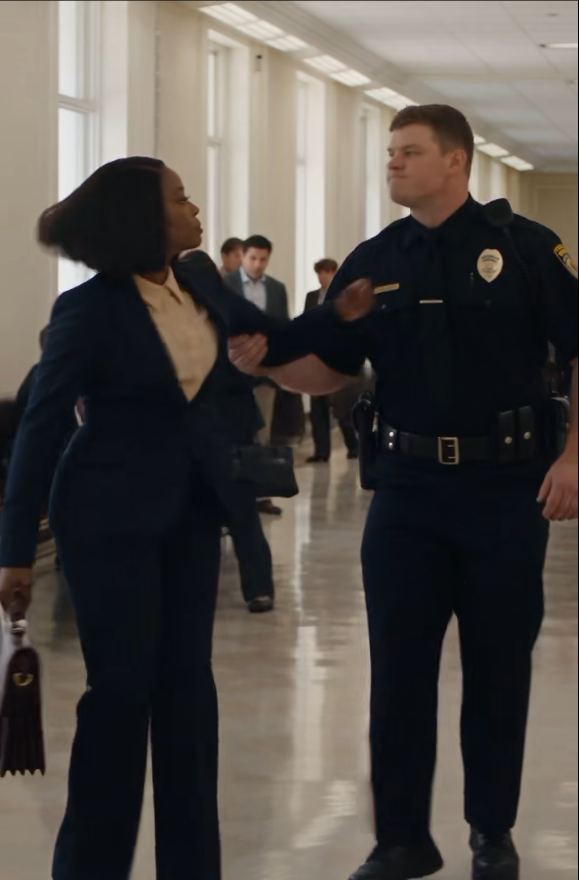
On the fourth floor, a Black woman in a dark coat entered.
For an instant, I saw Miller’s hallway again.
Then the woman pressed the button for the lobby and looked at her phone.
Nothing happened.
No one stopped her.
No one demanded that she explain where she was going.
No one asked her to prove she belonged.
The elevator descended.
And for once, inside that courthouse, a stranger was allowed to remain exactly what she was until she told us otherwise.