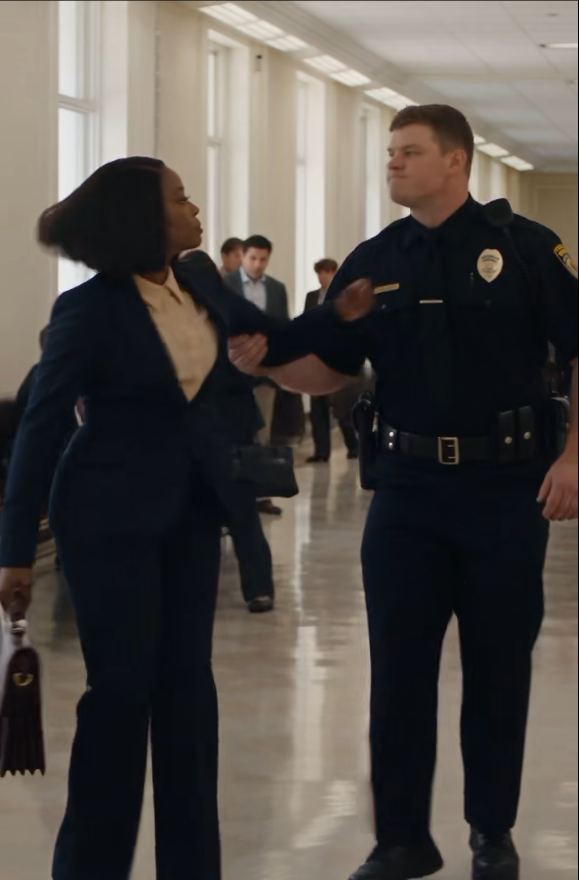
“You told internal affairs you wanted your incident handled exactly as it would have been if you were Maya Reynolds.”
“Yes.”
“But that’s impossible, isn’t it?”
I said nothing.
He continued.
“You’re a judge. She is a criminal defendant. You have status she does not. Institutional relationships she does not. Public credibility she does not.”
The words were harsh.
But accurate in ways he perhaps did not intend.
“So when you demanded equal treatment, what you really meant was that you wanted the system to treat her complaint with the seriousness it would give yours.”
“Yes.”
He seemed surprised by the immediate answer.
I leaned slightly toward the microphone.
“That is exactly what I meant.”
Silence.
The attorney looked down at his notes.
“No further questions.”
The trial lasted four days.
I did not attend after testifying.
Thomas did.
He called me when the verdict came.
The visiting judge found Miller guilty of simple battery and falsifying an official report.
Not guilty of official misconduct under the narrower statutory definition charged.
I listened without speaking.
Thomas said, “You there?”
“Yes.”
“How do you feel?”
“I don’t know yet.”
“Fair.”
“What did the judge say?”
“That the initial misidentification could have been an honest mistake.”
I closed my eyes.
“And?”
“That what happened after you identified yourself was not.”
I sat on the edge of my desk.
Thomas continued.
“He said the most significant evidence wasn’t that Miller was wrong about who you were. It was what he did after he was given information contradicting his assumption.”
That sounded right.
“The report?” I asked.
“Judge said the report was deliberately misleading.”
I looked at the hallway outside my chambers.
People passed.
Ordinary day.
“What about sentencing?”
“Next month.”
“Okay.”
“That’s it?”
“What do you want me to say?”
“I don’t know. Something profound. You’re the judge.”
“Wrong judge.”
Thomas laughed softly.
Then he said, “Maya was here.”
I sat straighter.
“Why?”
“Her own case.”
“What happened?”
“You haven’t heard?”
“No.”
He hesitated.
“The state dismissed it.”
I said nothing.
“Employer records came in. Reimbursements were authorized. Accounting problem, not theft.”
I stared at the wall.
“So she was never—”
“No.”
Never a thief.
Never someone trying to escape court.
Never the person Miller imagined when he saw me walking toward the stairs.
Thomas continued.
“She asked whether you were around.”
“You didn’t send her up.”
“No.”
“Why not?”
“Figured you’d yell at me about boundaries.”
“Good judgment.”
“I have moments.”
We were both quiet.
Then Thomas said, “She left something with your clerk.”
After the call, I opened my office door.
My clerk handed me a small envelope.
Inside was a card.
No legal argument.
No accusation.
Six handwritten words.
He believed you when someone important spoke.
I turned the card over.
On the back, Maya had written five more.
Now make that part matter.
Part VI — The Harder Choice
Miller’s conviction did not fix the courthouse.
That should be obvious.
But institutions are often tempted by clean endings.
One officer punished.
One press conference.
One revised policy.
A training seminar.
A statement about restoring trust.
Then everyone returns to work.
Three weeks after the verdict, I was asked to join a courthouse “community confidence task force.”
The title alone made me suspicious.
The chief judge chaired it.
Police representatives attended.
Public defenders.
Prosecutors.
Bailiffs.
Clerks.
Community advocates.
The first meeting lasted ninety minutes.
For sixty of them, people discussed body-camera compliance.
Useful.
Necessary.
Incomplete.
Then they discussed identification procedures for plainclothes judges.
I listened for ten minutes.
Finally I said, “No.”
The room stopped.
The chief judge looked at me.
“No what?”
“No special credential system for judges.”
A police commander frowned.
“Judge Caldwell, with respect, that could have prevented what happened.”
“So could Miller believing me when I gave him my name.”
“A visible judicial credential would reduce confusion.”
“For judges.”
“Yes.”
“What about everyone else?”
He hesitated.
I continued.
“If the primary lesson from my asNextlt is that judges need better ways to prove they’re important, then we have learned the wrong lesson.”
The chief judge leaned forward.
“That’s not what anyone is saying.”
“It’s exactly what the proposal does.”
The commander said, “We have to address practical risks.”
“Then address the risk that an officer makes a conclusion before asking a question.”
“We’re doing bias training.”
“I’m not talking about a seminar.”
“What are you proposing?”
I had thought about that question for weeks.
Not a grand solution.
Grand solutions usually collapse under their own certainty.
Something narrower.
Structural.
“Centralize courthouse complaints involving law enforcement contacts.”
The room quieted.
A prosecutor asked, “Meaning?”
“Right now complaints live in separate systems. Police complaints go to the department. Courthouse complaints may go to administration. Defense allegations appear inside individual case files. Bailiff concerns remain supervisory. Nobody sees patterns unless a formal investigation is already underway.”
The public defender across the table nodded slowly.
I continued.
“I’m not proposing automatic findings. I’m proposing a record that shows repeated allegations involving the same officer, location, or type of contact.”
The police commander’s expression hardened.
“That risks creating a database of unsubstantiated accusations.”
“Yes.”
He looked surprised that I agreed.
“Then you understand the problem.”
“I understand there must be protections.”
“An officer could have ten false complaints and suddenly look like a problem.”
“Then the system should also record outcomes.”
“What if there are no findings?”
“Then it says no findings.”
He leaned back.
“But judges could see those complaints and become biased.”
“Judges should not receive raw allegations in pending cases unless disclosure rules require it.”
“Then who sees the pattern?”
“An independent courthouse review officer. Not a sitting judge deciding individual cases.”
The chief judge studied me.
“You’ve been working on this.”
“Yes.”
“For how long?”
“Since I realized nine body-camera deactivations looked different when someone finally put them on the same page.”
Nobody answered.
Thomas, sitting near the end of the table as the bailiff representative, lifted one hand.
Everyone looked at him.
“I have a question.”
The chief judge nodded.
Thomas said, “Would courthouse employees be required to report things they personally witness?”
The question was for me.
“Yes.”
“What counts?”
“Use of force. Threats. discriminatory language. Material deviations from security procedures. Anything that would matter if a supervisor were standing there.”
Thomas nodded.
“And if we’re not sure?”
“Report what you saw. Don’t characterize what you didn’t.”
He looked down.
“Should’ve had that thirty years ago.”
The commander said, “We already have internal affairs.”
Thomas turned toward him.
“With respect, Captain, internal affairs didn’t know what I knew because I never called internal affairs.”
“That’s on you.”
“Yes.”
Thomas did not defend himself.
“That’s the point.”
The room became quiet again.
The proposal was not adopted that day.
Nor the next month.
There were objections.
Union concerns.
Privacy questions.
Disclosure rules.
Due-process protections.
Questions about who controlled the information.
Questions about how long reports were retained.
Good questions.
Necessary questions.
For once, I did not resent procedure.
Procedure was not the enemy.
Procedure without attention was.
We revised the proposal.