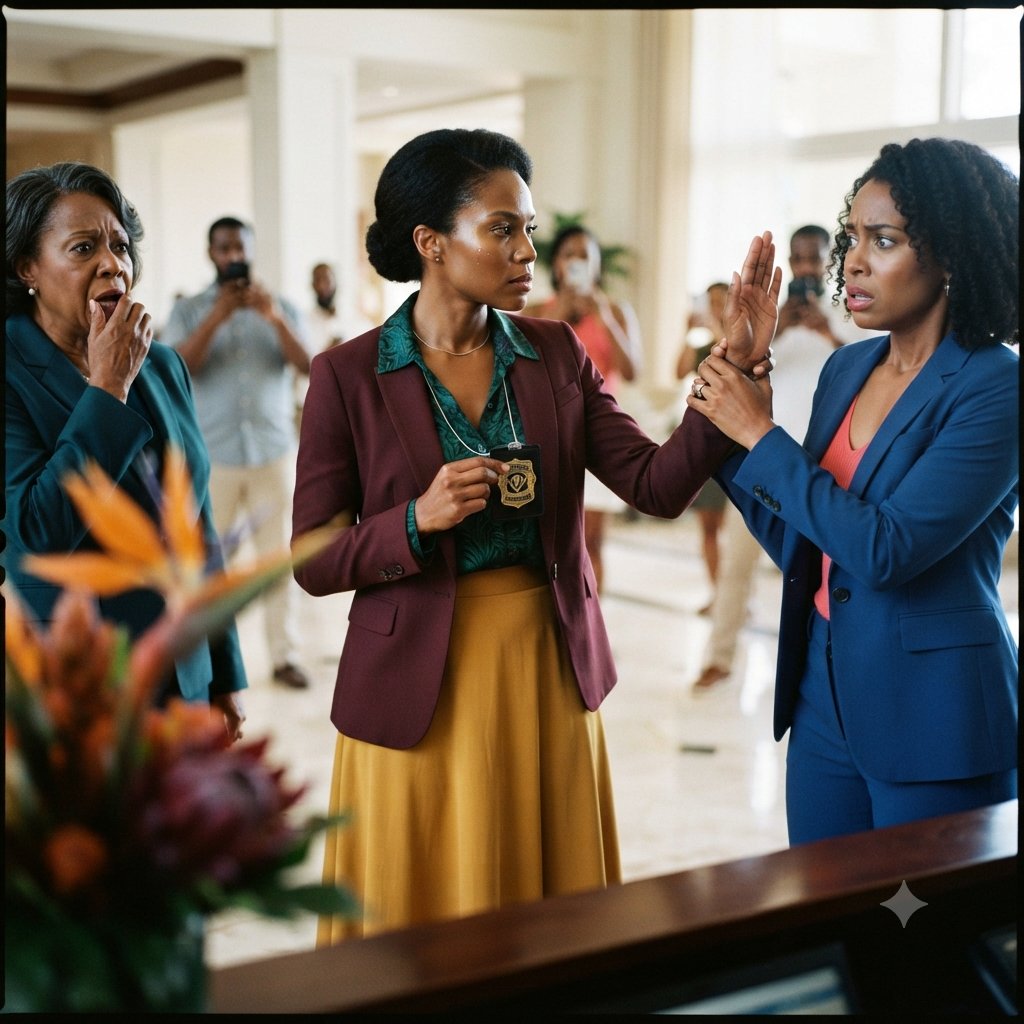
Eleanor called my father's office on Tuesday.
She didn't call me.
She called him, which told me everything about how she had decided to approach the situation — as a matter between powerful people, with me as a secondary detail to be managed.
Martin took the call.
He listened for four minutes, said three sentences, and hung up.
"She wants to discuss a private resolution," he told me afterward.
"She's concerned about the incident report."
"She should be," I said.
"She's also concerned about what Chloe's husband may do."
"What is Garrett doing?"
Martin set a piece of paper on the desk.
It was a letter from Garrett Voss's attorney, addressed to the venue, requesting a copy of the security footage for the purposes of a separate legal proceeding.
"He's filing for an annulment," Martin said.
"On the grounds of fraud.
Specifically, that Chloe misrepresented her character and conduct in the period leading up to the marriage."
I looked at the letter.
"He found out about more than just the ring," I said.
"It appears so," Martin said.
"His attorney has been in contact with the wedding planner.
Diane was cooperative."
I set the letter down.
I thought about Chloe — not the Chloe who had pointed at me across the ballroom, not the Chloe who had spent three years sharpening her contempt into something precise and practiced, but the Chloe I had heard crying through a door on Friday night.
The one whose new marriage was now dissolving four days after the ceremony.
I didn't feel satisfaction.
I had expected to, and I didn't.
"What about Eleanor?" I said.
"The venue has filed its own report with the city for the destruction of property on the premises," Martin said.
"That's separate from any action you choose to take." He paused.
"I've drafted a civil filing.
It names Eleanor specifically.
Destruction of property, public defamation, and emotional distress.
Given that you were eight months pregnant at the time, the distress component is significant."
He set the draft in front of me.
I read it carefully.
My name at the top.
Eleanor's name below it.
The facts laid out in the clean, bloodless language of legal documents that somehow made everything feel more real, not less.
"If I file this," I said, "what happens?"
"She will almost certainly settle.
Her attorney will advise it.
A public trial would be far more damaging to her than a private settlement."
"I don't want a private settlement," I said.
Martin looked at me.
"I want an acknowledgment," I said.
"In writing.
That what she did was wrong.
That the accusation was false.
That my husband's family treated me badly for three years and I did nothing to deserve it." I paused.
"I want it in writing, and I want it sent to every person who was in that ballroom."
Martin was quiet for a moment.
"That's an unusual request," he said.
"Can it be done?"
"It can be made a condition of any settlement," he said.
"Whether she agrees is another matter."
"If she doesn't agree," I said, "then we file."
Martin picked up his pen.
"Understood."
My father said nothing.
He was sitting at the corner of the desk, and he let me handle it, which was the right thing to do.
Three days later, Eleanor's attorney called back.
She would not agree to a public acknowledgment.
Martin filed the suit on Friday morning, exactly one week after the wedding.
---
The baby came six weeks later, on a Tuesday, at 4:17 in the afternoon.
A girl.
Dominic was in the waiting room.
I had told him he could be there, which was not the same as telling him everything was resolved, and he understood the difference.
He had spent the six weeks between the wedding and the birth doing the things a man does when he is trying to demonstrate something through action rather than words: attending every appointment, staying in the guest room of my father's house when I allowed it, not pushing when I didn't.
It was not enough to fix what had been broken.
It was enough to be a start.
When the nurse brought him in, he stood at the edge of the room and looked at the baby in my arms with an expression I had never seen on his face before.
Something that had no performance in it at all.
"What's her name?" he said.
I had decided this on my own, and I had told no one.
"Margaret," I said.
He looked at me.
"Not after anyone," I said.
"I just like the name."
He nodded.
His eyes were bright.
"Can I—" he started.
I held her out.
He took her with the careful, slightly terrified competence of a man who has never held a newborn and is determined not to show it.
She fit against his chest and blinked at him with the unfocused, ancient gaze of the very new.
"Hello," he said to her, very quietly.
My father was in the waiting room too.
I had the nurse bring him in after a few minutes.
He stood in the doorway and looked at his granddaughter, and something in his face went soft in a way I had only seen a handful of times in my life.
"She has your mother's nose," he said.
"She's four hours old," I said.
"Still," he said.
He came and sat beside me, and we were quiet for a while — my father, my husband, my daughter, and me — in the particular stillness of a room where something new has just arrived.
---
Eleanor settled eight weeks after the filing.
She did not agree to the public acknowledgment.
What she agreed to, after three rounds of negotiation, was a written statement of apology delivered to me directly, a financial settlement that Martin described as "more than adequate," and a formal letter from her attorney acknowledging that the accusation of theft made at the reception was false and without basis.
It was not everything I had asked for.
It was enough.
Chloe's annulment was granted on a Thursday.
I heard about it from Dominic, who heard about it from a mutual acquaintance.
Chloe had moved back to her mother's house.
She had not contacted me.
I did not contact her either.
But I thought about her sometimes.
About what it costs a person to spend years building contempt for someone, and what it costs when that contempt turns back on you.
I didn't forgive her — not yet, maybe not for a long time.
But I stopped carrying the anger, because anger is heavy and I had other things to carry now.
Dominic and I were not fixed.
We were working.
There is a difference, and it matters.
He moved back into our house when Margaret was three months old.
Not because everything was resolved, but because we had both decided that working on something is better done in the same room.
We had a therapist.
We had honest conversations that were sometimes very difficult.
We had a daughter who needed both of us present.
Some mornings were hard.
Some evenings were easy.
That was what repair looked like, and I had stopped expecting it to look like anything else.
Thomas Reeve met my father for coffee on a Wednesday in November, at a small place near my father's office.
I don't know everything they said.
My father told me it lasted two hours and that Thomas had ordered the same thing he always ordered, which my father found meaningful in a way he couldn't entirely explain.
They met again the following month.
And the month after that.
The Kellerman and Osei families received formal acknowledgments and settlements that Martin described as fair.
The city ethics review concluded in the spring.
Ashworth Development paid a significant fine and agreed to a revised permitting process going forward.
It was in the news for two days and then it wasn't.
My father handled it without flinching, which was the thing I had asked him to do.
---
On a Saturday in March, I put Margaret in her carrier and walked to the small park three blocks from our house.
It was cold but clear.
The kind of day that feels like a door opening.
I sat on a bench and watched the trees and thought about nothing in particular.
A woman sat down at the other end of the bench.
Older — late sixties, maybe.
She glanced at Margaret and smiled the way strangers smile at babies, with uncomplicated warmth.
"How old?" she said.
"Four months," I said.
"They change so fast," she said.
"Enjoy every bit of it."
"I am," I said.
She nodded and went back to her book.
I looked down at my daughter, who was awake and regarding the bare branches above us with the focused intensity she brought to everything.
I thought about the ballroom.
The torn dress.
The scattered vitamins on the marble floor.
Dominic's sigh.
My father's voice on the phone, steady and certain: *They're already on their way.*
I thought about how long I had stayed quiet, and why, and what it had cost.
I thought about what it had finally taken to say: *It's time.*
Margaret grabbed my finger without looking at me.
Her grip was surprisingly strong.
"I know," I said to her quietly.
"I know."
The woman at the other end of the bench turned a page.
The trees held still in the cold air.
And for the first time in a very long time, I sat somewhere without waiting for the next thing to go wrong.
---
*Sometimes the people who underestimate us the most are the ones standing closest.
And sometimes it takes one unbearable moment for everything that was hidden to finally come into the light.*
Have you ever been dismissed or underestimated by someone who didn't know your full story — and what did it take for the truth to finally come out?
Share your experience in the comments below.