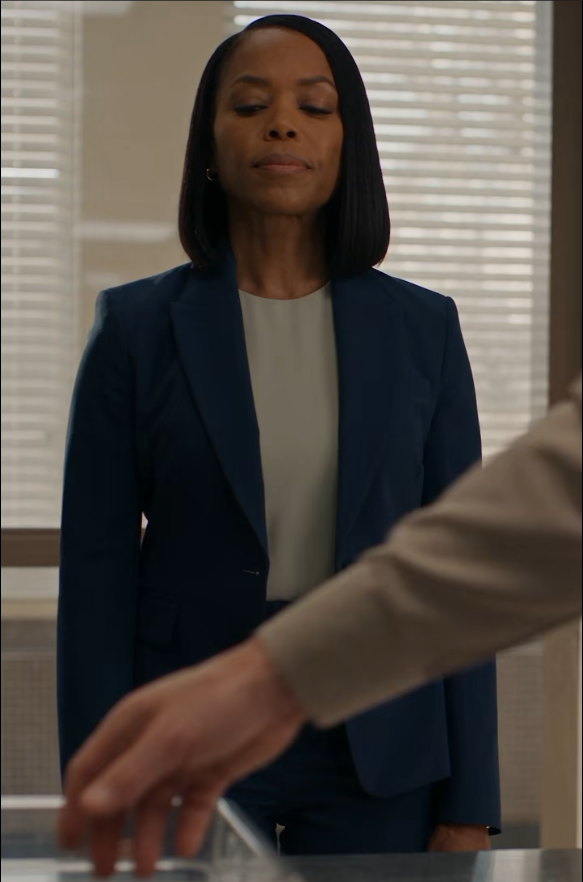
For the first time that afternoon, she allowed herself to exhale.
Not because she was afraid of what he would find.
He would find nothing.
She was thinking about what would happen when the device’s biometric lock registered prolonged separation from its authorized user.
A timer had already started.
The Oak Haven Sheriff’s Department occupied a low brick building beside the courthouse, the municipal garage, and a flagpole that leaned slightly east.
Inside, fluorescent lights buzzed above faded linoleum.
Deputy Toby Miller looked up from the booking desk when Cleary entered with Sarah.
Miller was younger, early thirties, with a deputy’s uniform that still looked as though he ironed it every morning. He had been sorting traffic forms.
His eyes went first to the handcuffs.
Then to Sarah.
Then to his sheriff.
“What happened?”
“Traffic stop went sideways.”
Cleary guided Sarah toward the counter.
“She got difficult.”
Sarah glanced at Miller but said nothing.
Cleary placed her belongings on the counter one at a time, enjoying the rhythm of it.
Wallet.
Keys.
Lip balm.
Secure device.
Miller reached automatically for the inventory sheet.
“What are the charges?”
Cleary removed his sunglasses.
“Resisting. Disorderly. Failure to comply.”
Miller’s pen stopped.
“Was there—”
“Problem?”
“No.”
“Then book her.”
Miller looked toward Sarah.
“Ma’am, I need your full name.”
“Sarah Evelyn Hayes.”
“Date of birth?”
She answered.
“Occupation?”
Sarah paused.
Cleary leaned against the counter.
“This ought to be good.”
Sarah looked at Miller.
“Federal service.”
Cleary laughed.
Miller did not.
He wrote it down.
“Specific agency?”
“For the booking form, federal service is sufficient until counsel is present.”
Cleary pushed away from the counter.
“No, it isn’t.”
Sarah looked toward him.
“You have my driver’s license. You may verify my identity through lawful channels.”
“Lawful channels.”
He repeated the phrase with open mockery.
Then he picked up the black device.
“You federal people always carry toys like this?”
“Put it down,” Sarah said.
Her tone had changed only slightly.
Miller noticed.
It was no longer conversational.
It was command.
Cleary noticed too.
That made him grip the device harder.
“Why?”
“Because you do not know what it is.”
“I know it’s evidence.”
“It has no evidentiary relationship to the alleged traffic offenses.”
“You a lawyer too?”
“No.”
Cleary tossed it into a transparent property tray.
Plastic struck plastic.
Miller flinched.
Sarah’s expression did not change.
“Time,” she said.
Miller looked at her.
“What?”
“Please record the time the device was removed from my control.”
Cleary sighed.
“Put her in holding.”
Miller glanced at the wall clock.
3:17 p.m.
He wrote it down.
The holding cell smelled of bleach, old concrete, and heat trapped behind cinder block.
Sarah sat on the bench.
The handcuffs had been removed.
A red mark circled her right wrist.
She rubbed it once, then stopped.
Across the corridor, Cleary sat in his office with the door open, visible through two sets of bars and the booking area.
She could hear him speaking.
Not every word.
Enough.
“Yeah, DC plates.”
Pause.
“No. Black woman.”
Pause.
His laugh carried down the corridor.
Sarah looked at the floor.
Her secure device would have transmitted a separation warning almost immediately. Under ordinary circumstances, the duty system would have sent a verification request to her approved secondary channel.
She had no secondary channel.
That would escalate.
If the device detected unauthorized biometric contact—
She looked toward the booking room.
Cleary was holding it again.
Miller stood nearby.
“Sheriff,” Sarah called.
Cleary turned.
She stood and approached the bars.
“Do not handle that device.”
He looked down at it.
“What, this?”
“Yes.”
Miller spoke quietly.
“Sheriff, maybe we should just bag it.”
Cleary pressed his thumb against the biometric strip.
Nothing happened.
Sarah closed her eyes briefly.
Then opened them.
“Thank you,” she said.
Cleary frowned.
“For what?”
“For establishing unauthorized access.”
Miller stared at the device.
“What does that mean?”
Sarah stepped away from the bars.
“You’ll know shortly.”
Cleary laughed again.
But the laugh ended too quickly.
He tossed the device back into the tray.
At 3:42, Sarah requested her phone call.
Cleary made her wait eleven minutes.
At 3:53, Miller escorted her to the booking phone.
She picked up the receiver.
“Local calls only,” Cleary said.
Sarah looked at the keypad.
“I don’t need a local call.”
She entered twelve digits from memory.
The first eight routed through a protected federal access exchange.
The remaining four requested a military command authentication bridge.
Cleary folded his arms.
Miller stood behind the counter.
A synthetic voice answered.
“Authentication required.”
Sarah straightened.
“Echo Seven Tango Niner. Authorization code Black Sky Four. Priority Flash.”
Miller’s face changed.
Cleary’s did not—yet.
A pause.
A click.
Then another voice came over the line.
“National Military Command Center. Go ahead.”
The words were audible in the quiet room.
Cleary stopped leaning against the desk.
Sarah’s voice became precise.
“This is Brigadier General Sarah Hayes, United States Army. My encrypted communications device has been confiscated. I am currently being detained inside an unsecured local law enforcement facility without lawful cause.”
Miller looked at Cleary.
Cleary stared at Sarah.
“Trace my device,” she continued. “Notify General Thomas Reed. Initiate extraction protocol. Record potential compromise at three-one-seven local with unauthorized biometric contact at approximately three-four-eight.”
The voice on the line changed.
Sharper now.
“Authenticate identity.”
Sarah gave a second code.
There was a short silence.
“Identity confirmed, General.”
Cleary pushed away from the desk.
Sarah continued.
“Advise Reed I am uninjured. No emergency medical requirement. Preserve the scene. Federal coordination only. I do not want an escalatory posture unless the device registers compromise.”
“Understood.”
“And Command?”
“Yes, General?”
“Tell them the local deputy at booking has not interfered with me.”
Miller stared at her.
Cleary’s head turned toward him.
Sarah hung up.
Nobody spoke for several seconds.
Finally Cleary gave a humorless smile.
“Brigadier general.”
Sarah looked at him.
“Yes.”
“United States Army.”
“Yes.”
“You expect me to believe that?”
“No.”
She returned to the holding cell.
“Your belief is no longer relevant.”
Five minutes later, the red telephone in Boyd Cleary’s office rang.
It had been mounted on his wall for twelve years.
Nobody in the department had ever heard it ring.
Cleary stared at it.
So did Miller.
The second ring sounded louder.
Cleary crossed the room and picked it up.
“Sheriff Cleary.”
His posture changed.
Not dramatically.
A small straightening of the spine.
“What?”
Pause.
“No, sir, I—”
Another pause.
Sarah watched from the cell.
The color left his face.
“I understand, but this is a local criminal matter.”
Longer pause.
“No. I have not accessed—”
He looked toward the evidence tray.
His eyes moved to Miller.
“Yes, sir.”
A low vibration entered the building.
Miller looked toward the windows.
The vibration became a tremor.
Loose paper fluttered on the booking desk.
Cleary still held the red receiver.
Outside, the sound arrived.
Rotor blades.
Heavy.
Fast.
Miller moved to the window.
“Sheriff.”
Cleary ignored him.
“Sheriff.”
Cleary turned.
Two black military helicopters descended beyond the county lot through a storm of dust and dry grass.
The front doors of the sheriff’s department rattled in their frames.