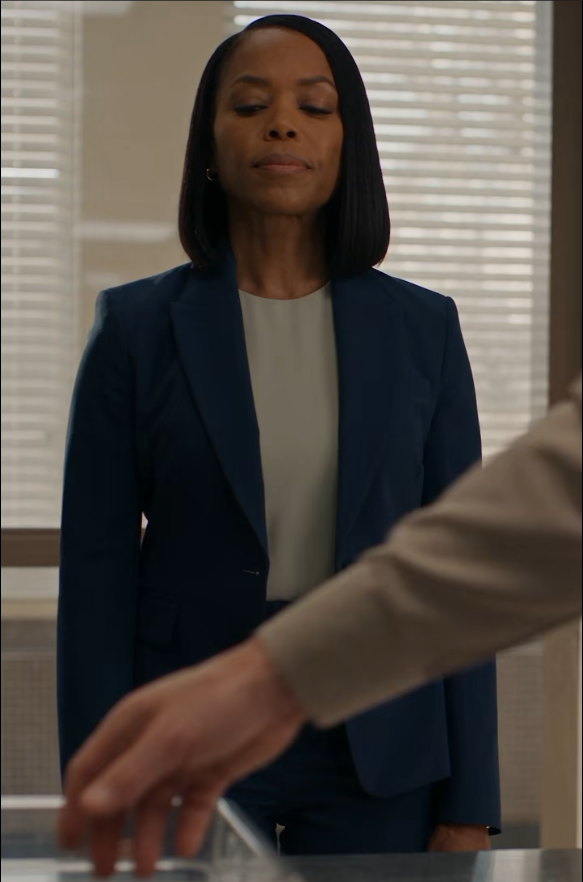
Sarah remained inside the cell.
She did not smile.
That disturbed Boyd Cleary more than anything else that had happened.
Because the woman he had handcuffed on the highway had warned him twice.
And now she looked less like someone waiting to be rescued than someone waiting to see whether he was capable of making one intelligent decision before the consequences arrived.
Part II — Pressure
The helicopters did not land in the parking lot.
That was the first sign the people aboard understood restraint better than Boyd expected.
They settled in an open county maintenance field beyond the courthouse, far enough from the department to avoid damage, close enough that the rotor wash sent dust skittering across every parked vehicle.
Men and women in military uniforms emerged.
No weapons raised.
No dramatic rush toward the building.
A small security element established a perimeter around the aircraft while three officers crossed the lot on foot.
At the center walked a tall man in an Army service uniform.
Four stars were visible on his shoulders.
Miller saw them first.
“Sheriff.”
“I know.”
“No,” Miller said quietly. “I don’t think you do.”
Cleary turned on him.
“Watch your mouth.”
Miller looked toward the holding cell.
Sarah stood with one hand resting loosely against the bars.
She had the stillness of someone refusing to add energy to a dangerous room.
The front door opened.
The four-star general entered with two officers behind him.
He removed his cap.
The room seemed suddenly too small.
Cleary moved behind the counter.
“You General Reed?”
The general looked at him.
“Thomas Reed.”
His voice was controlled.
No introduction beyond that.
His eyes shifted past Cleary.
He saw Sarah.
The general’s expression remained professionally neutral, but his shoulders eased by a fraction.
“General Hayes.”
Sarah stepped closer to the bars.
“General.”
Cleary looked between them.
Reed crossed the booking room.
He stopped outside the holding cell.
“You injured?”
“No.”
“Medical evaluation?”
“Not required.”
“Device status?”
“Confiscated at approximately fifteen-seventeen. Unauthorized biometric contact observed at approximately fifteen-forty-eight.”
Reed’s gaze moved toward the evidence tray.
“Anyone attempt to open it?”
“Not that I observed.”
Cleary cleared his throat.
“Okay. Hold on.”
Reed turned.
“This is still my facility.”
“Yes,” Reed said.
“I don’t care how many stars you’ve got. She was lawfully arrested.”
Reed studied him.
Sarah spoke before he could answer.
“General Reed.”
Reed looked back.
“Do not intervene in the local charging decision.”
Cleary blinked.
Miller did too.
Sarah continued.
“I want the evidence preserved. Vehicle telemetry, cruiser camera, body camera if present, dispatch traffic, booking video, property log, radio communications, and device chain of custody.”
Reed understood immediately.
“You intend to remain?”
“If Sheriff Cleary believes he has probable cause, he should state it and document it.”
Cleary recovered some of his confidence.
“There you go. She understands.”
Reed ignored him.
“Sarah.”
It was the first time he used her first name.
A warning between colleagues.
Sarah met his eyes.
“Tom, if you remove me because of my rank, what happens to the next person he stops who doesn’t have helicopters?”
The room went quiet.
Cleary’s face hardened.
“This is becoming a federal intimidation circus.”
Sarah turned toward him.
“No, Sheriff. That is precisely what I am preventing.”
She looked back at Reed.
“I will accept release according to the same lawful procedure available to any other detainee. Nothing more.”
Reed’s jaw shifted.
He did not like it.
But he nodded.
“Understood.”
Cleary spread his hands.
“Well, then maybe everybody can get off my property.”
Reed walked to the evidence tray.
He did not touch the device.
Instead, he looked at Miller.
“You logged this?”
“Yes, sir. Three-seventeen.”
“Anyone besides the sheriff handle it?”
“No, sir.”
“Did you?”
“No.”
Reed nodded.
“Thank you.”
Cleary stepped between them.
“You don’t question my deputy.”
“I asked him a question.”
“This is my investigation.”
Reed looked directly at him.
“No, Sheriff. You initiated a local investigation when you arrested General Hayes. You potentially initiated a federal security investigation when you took possession of that device.”
Cleary’s eyes flicked toward the black rectangle.
“What’s on it?”
“Nothing you can access.”
“Then what’s the big emergency?”
Reed’s face remained still.
“The emergency is not what you might read. It is what hostile intelligence services could learn from proving where the device was, when it was separated from its authorized custodian, and what network protocols responded afterward.”
Cleary opened his mouth.
Reed cut him off without raising his voice.
“Which is why no one is going to play games with it.”
Sarah watched him.
Thomas Reed had spent thirty-six years learning how to dominate rooms without theatrics.
Boyd had spent nearly twenty believing theatrics were domination.
The difference was visible now.
Miller reached for the property tray.
“I can secure it in evidence.”
Sarah immediately said, “Do not move it.”
Miller froze.
Reed nodded.
“Leave it where it is until the technical team arrives.”
Cleary looked at Sarah.
“You sure give a lot of orders for somebody in my jail.”
Sarah’s eyes stayed on him.
“You mistook professionalism for weakness once already. I suggest you avoid repeating yourself.”
For the first time, Cleary had no answer ready.
The courthouse magistrate handled Sarah’s release remotely at 5:26 p.m.
No special order.
No Pentagon demand.
No military extraction.
The prosecutor on call reviewed Cleary’s preliminary paperwork and declined to request continued detention pending arraignment.
Sarah signed a promise to appear.
Miller brought her belongings to the counter except for the secure device, which remained isolated.
Cleary stood in his office doorway.
“The charges stand.”
Sarah inspected her wallet.
“I understand.”
“Resisting arrest. Disorderly conduct. Failure to comply.”
“I heard them the first time.”
“You think your people can make this go away?”
Sarah slipped her wallet into her purse.
“My people?”
“The Pentagon. Army. Whoever.”
“No.”
That answer surprised him.
Sarah looked at him.
“I think evidence will determine whether it goes away.”
Cleary’s mouth tightened.
“You were hostile on that road.”
“Then your recording should show it.”
“You challenged everything I said.”
“That is not a crime.”
“You refused to respect my authority.”
Sarah paused.
There were dozens of responses available to her.
She selected the simplest.
“Authority that depends on humiliation is not authority.”
Miller stared at the counter.
Cleary stepped forward.
Reed moved once.
Just one step.
Sarah held up a hand without looking at him.
He stopped.
Cleary noticed.
So did Miller.
A four-star general had stopped because Sarah Hayes lifted one hand.
That seemed to land harder than the helicopters.
Sarah picked up her rental keys.
“Where is my vehicle?”
“Impound,” Cleary said.
“Why?”
“Incident inventory.”
“Was a warrant obtained?”
“It was lawfully impounded.”
“Was it searched?”
Cleary did not answer.
Sarah looked at Miller.
The deputy swallowed.
“The tow company brought it to the county lot. I don’t know if it was searched.”
Cleary glared at him.
Sarah nodded.
“Thank you.”
Then she walked out of the sheriff’s department without another word.
Reed followed.
Outside, sunset light had softened the courthouse bricks.
The helicopters remained in the field.
News had already begun to spread.