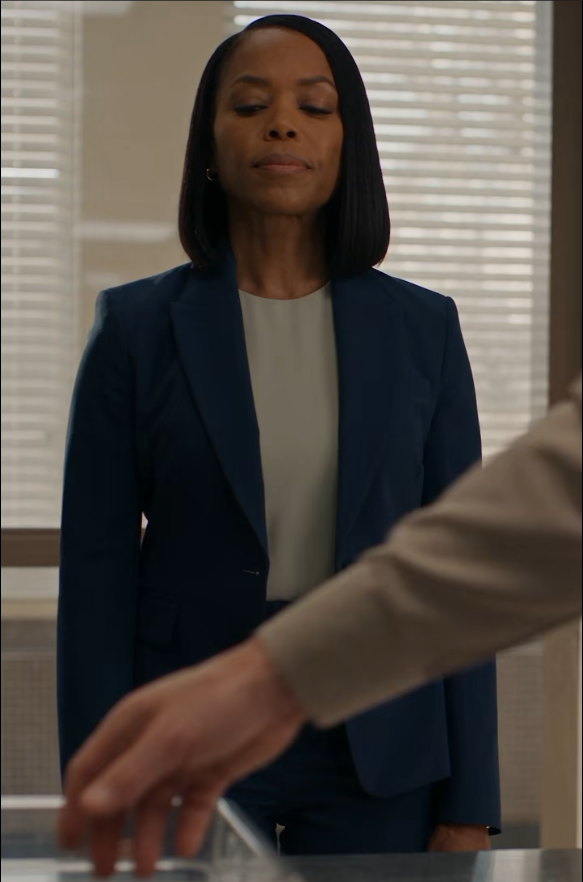
People stood beyond the municipal lot holding phones.
Sarah stopped.
Reed came beside her.
“You missed your flight.”
“I noticed.”
“You could have identified yourself.”
“I did eventually.”
“You know what I mean.”
Sarah looked across the lot toward the sheriff’s cruiser.
The hood still carried a film of dust from the helicopters.
“Yes.”
“Why didn’t you?”
“Because he should not need to know I’m a general in order to behave lawfully.”
Reed was silent.
Sarah rubbed the red mark around her wrist.
“He wasn’t confused, Tom.”
“No.”
“He was comfortable.”
Reed looked at her.
“That’s what worries you.”
“That should worry everybody.”
One of Reed’s aides approached but remained several feet away.
“Sir. General. Technical team confirms the device entered secure lockdown. No data breach detected.”
Sarah nodded.
“Network exposure?”
“Minimal. Separation alert only.”
“Good.”
The aide continued.
“There’s another issue.”
Sarah waited.
“The county evidence-room workstation made a physical connection request to the device.”
Her gaze sharpened.
“When?”
“Sixteen-oh-two.”
Reed turned toward the building.
Sarah did not.
“Could it authenticate?”
“No, General.”
“Was data transferred?”
“No.”
“Then preserve the logs.”
Reed stared at her.
“You told Cleary not to connect it.”
“Yes.”
“He did it anyway.”
“We don’t know that.”
“You think Miller did?”
“No.”
“Then who?”
Sarah looked through the sheriff’s department window.
Boyd Cleary stood inside watching them.
“I said we don’t know.”
Reed followed her gaze.
“What now?”
Sarah’s answer came after a moment.
“Now we stop assuming the worst thing he did happened on the highway.”
Part III — Reversal
Sarah did not leave Oak Haven that night.
She could have.
A military aircraft could have moved her within the hour.
Reed offered twice.
She declined twice.
Instead, she took a room at the only hotel near the interstate that still had vacancies.
Her security detail occupied rooms nearby despite her objections.
At 7:10 the next morning, she sat at a laminate table beside the hotel window with black coffee, scrambled eggs she had barely touched, and the preliminary incident packet Reed’s staff had assembled.
She read Boyd Cleary’s report first.
It said she had been driving “erratically.”
It said her vehicle crossed the center line twice.
It said she became “confrontational” when asked for identification.
It said she “refused repeated lawful instructions to exit.”
It said Cleary feared the encounter might escalate because she “assumed an aggressive posture.”
Sarah read that sentence twice.
Then she turned the page.
It said she pulled her arm away while Cleary attempted to detain her.
She touched the bruise forming near her wrist.
Across from her, Reed lowered his coffee.
“What?”
She pushed the report toward him.
He read the paragraph.
His eyes hardened.
“You never pulled away.”
“No.”
“He’s describing a different stop.”
“Or the stop he expected the camera to support.”
Reed looked toward the next document.
“No cruiser video file.”
Sarah stopped.
“What?”
“According to the county system inventory, Cleary’s dash camera was marked malfunctioning.”
“When?”
“Yesterday.”
She looked at him.
“Before or after the stop?”
“That’s the question.”
Her body camera question on the highway returned.
That pause.
Sarah leaned back.
“County retention logs.”
“We’re requesting them.”
“Not through military channels.”
“Federal investigators are already involved because of the communications device.”
“Device issue only.”
“Sarah.”
“Tom.”
He gave her a tired look.
“You nearly got arrested again in the lobby ten minutes ago arguing jurisdiction with my legal team.”
“They were overreaching.”
“They were trying to help.”
“So was Boyd when he told me to put my hands on the car.”
Reed almost smiled.
Almost.
Then his expression became serious again.
“This is bigger now.”
Sarah closed the incident report.
“It may be.”
“You understand the department workstation attempted to connect to a classified communications device after explicit warning.”
“I understand that.”
“And the sheriff wrote a report that conflicts with your account.”
“Yes.”
“You sound remarkably calm.”
“I am deciding which problem belongs to whom.”
Reed folded his arms.
“And?”
“The device issue belongs to federal security investigators. The false-arrest question belongs to the courts and appropriate civil authorities. The traffic stop belongs to evidence.”
“You forgot Cleary.”
“No.”
Sarah looked through the window toward the highway.
“I’m trying not to make him the center of this.”
Deputy Toby Miller arrived at the hotel at 8:03.
He came alone and out of uniform.
Sarah’s security detail stopped him in the lobby.
He asked to speak to her.
Reed objected immediately.
Sarah overruled him.
Miller sat across from them at the same breakfast table.
He looked as though he had not slept.
“General Hayes.”
“Sarah is fine while you’re off duty.”
He shook his head.
“Probably safer if I don’t.”
Reed watched him closely.
Miller set a flash drive on the table.
Sarah did not touch it.
“What is that?”
“The booking-room camera.”
Reed’s posture changed.
Miller continued.
“Copy from the internal archive.”
“Why do you have it?”
“Because Sheriff Cleary told me at six-thirty this morning to delete yesterday’s footage.”
Sarah stared at him.
Reed spoke first.
“Did you?”
“No.”
“Did you tell anyone?”
“No.”
“Why come here?”
Miller looked at Sarah.
“Because you told General Reed I didn’t interfere with you.”
Sarah said nothing.
Miller rubbed a hand over his face.
“I’ve worked there seven years. Yesterday wasn’t the first bad stop I’ve seen.”
Reed leaned forward.
“Be careful.”
Miller nodded.
“I know.”
Sarah’s voice remained quiet.
“Do not tell me anything you are not prepared to put in a sworn statement.”
He looked at her.
“That’s why I’m here.”
Sarah glanced at the flash drive.
“Who copied it?”
“I did.”
“When?”
“Seven-fifteen.”
“Did you alter the original?”
“No.”
“Do you know whether anyone else accessed it?”
“Sheriff tried. The archive administrator login stopped working overnight.”
Reed frowned.
“Why?”
Miller gave a strained laugh.
“Because apparently when military helicopters land behind your courthouse, the state information office starts paying attention.”
Sarah ignored the joke.
“Yesterday at sixteen-oh-two, was the secure communications device connected to your evidence workstation?”
Miller’s eyes dropped.
“Yes.”
“By whom?”
“The sheriff.”
Reed leaned back.
Sarah stayed still.
“What happened?”
“He found a cable in the evidence kit that fit the recessed port.”
“He plugged it in?”
“Yes.”
“Why?”
“He said he wanted to see if it was really government property.”
“What did the computer display?”
“Nothing at first. Then the monitor went black for maybe two seconds. A warning came up. Federal property. Unauthorized access. Something like that.”
“And then?”
“He unplugged it.”
“Did he photograph the screen?”
“No.”
“Did he attempt again?”
“No.”
“Did anyone else touch the device afterward?”
“Not before the technical team arrived.”
Sarah nodded.
“What about his body camera?”
Miller’s silence answered before he did.
Reed looked at him.
“Deputy?”
Miller took a breath.
“He wore it.”
Sarah’s fingers tightened once around her coffee cup.
“Was it recording?”
“I saw the status light when he brought you in.”
“Where is the file?”
“He docked the camera before filling out the report.”
“Automatic upload?”
“Yes.”
“Does Cleary have deletion privileges?”
“Not supposed to.”