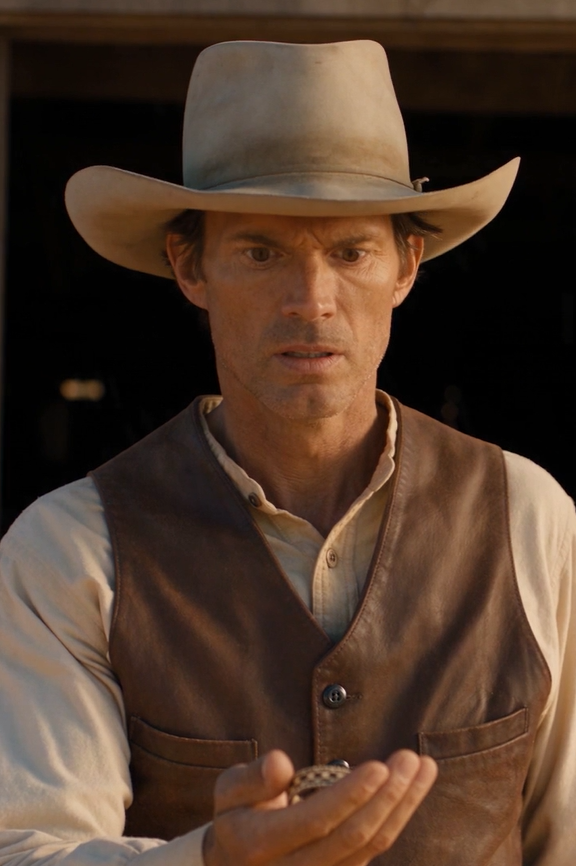
Solomon was sixty-two and looked carved rather than born.
White beard.
Black coat.
No badge.
He did not need one.
Power had served him better.
“Give me the papers,” Solomon called.
Eli stepped into view.
“Come get them.”
Solomon smiled.
“You always were stubborn.”
“You tried to kill my boy.”
“You don’t have a boy.”
The words struck too quickly.
Solomon realized his mistake.
Eli smiled.
“Yes, I do.”
For the first time, fear entered Solomon Rusk’s face.
Only for a second.
But Eli saw it.
“You don’t know what you’re talking about.”
“I know Daniel lived.”
Solomon’s hand drifted toward his revolver.
Eli raised Rebecca’s letter.
“And I know federal marshals are coming.”
That got the reaction he wanted.
Solomon turned toward one of his men.
Tiny movement.
Enough.
Eli understood.
Solomon did not intend to hold the ranch until sunset.
He intended to destroy evidence and flee.
Eli shouted.
“DOWN!”
The gunfight erupted.
Sunset turned the Arizona sky red enough to resemble another fire.
By then, Eli had five bullets left.
Tazha had three.
Mesa had none.
Six women were wounded.
Harlan Rusk lay unconscious.
The well stones were chipped by bullets.
The barn roof burned at one corner.
Solomon still had nine men.
Then the western ridge moved.
At first Eli thought it was heat shimmer.
Then shapes appeared.
Riders.
Dozens.
Women first.
Then older men.
Then young men.
Then wagons.
The surviving people of Black Mesa.
They came across the ridge in silence.
Not charging.
Not shouting.
Just arriving.
Solomon’s men saw them.
One dropped his rifle.
Another mounted and fled.
Then a third.
Solomon turned in the saddle.
“Stand your ground!”
Nobody listened.
Power is impressive until the first person discovers it can be disobeyed.
Within thirty seconds, half his men were running.
Solomon drew his revolver and shot one of them in the back.
The desert became silent.
Even his remaining men stared.
That was the moment he lost.
Tazha stepped into the open.
Behind her, twenty-four women formed a line.
The same line Eli had seen at dawn.
But now he understood what it meant.
Not threat.
Witness.
Each woman had survived something Solomon wanted erased.
Burned homes.
Poisoned springs.
Missing husbands.
Dead brothers.
Stolen land.
Twenty-five women.
Twenty-five stories.
Twenty-five people he could not silence at once.
Solomon aimed at Tazha.
Eli raised his rifle.
“Don’t.”
Solomon laughed.
“You’ll shoot me?”
“Yes.”
“You?”
“Yes.”
“The man who spent three years hiding in a barn because he was too scared to live?”
Eli felt the insult land.
Then fall away.
“I wasn’t scared to live.”
He looked toward Rebecca’s house.
“I was scared living meant leaving them behind.”
Solomon sneered.
“They’re dead.”
Eli looked back.
“Not all of them.”
Solomon fired.
Eli fired.
One shot.
Solomon’s revolver spun from his hand.
He screamed and grabbed his wrist.
Before he could recover, riders surrounded him.
Black Mesa men.
Women.
Families.
No one killed him.
Tazha walked forward.
“You stand trial.”
Solomon spat at her feet.
“Trial? You think anyone cares what you say?”
A voice answered from behind the ridge.
“I do.”
Three mounted men appeared.
Then six.
Federal badges.
Deputy Marshal Nathan Bell rode down toward the ranch, dust coating his coat.
He surveyed burned fence, wounded people, Solomon Rusk clutching his hand.
“Hell of a welcoming committee.”
Eli laughed.
He could not help it.
The sound became painful.
Then emotional.
Then almost hysterical.
Tazha touched his shoulder.
Marshal Bell dismounted.
“Eli Caldwell?”
“Yes.”
“I have a federal warrant for Solomon Rusk and Harlan Rusk concerning fraud, conspiracy, illegal seizure of territorial water rights, destruction of federal survey records, and suspected murder.”
Eli looked toward Harlan.
“He confessed.”
“Good.”
“Maybe.”
Bell lowered his voice.
“There’s someone with us who asked to see you before anything else.”
Eli stopped.
The desert became very quiet.
Behind the marshal’s riders, a small wagon had reached the ridge.
An older Apache woman held the reins.
Beside her sat a boy.
Seven years old.
Brown curls.
Thin shoulders.
One front tooth missing.
Eli could not breathe.
The wooden horse rested in the boy’s lap.
Nobody had to tell him.
Blood knew before the mind did.
The boy climbed slowly down.
He stared at Eli.
Eli’s rifle fell from his hand.
“Daniel?”
The boy did not move.
Three years is a lifetime when you are seven.
Eli suddenly understood something terrible.
He remembered Daniel.
But Daniel barely remembered him.
Eli walked forward.
Stopped.
He was afraid to come closer.
The boy looked at Tazha.
She nodded.
Daniel looked back at Eli.
“My mother said you whistle badly.”
Eli’s face collapsed.
Rebecca.
She had told him that.
She always complained he could not hold a tune.
A laugh tore through his tears.
“She was right.”
Daniel took one step.
Then another.
“Are you my father?”
Eli dropped to his knees.
“Yes.”
The boy stood five feet away.
Eli held out his hands.
But he did not touch him.
“I’m your father.”
Daniel stared.
Then looked at the scar on Eli’s chin.
His small face changed.
“I remember that.”
Eli cried harder.
“You fell from the horse.”
“I did.”
“Mother laughed.”
“She did.”
Daniel ran.
Eli caught him.
Three years vanished and did not vanish.
Nothing could restore what had been taken.
But the boy’s arms locked around his neck.
Real.
Warm.
Alive.
Eli Caldwell had buried an empty coffin, but he had not buried his son.
For the first time in three years, hope did not feel dangerous.
It felt like breathing.
Solomon Rusk survived to face trial.
Harlan survived too.
That surprised everyone, especially Harlan.
He spent six weeks in a federal hospital and the following years testifying against his brother and half a dozen territorial officials.
His confession did not absolve him.
Eli never pretended it did.
Some wrongs cannot be made clean simply because a guilty man finally tells the truth.
Solomon was convicted of fraud, conspiracy, arson, murder, and attempted murder.
The newspapers called it the Dry Hollow Water Scandal.
They printed Rebecca Caldwell’s name.
They printed Jonah’s.
They printed names from Black Mesa that Solomon had expected history to forget.
The original survey was upheld.
Eli’s ranch retained the well.
More importantly, the northern easement guaranteed access to the connected springs for the communities that had depended on them before Solomon began fencing water away.
Eli signed additional agreements nobody required him to sign.
When Marshal Bell asked why, Eli said, “Because a man shouldn’t own thirst.”
Bell printed that line in his official report.
Eli hated him for it.
Tazha laughed for almost ten minutes.
The twenty-five women stayed at the ranch through autumn.
Not because Eli asked.
Because rebuilding Black Mesa took time.
The barn became crowded.
Then the house did.
Then Eli built another bunkhouse.
Children appeared.
So did dogs.
So did arguments.
For a man who had once considered one month of silence peaceful, Eli discovered human beings were astonishingly loud.
Daniel was loudest.
At first the boy called him Eli.
That hurt.
Eli never corrected him.