Some nights Daniel slept in the house.
Some nights he slept near Sees-the-Rain, the older woman who had raised him during the missing years.
Eli learned not to compete with love.
A child’s heart did not have to empty one home to make room for another.
Winter came.
Daniel began following Eli to the fence lines.
He asked six thousand questions per day.
“Why do cows stare?”
“No idea.”
“Why do horses sleep standing?”
“Because lying down makes them nervous.”
“Why do you whistle bad?”
“Your mother cursed me.”
Daniel considered that.
“Can curses do that?”
“Powerful ones.”
The boy laughed.
And sometimes, when he laughed, Rebecca returned for half a second.
Not as a ghost.
As movement.
Expression.
Light.
Those moments stopped breaking Eli eventually.
They began healing him instead.
One December evening, Tazha found Eli beside the well.
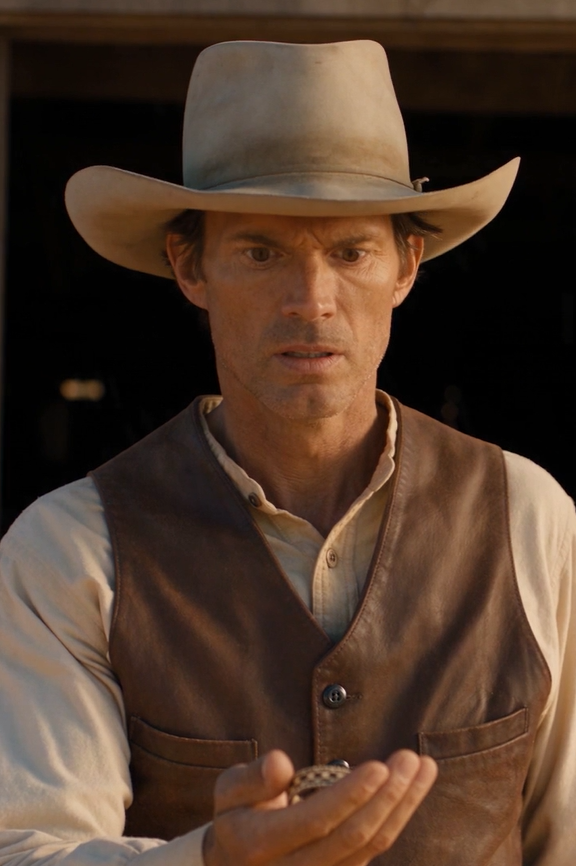
He was turning the old bracelet in his hands.
Four blue beads.
One white.
Four blue.
One white.
“You never told me what pattern means,” he said.
Tazha leaned against the stones.
“My sister made it.”
“Nessa?”
“Yes.”
“The woman who saved Daniel.”
Tazha nodded.
Eli stared at the bracelet.
“So what does it mean?”
She smiled.
“Rebecca chose colors.”
“Of course she did.”
“Blue for water.”
“And white?”
Tazha looked toward the house.
Daniel’s laughter drifted through the doorway.
“Life returned.”
Eli swallowed.
He studied the pattern.
Four blue.
One white.
Then repeated.
Water.
Life.
Water.
Life.
He smiled.
“That sounds like Rebecca.”
Tazha’s expression became strangely serious.
“What?”
“There is something else.”
Eli sighed.
“No.”
She frowned.
“No?”
“I have had enough secrets from dead people.”
“This one is not from dead person.”
He looked at her.
“What does that mean?”
Tazha reached beneath her shawl.
For one terrible second, Eli thought she had another letter.
Instead she removed a photograph.
Old.
Faded.
He took it.
His father stood beside an Apache woman.
John Caldwell.
Young.
Perhaps twenty-five.
Beside him stood Sees-the-Rain.
And between them—
a boy of about eight.
Jonah.
Eli’s brother.
He stared at the face.
The resemblance was unmistakable.
Same eyes.
Same jaw.
Same crooked left eyebrow.
“I wish I’d met him.”
Tazha looked away.
“You did.”
Eli frowned.
“What?”
“Once.”
His heart slowed.
“When?”
“Six years ago.”
“I would remember.”
“You called him Samuel.”
The world shifted.
Eli stared.
Samuel.
A drifting ranch hand had worked for Eli one winter.
Quiet man.
Dark hair.
Scar beneath the left ear.
Stayed four months.
Fixed the barn roof.
Helped Daniel learn to ride.
Vanished in spring without collecting his final week’s pay.
Eli had been angry.
Rebecca had not seemed surprised.
“No.”
Tazha nodded.
“He wanted to know you before telling you.”
Eli remembered Samuel sitting on the porch.
Watching Daniel chase chickens.
Asking strange questions.
You ever wonder what your father was like before you knew him?
Eli had laughed.
Old.
Samuel had laughed too.
Eli sat on the well stones.
“He was my brother.”
“Yes.”
“And Rebecca knew.”
“Yes.”
“Did everybody know except me?”
Tazha smiled faintly.
“Almost.”
Eli covered his face.
He should have been angry.
Instead he began laughing.
Life had become too absurd for anything else.
After a moment, Tazha sat beside him.
“He liked you.”
Eli’s laughter stopped.
“What?”
“Jonah.”
Her voice softened.
“He told my mother you were stubborn. Bad cook. Too proud.”
“Accurate.”
“He said you loved your family.”
Eli looked toward the house.
“He should have told me.”
“He was afraid.”
“I could have had a brother.”
“Yes.”
Grief returned.
Different shape.
Same weight.
Then Tazha said something Eli never forgot.
“You had brother.”
Eli looked at her.
“You just did not know the years while they happened.”
The sentence settled inside him.
He thought of Rebecca.
Daniel.
Jonah.
The twenty-five women.
All the invisible threads crossing his life while he believed himself isolated.
Maybe loneliness was not always the absence of people.
Sometimes it was the absence of truth.
Spring turned the desert briefly green.
Wildflowers appeared along the wash.
The burned fence was replaced.
Black Mesa rebuilt two springs.
Dry Hollow elected a new sheriff.
Harlan Rusk, after serving his sentence for obstruction and falsifying records, left Arizona.
Eli never saw him again.
One April morning, Daniel found Eli repairing the well rope.
“Eli?”
Eli looked down.
The boy still used his name most days.
“Yeah?”
“Sees-the-Rain says I can stay here permanent if I want.”
Eli’s hands stopped.
“Oh.”
“She says both places can be home.”
Eli nodded carefully.
“That sounds right.”
Daniel kicked dust.
“If I stay…”
“Yes?”
“Can I call you Pa?”
Eli looked away toward the mountains because suddenly the sunrise was much too bright.
“You can call me whatever you want.”
Daniel considered.
“Pa.”
Eli closed his eyes.
There were moments in a man’s life too large to answer correctly.
So he climbed down from the well.
Daniel hugged him.
And Eli hugged him back.
The boy smelled like dust, horsehair, and breakfast.
Exactly like home.
Later that afternoon, Tazha rode in from Black Mesa carrying mail.
“One letter,” she said.
Eli groaned.
“No dead people?”
“Government.”
“Worse.”
She tossed it.
Federal Land Office.
Eli opened the envelope.
Read.
Stopped.
Read again.
Tazha watched.
“What?”
Eli handed it to her.
She read more slowly.
Then smiled.
The federal hydrological survey confirmed what Rebecca had suspected.
The underground aquifer beneath the Caldwell ranch did feed Black Mesa and six other spring systems.
But that was not the surprise.
The surveyors estimated the deep reservoir was enormous.
Far larger than Solomon Rusk had known.
Enough water, properly managed, to sustain ranches and communities across the region for generations.
Eli sat on the porch.
All of this.
The murders.
The fires.
The fraud.
For something that had never needed to be hoarded.
There had been enough.
That was the cruelest part.
Solomon had destroyed lives because he believed survival required ownership.
He had never understood abundance.
Tazha sat beside Eli.
“You rich now?”
“Apparently.”
“What you do?”
Eli looked toward Daniel racing a horse along the fence.
Then toward Black Mesa beyond the hills.
Then at the old stone well where three thirsty women had changed his life.
He smiled.
“Give it away.”
Tazha blinked.
“Water?”
“Rights.”
“All?”
“Enough.”
“You are foolish.”
“I’ve been told.”
The following month, Eli placed the majority of the aquifer rights into a community water trust shared among neighboring ranches, Black Mesa families, and Dry Hollow.
No single person could sell it.
No company could own it outright.
No sheriff could quietly transfer it.
The agreement began with a sentence Rebecca had written years before in the margin of the original survey.
Water survives by moving. People should learn from it.
Eli carved those words into a plank above the well.
Not because Rebecca was perfect.
She had kept secrets that hurt him deeply.
She had made decisions for him he wished she had trusted him to make.
He loved her anyway.
Maybe love did not require turning the dead into saints.
Maybe it meant allowing them to remain human.
Brave.
Afraid.
Wrong.
Right.
Impossible.
Loved.
Twenty years later, travelers still stopped at Caldwell Well.
The ranch had grown.