He Gave Water to a Dying Stranger. By Sunrise, Three Hundred Apache Warriors Had Surrounded His Ranch.
I. THE WOMAN BESIDE THE FENCE
Corvin Torne had spent nineteen years believing that the worst day of his life was behind him.
Then, on an afternoon hot enough to make the Arizona sky look like molten glass, he found a dying woman beside his fence.
And by the following morning, nearly three hundred Apache warriors had surrounded his ranch.
The heat had been building since before sunrise.
By noon, the valley had lost almost every sound. Lizards vanished beneath stones. Cattle stood in scraps of shade with their heads hanging low. Dust drifted lazily across brittle grass, collecting against fence posts and the warped boards of Corvin’s barn.
At thirty-nine, Corvin had learned to respect Arizona heat in the same way a sailor respected deep water.
You did not defeat it.
You survived it by never pretending it could not kill you.
That afternoon he had already hauled six buckets from his well to the corral and was returning for a seventh when he noticed something dark beside the western fence.
At first he thought a blanket had blown loose.
Then the shape moved.
Corvin stopped.
A young woman was collapsed beneath the rails.
His hand instinctively shifted toward the revolver on his hip.
He studied the hills.
Nothing moved among the red rocks.
No horses.
No riders.
No smoke.
Only endless shimmering distance.
Corvin set down his bucket and walked closer.
The woman was Apache.
That much was immediately clear from her clothing, her moccasins, and the faded beads around her neck.
But something else made him pause.
She was extraordinarily tall.
Even slumped against the fence, her body looked powerful. Long dark hair hung across her face, tangled with dust. Her deerskin clothing was stained nearly black with sweat.
There was blood on her left shoulder.
Her lips were cracked almost white.
Corvin crouched several yards away.
“Can you hear me?”
No response.
He went to the well.
The stone circle surrounding it had been built before he owned the ranch and perhaps before his father had owned it. The spring beneath never failed, even during years when smaller creeks vanished completely.
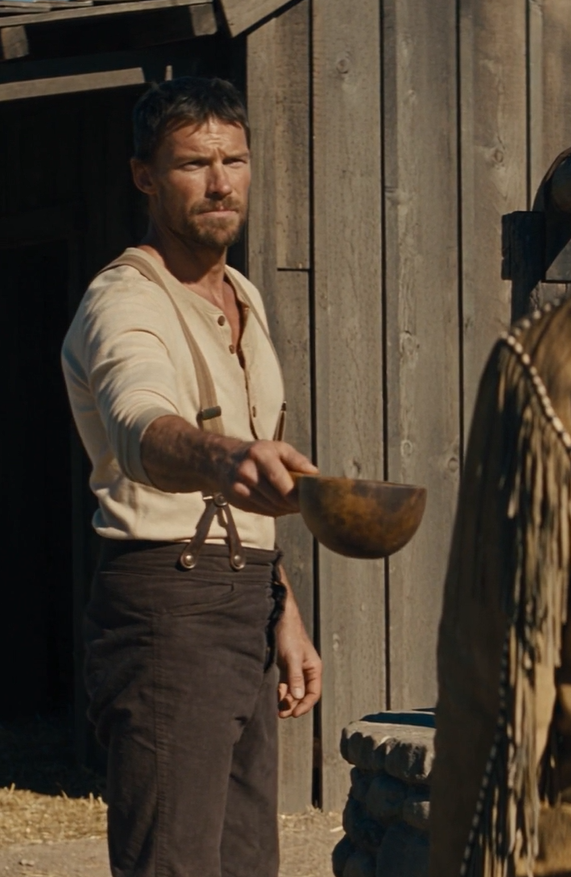
Corvin dipped a metal ladle into the bucket and returned.
The woman’s eyes opened before he reached her.
He stopped.
They were not the frightened eyes of someone helpless.
They were sharp.
Focused.
Measuring him.
Corvin raised the ladle.
“Water.”
She looked at it.
Then at him.
“I’m not coming closer unless you want me to.”
Her hand moved.
Slowly.
Corvin extended the ladle.
She accepted it.
The first swallow seemed painful.
The second easier.
By the third, some color had returned to her expression.
“More?”
She nodded.
He filled the ladle again.
This time she drank steadily.
Corvin noticed a wound near her shoulder.
A bullet had grazed her.
“You’ve been shot.”
Her eyes shifted toward him.
“Someone chasing you?”
Silence.
“Good conversation.”
Something almost like amusement appeared in her eyes.
Corvin soaked a strip of cloth.
“I can clean that.”
She stiffened.
“I’ll show you.”
He touched his own shoulder, demonstrating.
The woman watched him.
Then allowed him closer.
The bullet had torn through flesh without striking bone.
Lucky.
Discover more
Cowboy boots
Historical fiction books
Emergency water supplies
Corvin cleaned it.
She never cried out.
When he finished tying the cloth around her shoulder, she placed one hand against the fence and rose.
Corvin had to tilt his head upward.
“Good Lord.”
She stood taller than he did.
Corvin was six feet.
The woman had him by several inches.
Despite dehydration, blood loss, and exhaustion, there was something regal in the way she straightened.
Then she stared at him.
Not at his gun.
Not at the ranch.
Not at the well.
At his face.
For so long that Corvin became uncomfortable.
“What?”
Her gaze moved to his left hand.
A white scar crossed his palm.
Corvin closed his fingers.
“Old injury.”
The woman looked back at his face.
“Do I know you?”
Nothing.
Corvin sighed.
“You ought to rest.”
Discover more
Native American history
Outdoor adventure gear
Hunting & Shooting
She turned toward the northern hills.
“That’s thirty miles of bad country.”
She stepped away from the fence.
“Wait.”
The woman stopped.
Corvin held up his canteen.
“At least take this.”
She considered.
Then accepted.
Their fingers touched.
Something changed in her expression.
Not gratitude.
Recognition.
Corvin felt a strange chill despite the heat.
“What is it?”
She said nothing.
Then she walked north.
Corvin watched her until the shimmering air swallowed her shape.
“That’s that,” he muttered.
He picked up his bucket.
He had never been more wrong.
Corvin’s ranch sat between two stone ridges and a dry creek bed nearly two days from the nearest settlement.
Isolation had been the reason he stayed.
He had inherited the property from Abram Torne, the only father he had ever known.
Discover more
Ranch management tools
People & Society
Farms & Ranches
Abram had been a hard man with rough hands, a surprisingly gentle voice, and an almost religious devotion to keeping records.
Every evening, Abram had written in a ranch ledger.
Rainfall.
Broken fences.
Cattle births.
Visitors.
Strangers.
Even arguments.
After Abram died nine years earlier, Corvin continued the habit.
At exactly 7:42 that evening, he opened the ledger beneath the yellow glow of an oil lamp.
He wrote:
Apache woman at west fence. Injured shoulder. Severe thirst. Gave water. Left north.
Corvin paused.
The pen hovered.
He added:
Looked familiar.
Then immediately scratched the words out.
Ridiculous.
He had never seen her.
Had he?
Corvin closed the ledger.
Outside, darkness covered the valley.
He ate beans and stale bread.
Checked the corral.
Fed his horses.
Discover more
Horses
fence
Rural property listings
Then went to bed.
At midnight, one mare screamed.
Corvin woke instantly.
He reached for the rifle hanging above his bed.
The horses were moving wildly outside.
He crossed to the window.
Moonlight covered the yard.
Nothing.
Then he saw something on the northern ridge.
A mounted silhouette.
Corvin narrowed his eyes.
Another appeared beside it.
He blinked.
Gone.
“Coyotes spooked them,” he told himself.
He returned to bed.
Sleep came slowly.
And when it did, Corvin dreamed about fire.
A canyon.
Gunshots.
A child screaming.
And a voice he had spent nineteen years trying to forget.
Leave no witnesses.
II. THE RIDGES AT DAWN
Corvin woke before sunrise.
The dream clung to him.
It usually did.
He dressed, pulled on his boots, fastened his gun belt, and stepped outside.
He froze before reaching the porch steps.
A rider stood along the northern ridge.
Corvin stared.
Then another rider appeared.
Then another.
Ten.
Twenty.
Fifty.
His stomach tightened.
More mounted figures lined the eastern slope.
Still more appeared beyond the dry creek bed.
Apache warriors.
Armed.
Watching.
Corvin stepped backward until his shoulder touched the doorframe.
His rifle was inside.
His hand drifted toward it.
Then stopped.
More riders appeared.
One hundred.
One hundred fifty.
Two hundred.
Some carried rifles.
Others held long spears that cut dark lines against the pale dawn sky.
Corvin stopped counting after two hundred fifty.
There were probably close to three hundred.
His horses pressed themselves against the far side of the corral.