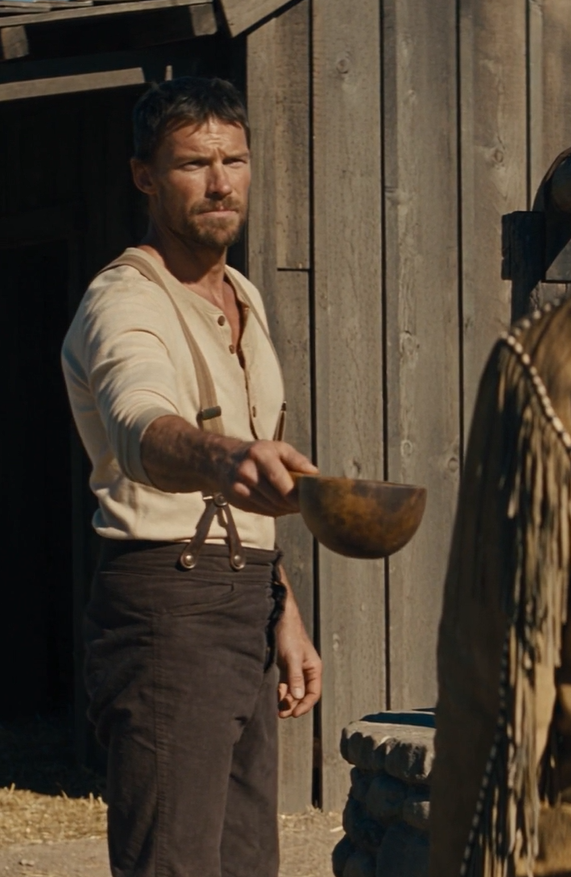
Their eyes rolled white.
Corvin’s pulse hammered.
One rifle.
One revolver.
Three hundred warriors.
Reaching for a weapon would not have been courage. It would have been suicide.
He stepped into the open yard with both hands visible.
Nothing happened.
No war cry.
No charge.
No gunfire.
That frightened him more.
This was not a raid.
If they intended to kill him, they could already have done it.
They wanted him to see them.
A single rider separated from the northern ridge.
An older Apache man descended toward the ranch.
His hair was streaked with gray. Deep lines marked his face. He rode without hurry, carrying himself with unmistakable authority.
He stopped about fifty feet from Corvin.
Corvin swallowed.
“I’m not looking for a fight.”
The old warrior said nothing.
Then raised one hand.
Every horseman along the surrounding ridges remained motionless.
The silence became unbearable.
The elder lowered his arm.
Then pointed.
Corvin followed the gesture.
The well.
“The well?”
The warriors on the eastern slope began separating.
A path formed through the riders.
A horse appeared.
Its rider emerged slowly.
Corvin recognized her instantly.
The woman from yesterday.
Her shoulder was bandaged.
She sat tall in the saddle despite her injury.
As she passed between the warriors, something extraordinary happened.
Rifles lowered.
Spears dipped.
Heads bowed.
One after another.
Corvin felt a cold knot form beneath his ribs.
Whoever this woman was, she mattered.
A great deal.
She rode into the yard and stopped beside the well.
Her eyes found Corvin’s.
The old warrior spoke.
His English was careful but clear.
“You gave her water.”
Corvin looked at the woman.
“Yes.”
“Why?”
“Because she needed it.”
“You did not know her.”
“No.”
“You knew she was Apache.”
“Yes.”
The elder watched him closely.
“And if she had been your enemy?”
Corvin almost laughed.
“I didn’t ask whether she was my enemy.”
The old warrior’s eyes narrowed.
“Why not?”
“Because dying of thirst comes before politics.”
A faint sound came from the woman.
Corvin realized she had almost laughed.
The old warrior asked, “What is your name?”
“Corvin Torne.”
The woman spoke for the first time.
“I know.”
Corvin stared.
Her voice was lower than he expected and rough from dehydration.
“How?”
She looked toward his cabin.
“Your father wrote your name many times.”
Corvin’s body went still.
“My father has been dead nine years.”
“Yes.”
“What did you know about Abram?”
The woman dismounted.
Her knees nearly buckled.
Corvin instinctively caught her arm.
She recovered quickly.
“My name is Neya.”
Corvin released her.
“That doesn’t answer me.”
The old warrior dismounted.
“I am Dasoda.”
Corvin looked at him.
Dasoda said, “We need something your father hid.”
“I don’t know what you’re talking about.”
Neya walked toward the porch.
“Then your father hid it well.”
Corvin blocked her path.
“Three hundred men surround my ranch before breakfast, and now you want to search my home?”
Dasoda answered quietly.
“We came with three hundred because fewer might not keep you alive.”
Corvin stared.
“Alive from what?”
Neya looked toward the southern ridge.
“From the men coming to kill you.”
Corvin followed her gaze.
At first there was nothing.
Then he saw dust.
A faint brown plume rising beyond the horizon.
Riders.
“How many?”
“Forty,” Neya said. “Perhaps fifty.”
“Who?”
She looked directly into his eyes.
“Silas Vane.”
Corvin forgot about the warriors.
Forgot about the well.
Forgot about the rising sun.
That name alone dragged him nineteen years backward.
Smoke.
Blood.
A cavalry uniform.
A pistol pressed against a prisoner’s head.
And Captain Silas Vane saying:
“Nobody leaves Red Hollow alive.”
III. RED HOLLOW
Corvin entered the cabin without inviting anyone.
Neya followed.
So did Dasoda.
Corvin went directly to a cabinet and poured whiskey into a cup.
His hands were shaking.
Neya noticed.
“You know him.”
Corvin drank.
“I knew him.”
“Red Hollow?”
Corvin slowly set down the cup.
“How do you know about Red Hollow?”
Neya reached inside her deerskin clothing.
Corvin’s hand moved toward his revolver.
She stopped.
“Paper.”
He relaxed slightly.
Neya withdrew a folded sheet stained with blood.
She placed it on the table.
Corvin unfolded it.
The first line made the room tilt.
CAPTAIN VANE—CORVIN TORNE HAS BEEN FOUND. ABRAM’S RECORDS MAY STILL BE AT THE RANCH.
Corvin read the line twice.
Then looked at Neya.
“Where did you get this?”
“From one of the men who shot me.”
“You killed him?”
“No.”
Dasoda said, “Someone else did.”
Corvin waited.
Neya continued.
“A former army clerk named Elias Mercer had been collecting evidence against Vane.”
Corvin remembered Mercer.
A thin young soldier who carried paperwork for officers.
“He survived?”
“Until three days ago.”
Corvin lowered his eyes.
“What happened?”
“Vane found him.”
Neya continued.
“Mercer gave us documents before he died. He said Abram Torne possessed the only surviving firsthand record of what happened at Red Hollow.”
Corvin laughed bitterly.
“My father never talked about Red Hollow.”
“That does not mean he wrote nothing.”
“No.”
“It means you have not found it.”
Corvin stared at the floor.
Abram wrote everything.
Everything.
Rain.
Arguments.
Dead livestock.
Visitors.
Why not Red Hollow?
Because perhaps he had.
Just not in the ranch ledgers Corvin knew.
Dasoda moved toward the bookshelf.
“Mercer said Abram hid evidence beneath the house.”
Corvin frowned.
“He had never been here.”
“He saw letters.”
Corvin knelt.
The cabin floor was made from broad planks.
He began tapping.
Solid.
Solid.
Solid.
Then—
Hollow.
Corvin stopped.
Neya crouched beside him.
“That board.”
He took a pry bar.
The plank lifted.
Beneath it lay an iron box.
Corvin stared.
Eleven years living in that cabin.
Nine since Abram died.
He had never known.
The lock broke easily.
Inside were photographs.
Army documents.
A revolver.
Three letters.
And a black leather ledger.
Corvin opened it.
Abram’s handwriting.
The first entry read:
June 18, 1871. God forgive every man who rode into Red Hollow today.
Corvin sat heavily.
Neya stood across from him.
“Read.”
He did.
Red Hollow had been officially recorded as an armed confrontation.
Apache raiders allegedly attacked soldiers during peace negotiations.
The army responded.
Thirty-seven Apache dead.
Four soldiers killed.
That was the public record.
Abram’s account told another story.
The Apache families had come under assurances of safe passage.
They were waiting to discuss boundaries near land containing water and newly discovered copper deposits.
Silas Vane had financial interests in those deposits.
He ordered soldiers to surround the hollow before sunrise.
No warning.
No negotiation.
Abram described men firing into tents.
Women running.
Children hiding beneath wagons.
Corvin stopped reading.
He remembered too much.
He had been twenty.
A young cavalry scout.
Stupid enough to believe uniforms meant order.
Captain Vane ordered Corvin to block the eastern wash.
Then three women and several children ran toward him.
One woman carried an infant.
Vane shouted:
“Shoot!”
Corvin had lowered his rifle.
“I said fire!”
“No.”
Lieutenant Bell struck Corvin.
Corvin struck him back.
Everything collapsed afterward.
He remembered helping survivors escape.
A little girl with black hair.
A bleeding hand.
His own.
Corvin looked across the table at Neya.
She was touching the beads around her throat.