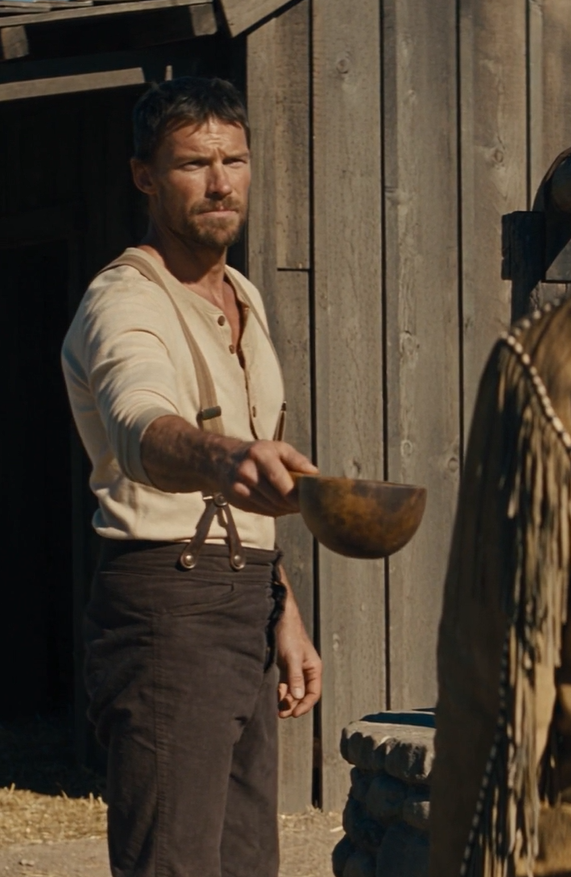
The underground spring remained protected.
Years passed.
Cottonwoods grew tall beside Corvin’s cabin.
Children who once visited became adults.
Some built houses nearby.
The ranch no longer felt isolated.
One evening, Corvin and Neya sat beside the well.
They had married three years earlier in a small ceremony attended by more people than Corvin believed he knew.
Dasoda had laughed through most of it.
He died the following winter.
Peacefully.
Neya rested her head against Corvin’s shoulder.
“You still write in the ledger every night.”
“Habit.”
“What did you write today?”
“Fence repaired. Two calves born. Neya complained about my cooking.”
“I did not complain.”
“You called it an insult to beans.”
“That was accurate.”
Corvin smiled.
Children were playing near the creek.
One boy asked:
“Uncle Corvin, is it true three hundred warriors came to kill you?”
Neya laughed.
Corvin groaned.
“Who told you that?”
“Samuel.”
“Samuel lies.”
The boy persisted.
“Why did they come?”
Corvin looked at Neya.
For years, he thought he knew.
They came because she was important.
Because she had been injured.
Because Vane was coming.
Because Abram’s ledger mattered.
All true.
But Neya had eventually told him one final detail.
Something she kept from him until after Dasoda died.
The three hundred warriors had gathered before anyone knew Vane would arrive.
Before Mercer’s warning.
Before the threat.
Corvin turned to Neya.
“You tell him.”
She smiled.
“No.”
Corvin sighed.
The boy waited.
Corvin said:
“They came to see whether I would give somebody water.”
The child frowned.
“That makes no sense.”
“It didn’t to me either.”
Neya laughed.
Corvin continued.
“Neya knew who I was before she reached the ranch.”
The boy looked at her.
“You did?”
Neya nodded.
Corvin said:
“She had heard about a young soldier who helped several children escape Red Hollow.”
The boy’s eyes widened.
“That was you?”
“Yes.”
“But why test you?”
Corvin looked at his hands.
“Because nineteen years is a long time.”
Neya answered softly:
“My grandfather wanted to know whether the young man who saved me still existed.”
The boy thought.
“So they watched?”
“Yes.”
“They could’ve just asked.”
Corvin pointed at him.
“I like this child.”
Neya smiled.
“They wanted an answer that could not be rehearsed.”
The boy looked toward the well.
“And you gave her water.”
Corvin nodded.
“Three times.”
Neya corrected him.
“Five.”
“Three before you started demanding more.”
“I was dying.”
“You were very demanding for a dying woman.”
She elbowed him.
The boy laughed.
Then asked:
“What would they have done if you refused?”
Corvin had asked Dasoda the same question years earlier.
The answer surprised him.
He repeated it now.
“They would have given her water themselves.”
The boy blinked.
“And then?”
“Left.”
“That’s all?”
“Yes.”
No punishment.
No attack.
No revenge.
The three hundred warriors had not come to judge whether Corvin deserved to live.
They had come to discover whether a story deserved to live.
For nineteen years, survivors of Red Hollow told their children about a young cavalryman who lowered his rifle.
A man who carried children through bullets.
A man who gave his canteen to a thirsty six-year-old while blood poured from his own hand.
Stories changed.
People changed.
Heroes became cruel.
Cowards became brave.
The survivors wanted to know what time had done to Corvin Torne.
Neya had volunteered to find him.
Her injury had not been planned.
Her thirst was real.
Her collapse was real.
But when Corvin approached without drawing a weapon—
when he offered water before questions—
when he cleaned the wound of a stranger whose people his own uniform had once hunted—
Neya already knew the answer.
And during the night, she rode back to Dasoda.
The first words she said were:
“It is still him.”
That was why three hundred warriors gathered before sunrise.
Not to threaten.
Not to avenge.
To honor.
They had come to stand silently around a man who never knew anyone remembered what he had done.
XII. THE LAST ENTRY
Corvin lived at Red Hollow for another thirty-two years.
The valley changed around him.
Railroads came closer.
Towns expanded.
Telegraph wires crossed places where riders once carried messages for days.
But the well remained.
Nobody was ever refused water.
That rule became almost sacred.
During drought years, families rationed their own supplies before closing the well to travelers.
They never closed it.
Corvin grew old.
His hair turned silver.
His hands became stiff.
Neya remained taller than him until the end, which she reminded him about whenever possible.
One autumn evening, when Corvin was seventy-three, he opened Abram’s black ledger.
The original.
Its pages were brittle.
He had written his own entries after Abram’s ended.
Trials.
Births.
Deaths.
Rainfall.
Visitors.
Trust meetings.
Arguments with Neya.
The last entry from Abram still made him pause.
If Corvin ever learns everything, I pray he judges me not by the truth I hid, but by the boy I tried to keep alive.
Corvin had spent years angry with Abram.
Then more years understanding him.
Finally, he wrote beneath it:
You were my father before I knew blood could prove it. You would have been my father even if blood proved otherwise.
He closed the ledger.
Neya entered carrying two cups.
“You’re sentimental.”
“Never.”
“You’re writing in an old dead man’s book.”
“Inventory.”
“Of feelings?”
“Very valuable livestock.”
She laughed.
They sat on the porch.
The sun dropped behind the northern ridge.
Corvin could still remember the first morning.
Riders appearing against pale sky.
His hand drifting toward his rifle.
Dasoda descending alone.
The old warrior pointing toward the well.
And Neya riding between hundreds of lowered weapons.
Corvin said:
“I thought I was going to die.”
Neya sipped her coffee.
“You looked like it.”
“Thank you.”
“Your face was terrible.”
“You married this face.”
“One of my greatest mistakes.”
Corvin smiled.
After a moment, he said:
“Why didn’t you tell me immediately?”
“Tell you what?”
“That you remembered me.”
Neya thought.
“Because I wanted you to remember yourself.”
Corvin looked at her.
She continued.
“You spent nineteen years believing Red Hollow was the worst thing you had ever been part of.”
“It was.”
“Yes.”
“But?”
“You forgot it was also the day you decided what kind of man you would become.”
Corvin was silent.
Neya pointed toward the well.
“You thought you were hiding out here.”
“I was.”
“No.”
She smiled.
“You were practicing.”
“For what?”
“For the day the past came back thirsty.”
Corvin laughed softly.
Then his expression turned thoughtful.
Perhaps she was right.
Every bucket hauled.
Every traveler watered.
Every stranger fed.
Every man he refused to hate.
None were dramatic.
None would make newspapers.
But a life was rarely shaped by one enormous decision.
It was shaped by thousands of small ones made when nobody watched.
Except sometimes—
without your knowledge—
three hundred people were watching from the hills.
Neya died six years before Corvin.
Her final request was simple.
“Keep the water open.”
He promised.
When Corvin himself became too weak to work, younger families maintained the well.
On his last evening, he asked to be carried outside.
A chair was placed beside the stones.