The sunset turned the ridges red.
Children gathered nearby.
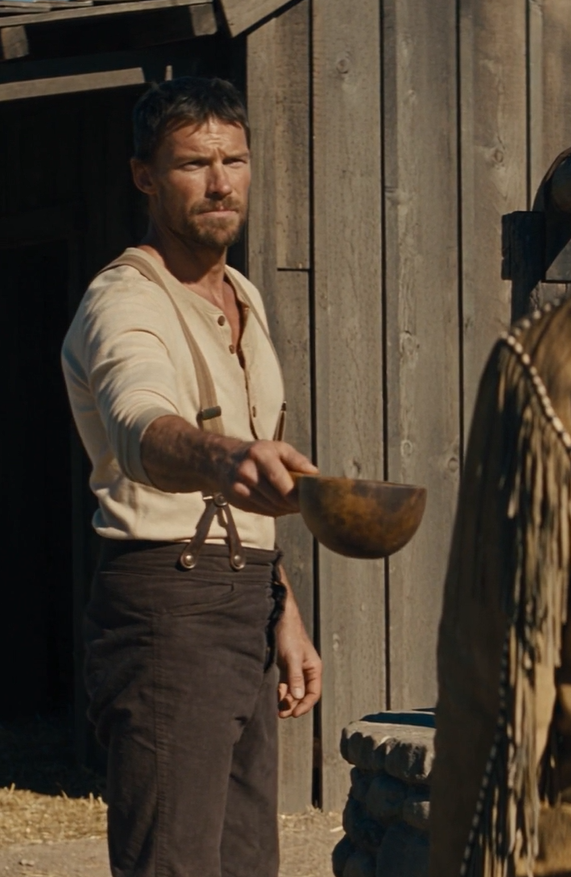
One little girl brought him a ladle of water.
Corvin drank.
“Thank you.”
She smiled.
“Grandfather says you saved this place.”
Corvin shook his head.
“No.”
“Everyone says you did.”
“Everyone exaggerates.”
“Then who saved it?”
Corvin looked across the valley.
At homes.
Horses.
Trees.
People.
Graves.
Memory.
“Nobody alone.”
The girl frowned.
“That’s not a good story.”
Corvin smiled.
“It’s the only true kind.”
She sat beside him.
After a while she asked:
“What was the bravest thing you ever did?”
Corvin thought about Red Hollow.
The gunfight.
Vane.
Mercer.
Courtrooms.
All the moments people might call brave.
Then he remembered a woman collapsed against a fence.
He had not known her.
He had not known three hundred riders were watching history begin again.
He had only known her lips were cracked and his well held water.
Corvin whispered:
“I gave somebody a drink.”
The girl laughed.
“That isn’t brave.”
“No?”
“No.”
Corvin looked toward the northern ridge.
The sun was almost gone.
He smiled.
“Maybe not.”
That night, Corvin Torne died peacefully in his sleep.
When they opened his ranch ledger, they found one final entry written in an unsteady hand.
No date.
No cattle count.
No weather.
Only five lines:
A stranger came thirsty.
I gave her water.
The past came with her.
I thought three hundred warriors had surrounded my ranch.
And beneath it:
I was wrong.
Three hundred witnesses had come to see whether kindness could survive nineteen years.
Below those words lay one final sentence.
Corvin had underlined it twice.
It could.
Years later, the old ranch cabin disappeared.
The original barn collapsed.
The fence was replaced.
The world changed.
But travelers still stopped at the spring.
A stone marker eventually stood beside it.
Politicians wanted an inscription explaining the historic trials.
Lawyers wanted dates.
Historians wanted names.
Some suggested listing Vane.
Others Mercer.
The families rejected every proposal.
Instead, the marker carried only seven words:
WATER FIRST. FEAR LATER. NO ONE REFUSED.
Most travelers never understood the words.
They drank.
Watered their horses.
Rested beneath the cottonwoods.
Then continued their journeys.
And perhaps that was exactly what Corvin would have wanted.
Because the truth hidden beneath all the blood, secrets, murders, trials, betrayals, stolen land, and buried identities was far simpler than anyone expected.
Silas Vane believed power meant deciding who was allowed to live.
Elias Mercer believed power meant deciding who owned the land.
Abram Torne believed love meant hiding the truth if the truth might endanger his son.
Corvin spent most of his life learning that each man had been wrong in a different way.
Real power was having something another human being desperately needed—and choosing not to use their need against them.
A cup of water.
A piece of land.
A truth.
A second chance.
That was why the story survived.
That was why generations remembered a lonely rancher nobody had considered important.
And that was the final secret behind the morning when nearly three hundred Apache warriors appeared around a small Arizona ranch.
They were not there because Corvin Torne was powerful.
They were not there because Neya demanded revenge.
They were not there because the well held treasure.
They had come because, nineteen years earlier, during the ugliest moment of his life, a frightened twenty-year-old soldier had refused an order to become cruel.
And when Neya returned nearly two decades later, wounded and dying beneath his fence, she discovered that time had taken his youth, his certainty, his family, and nearly everything he once believed about himself.
But it had not taken that.
Corvin still lowered the weapon.
Corvin still approached carefully.
Corvin still offered the water.
And somewhere beyond the ridges, before dawn, an old man who had lost his daughter at Red Hollow listened as his granddaughter described what happened.
Dasoda had asked only one question.
“Did he recognize you?”
Neya had answered:
“No.”
Dasoda had lowered his eyes.
Then Neya continued.
“But he gave me the water anyway.”
Only then had the old warrior smiled.
Only then had he ordered the riders to gather.
And only then had nearly three hundred men climbed onto their horses beneath the stars and ridden toward Corvin Torne’s lonely ranch.
Not because he remembered them.
Because he did not have to.