Chapter 1
“Move along, ma’am. This isn’t a homeless shelter.”
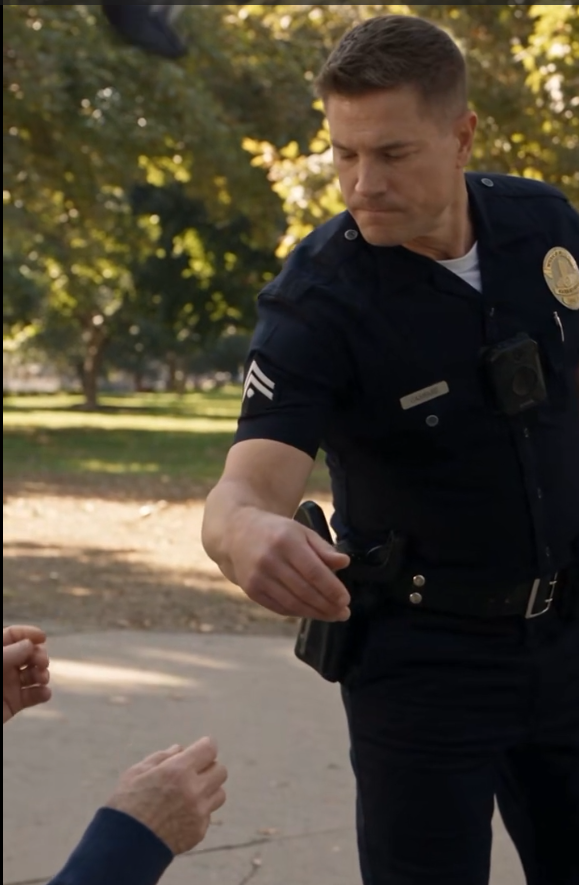
Officer Bradley’s voice cut across Riverside Park like a knife.
The morning had been peaceful until then.
Sunlight spilled through the branches of old maple trees, joggers moved steadily along the paved paths, dogs pulled lazily at their leashes, and coffee cups steamed in the hands of office workers crossing the park toward the towers downtown.
On a weathered wooden bench near the fountain sat sixty-eight-year-old Eleanor Washington.
She wore a simple floral dress beneath a navy cardigan. Her silver hair was pinned neatly into a bun. A small paper bag containing leftover breakfast bread rested between her hands.
Pigeons gathered around her shoes.
She had sat on that bench almost every morning for five years.
Officer Bradley did not know that.
More importantly, he did not seem interested in knowing.
Eleanor slowly looked up at him.
“I’m sorry?”
Bradley stood over her with his shoulders squared and one hand resting beside his belt.
His partner, Officer Morrison, remained a few feet behind.
Morrison looked uncomfortable.
Bradley looked certain.
“You heard me,” Bradley said. “You can’t stay here all day.”
Eleanor studied his face.
There was something especially painful about being judged by a stranger who had not even bothered to ask a question.
“Officer,” she said calmly, “I come here every morning.”
“I don’t care what you do every morning.”
Bradley glanced at the bag in her hands.
His expression tightened as if the bread somehow confirmed every assumption he had already made.
The expensive apartment towers surrounding Riverside Park had transformed the neighborhood over the previous decade. Condominiums overlooking the trees sold for millions. Restaurants that once served construction workers now offered seventy-dollar dinners.
But the park itself remained public.
At least, it was supposed to.
Bradley pointed toward the walkway.
“People pay a lot of money to live around here. They don’t want the park turning into a campground.”
Eleanor’s eyebrows rose.
“I’m not camping.”
“You know what I mean.”
“No,” she replied. “I don’t believe I do.”
A cyclist slowed nearby.
A woman pushing a stroller stopped beside the fountain.
Morrison shifted his weight.
Bradley’s irritation became visible.
“The park is for people who actually belong here.”
A silence seemed to spread around them.
Eleanor looked directly into his eyes.
“And what exactly makes you think I don’t belong?”
Morrison glanced sharply toward Bradley.
It was the kind of question that gave a person an opportunity to reconsider.
Bradley did not take it.
Instead, he reached down and struck the paper bag from Eleanor’s hands.
Bread scattered across the pavement.
The pigeons erupted upward in a storm of flapping wings.
A little girl nearby gasped.
Eleanor looked down.
One piece of bread had landed against her shoe.
Another floated into the shallow fountain.
She slowly raised her eyes.
“There was no reason to do that.”
Bradley laughed once.
There was no humor in it.
“The reason is that residents around here are tired of people hanging around.”
Eleanor straightened.
“I am a resident around here.”
“Of course.”
His tone carried more insult than the words themselves.
“I live three blocks from here.”
“Sure.”
“I taught at Lincoln Elementary School for thirty-five years.”
Bradley laughed louder.
“Right. And I’m the president.”
Morrison’s jaw tightened.
Eleanor said nothing for several seconds.
She had spent thirty-five years teaching children how to read, how to multiply fractions, how to tell the difference between memorizing history and understanding it.
But she had also taught something else.
Respect.
Hundreds of former students still recognized her in supermarkets.
Some were doctors.
Some were mechanics.
Some had become teachers themselves.
Parents occasionally approached her at restaurants and said, “Mrs. Washington, you probably don’t remember me.”
She almost always did.
After retirement, her life became quieter.
Breakfast at seven.
A walk at seven-thirty.
Riverside Park shortly before eight.
Ten minutes on the same bench.
Then home.
Nothing extraordinary.
Nothing dramatic.
Just a routine that belonged to her.
Bradley pointed again.
“You have one chance to leave voluntarily.”
Eleanor looked around.
Joggers had slowed.
Phones were appearing.
“Am I accused of breaking a law?”
“You’re being told to leave.”
“That wasn’t my question.”
Bradley stepped closer.
“I said leave.”
“And I asked what law I violated.”
Morrison finally intervened.
“Bradley, maybe we should just check her identification.”
Bradley turned sharply.
“I know what I’m looking at.”
Those words changed everything.
Not because Eleanor had never encountered prejudice.
She had.
She had simply learned long ago that the most revealing moments were often the ones when people believed they had nothing to hide.
Her expression became colder.
Bradley noticed.
“What?”
“Nothing,” Eleanor said.
He reached toward her arm.
“Stand up.”
She moved backward slightly.
“Do not grab me.”
“Then cooperate.”
“I am cooperating. I am asking you a lawful question.”
Bradley seized her forearm.
A woman near the fountain shouted, “Hey!”
Several phones rose instantly.
Morrison stepped forward.
“Bradley—”
But Bradley had already pulled Eleanor to her feet.
At sixty-eight, she was still strong enough to stand without assistance.
That did not mean being suddenly yanked from a bench did not hurt.
Pain flashed through her shoulder.
She refused to show it.
“Turn around.”
“For what?”
“Failure to comply.”
“With what lawful order?”
His jaw clenched.
Metal snapped around one wrist.
Then the other.
Cold handcuffs closed around Eleanor Washington’s hands.
The entire park seemed to freeze.
A jogger whispered, “Oh my God.”
Eleanor stood completely straight.
She did not cry.
She did not shout.
She did not struggle.
That somehow made the scene worse.
“Officer Morrison,” she said.
Morrison looked at her.
“Yes, ma’am?”
“My phone is inside my purse.”
Bradley snorted.
“What, you calling your attorney?”
“No.”
“Your husband?”
“My husband passed away twelve years ago.”
For the first time, Bradley looked momentarily uncomfortable.
It lasted less than a second.
Eleanor continued.
“I would like to call my son.”
Bradley laughed.
“Let me guess. Your son’s a lawyer.”
Eleanor looked directly at him.
“No.”
Morrison opened the purse carefully.
“What’s his name?”
“Marcus Washington.”
Morrison unlocked the phone using the passcode Eleanor provided.
He opened the contacts.
Then he stopped.
Eleanor noticed his face change.
Bradley noticed too.
“What?”
Morrison did not answer.
On the screen was a photograph of a man in formal military uniform.
His chest carried rows of decorations.
Silver eagles rested on his shoulders.
Beneath the photograph were the words:
COLONEL MARCUS WASHINGTON
COMMANDING OFFICER — STATE JOINT OPERATIONS GROUP
Morrison looked at Eleanor.
Then at Bradley.
“Bradley.”
“What?”
Morrison swallowed.
“You need to see this.”
Bradley walked over.
The arrogance disappeared from his face so quickly that one of the people filming actually lowered her phone in surprise.
“You’ve got to be kidding me.”
Eleanor’s voice remained calm.
“Call him.”
Morrison pressed the number.
It rang once.
Twice.
Then a deep male voice answered.
“Mom?”
Eleanor closed her eyes briefly.
“Hello, Marcus.”
The change in the man’s voice was immediate.
“What happened?”
“I’m all right.”
“Why are you calling from speaker?”
Eleanor glanced toward Morrison.
“There are two police officers here.”
Silence.
Then:
“Why?”
“One of them has placed me in handcuffs.”
The silence on the other end became terrifying.
When Marcus spoke again, his voice was controlled.
Too controlled.
“Put the officer on.”
Morrison raised the phone.
“Sir, this is Officer Morrison.”
“Officer Morrison, is my mother injured?”
“No, sir.”
“Did she threaten anyone?”
“No, sir.”
“Possess a weapon?”
“No.”
“Damage property?”
“No, sir.”
“Was she committing a crime?”
Morrison glanced at Bradley.
His hesitation answered the question.
Marcus spoke quietly.
“Officer Morrison.”
“Yes, Colonel?”
“Remove the handcuffs.”
Bradley snapped, “He doesn’t have jurisdiction here.”
Eleanor turned her head toward him.
Marcus had heard.
“You’re correct,” Marcus said through the phone. “I do not.”
Bradley almost smiled.
Then Marcus continued.
“Which is why I’m not giving you an order.”
A pause.
“I’m giving you an opportunity.”
Bradley’s smile vanished again.
“An opportunity for what?”
“To decide how much worse you want this morning to become.”
No one spoke.
Marcus continued.
“My mother is sixty-eight years old. She has no criminal record. If you have probable cause, articulate it. If you do not, take the handcuffs off her.”
Bradley reached for the phone.
“This is Officer Bradley. Your mother refused a lawful command.”
“What law?”
“She was told to leave.”
“What law required her to leave?”
Bradley said nothing.
Marcus waited.
Then he asked a question that made Morrison’s eyes widen.
“Is your body camera recording?”
Bradley instinctively looked down.
A red light blinked on his chest.
Marcus said, “Good.”
Then the line went dead.
Bradley stared at the phone.
“What did he mean, good?”
Eleanor knew.
But she did not answer.
Because her son had once told her something she had never forgotten.
When guilty people are nervous, silence makes them explain themselves.
Thirty seconds later, Bradley’s radio crackled.
“Unit Twelve, supervisor requested at Riverside Park. Hold position.”
Bradley froze.
Morrison looked at him.
“How did—”
The radio crackled again.
“Unit Twelve, acknowledge.”
Morrison answered.
“Unit Twelve. Copy.”
Bradley stared at Eleanor.
“You called someone else.”
“No.”
He stepped closer.
“What did your son do?”
Eleanor looked at him with genuine confusion.
“He answered his phone.”
The first patrol supervisor arrived three minutes later.
The second arrived less than two minutes after that.
Then a black city vehicle stopped beside the curb.
And when Captain Raymond Hargrove stepped out, his expression was not anger.
It was fear.
Eleanor noticed immediately.
And suddenly she understood something far more important than Bradley’s humiliation.
Captain Hargrove was not frightened because Bradley had arrested the wrong woman.
He was frightened because Eleanor Washington was sitting on the wrong bench.