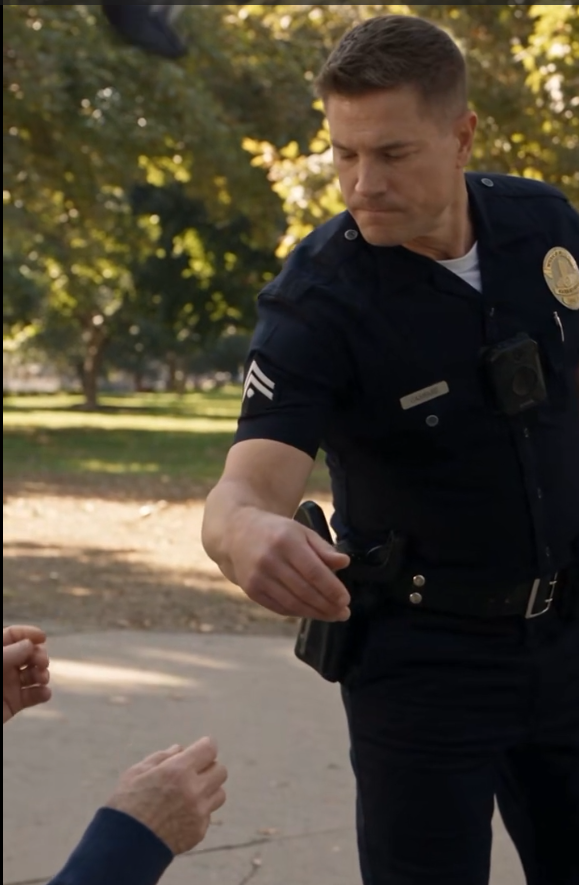
Chapter 2
Captain Hargrove moved quickly through the gathering crowd.
“Phones down, everyone. Give the officers space.”
Nobody obeyed.
At least twenty people were recording.
Bradley approached his captain.
“She refused to leave.”
Hargrove barely looked at him.
“Why was she asked to leave?”
Bradley hesitated.
“Possible loitering.”
“Possible?”
“She’d been sitting here.”
Hargrove stared.
“In a park?”
Morrison looked away.
Bradley’s face reddened.
“She appeared to be—”
He stopped.
Hargrove lowered his voice.
“To be what?”
Neither man noticed Eleanor watching them closely.
Hargrove turned toward her.
“Mrs. Washington, I’m Captain Raymond Hargrove. I apologize for the confusion.”
Eleanor lifted her cuffed wrists.
“This seems more serious than confusion.”
Hargrove glanced at Bradley.
“Take those off.”
Bradley obeyed.
The cuffs opened.
Eleanor rubbed one wrist.
A red mark already circled the skin.
The woman with the stroller whispered something angrily.
Hargrove noticed the phones again.
His expression hardened.
“Mrs. Washington, perhaps we could discuss this somewhere more private.”
“No.”
The answer surprised everyone.
Hargrove forced a smile.
“I only mean that crowds can sometimes make situations—”
“No,” Eleanor repeated. “Everything Officer Bradley wanted to say to me was said publicly. Whatever you wish to say can be said publicly too.”
Morrison almost smiled.
Bradley looked furious.
Hargrove’s face changed.
He studied Eleanor carefully for several seconds.
Then his eyes drifted toward the bench.
It was subtle.
Almost invisible.
But Eleanor caught it.
Not the fountain.
Not the crowd.
The bench.
She followed his gaze.
The wooden bench looked ordinary.
Brown slats.
Black iron supports.
A small brass plaque mounted on the back.
Eleanor had seen the plaque thousands of times.
She rarely noticed it anymore.
IN MEMORY OF
REV. THOMAS WASHINGTON
AND THE FAMILIES OF RIVERSIDE
WHO KEPT THIS PARK PUBLIC
Hargrove looked away quickly.
Something cold moved through Eleanor’s chest.
Thomas Washington had been her father-in-law.
He had died twenty-three years earlier.
Hargrove said, “Mrs. Washington, again, I apologize. You’re free to go.”
Eleanor remained still.
“Why was Officer Bradley here?”
Hargrove frowned.
“He patrols this district.”
“That wasn’t my question.”
“Excuse me?”
“Why was he standing beside this bench at eight in the morning telling an elderly woman she didn’t belong?”
Bradley scoffed.
Hargrove silenced him with a look.
Eleanor continued.
“Because this isn’t the first time, is it?”
Morrison’s head lifted.
Hargrove’s face emptied of expression.
“I don’t understand.”
Eleanor looked toward Morrison.
He immediately looked down.
That told her enough.
“Someone has complained about people sitting here.”
Nobody answered.
“Captain?”
Hargrove smiled tightly.
“I think you should go home, Mrs. Washington.”
She stared at him.
Then at Bradley.
Then at Morrison.
“All right.”
Hargrove relaxed.
Too soon.
Eleanor bent slowly and picked up her empty paper bag.
Morrison stepped forward.
“I can get that.”
“No, thank you.”
She collected several pieces of bread from the pavement.
Bradley watched impatiently.
As Eleanor walked away, the crowd parted for her.
The woman who had been jogging approached.
“Ma’am, I recorded everything.”
Eleanor stopped.
“Keep it.”
“I can send it to you.”
“Keep the original.”
The woman looked confused.
“Why?”
Eleanor glanced over her shoulder.
Captain Hargrove was standing beside the bench, speaking urgently to Bradley.
“Because I have a feeling someone may soon say this happened differently.”
By nine-thirty, Eleanor was home.
Her apartment was modest but warm, filled with books, framed school photographs, and plants she somehow managed to keep alive despite constantly forgetting to water them.
Marcus arrived at 9:47.
He did not knock.
The door opened and a six-foot-two man in a dark service uniform stepped inside.
“Mom?”
“In the kitchen.”
He appeared in the doorway.
Colonel Marcus Washington was forty-four years old, broad-shouldered, disciplined, and usually so composed that soldiers joked an earthquake would apologize before disturbing him.
The moment he saw the red marks around Eleanor’s wrists, that composure broke.
His eyes changed.
“Let me see.”
“I’m fine.”
“Mom.”
She held out her hands.
He examined the marks.
His jaw flexed.
“Did he hurt your shoulder?”
“A little.”
“We’re going to a doctor.”
“I am not spending three hours in an emergency room because my shoulder aches.”
“That wasn’t a suggestion.”
Eleanor looked at him.
Marcus sighed.
“Please.”
“That’s better.”
She poured him coffee.
His phone had been vibrating constantly since he entered the apartment.
He ignored it.
“Tell me everything.”
Eleanor did.
He listened without interrupting.
When she described Bradley knocking the bread from her hands, Marcus stared at the table.
When she described the handcuffs, he closed his eyes.
When she mentioned Captain Hargrove’s reaction to the bench, he opened them again.
“What do you mean?”
“He looked afraid.”
“Because people were filming.”
“No.”
“Because of Bradley?”
“No.”
Eleanor shook her head.
“He looked at the plaque.”
Marcus froze.
“What plaque?”
“Your grandfather’s.”
Marcus slowly put down his coffee.
“Exactly where were you sitting?”
“The same place I always sit.”
“Bench seventeen?”
Eleanor frowned.
“You know its number?”
He stood.
“Mom, answer me.”
“Yes.”
Marcus walked toward the window.
For the first time since arriving, Eleanor saw something she did not expect.
Her son looked genuinely disturbed.
“What is it?”
He did not answer immediately.
“Marcus.”
He turned.
“There’s something I need to tell you.”
Before he could continue, his phone rang again.
He looked at the screen.
The name displayed was:
ATTORNEY GENERAL’S OFFICE.
Marcus declined the call.
Eleanor stared.
“Why is the attorney general calling you?”
Marcus sat down.
“Because six weeks ago, my office received information about Riverside Park.”
Her stomach tightened.
“What information?”
He looked directly at her.
“That city employees may have been helping a private development group pressure certain people out of public areas.”
Eleanor said nothing.
Marcus continued.
“Homeless people. Street vendors. Elderly residents. Anyone who made the neighborhood look less attractive to prospective buyers.”
“And the police?”
“We didn’t know how involved they were.”
“Until this morning.”
Marcus’s expression darkened.
“Until this morning.”
Eleanor leaned back.
The room suddenly felt smaller.
“You knew this was happening?”
“I knew there were allegations.”
“And you never told me?”
“You’re my mother.”
“That is not an answer.”
“I didn’t want you involved.”
Eleanor almost laughed.
“Apparently Officer Bradley solved that problem.”
Marcus rubbed his forehead.
“There’s more.”
She waited.
“A development company called Voss Meridian has been trying to acquire management rights over part of Riverside Park.”
Eleanor stared.
“You cannot acquire a public park.”
“Not ownership. Commercial management. Events. Security. Leasing rights. Restaurants around the perimeter.”
“Privatization.”
“In everything but name.”
Eleanor’s expression hardened.
“And the bench?”
Marcus hesitated.
“Granddad’s plaque isn’t just a memorial.”
“I know that.”
“No, Mom. I mean legally.”
That silenced her.
Marcus leaned forward.
“Do you remember the Riverside Covenant?”
A memory surfaced.
Old papers.
Her late husband Isaiah sitting at the dining table.
Lawyers visiting after Thomas Washington died.
She had signed documents, but twenty years of ordinary life had buried the details.
“Parts of it.”
“The land was transferred to the city through a neighborhood trust in 1978.”
“Yes.”
“Your father-in-law was one of five trustees.”
Eleanor nodded slowly.
Marcus continued.
“The city received permanent use of the land under several conditions.”
He paused.
“One of those conditions was that no person could be excluded from ordinary use of the park based on residence, economic status, race, occupation, or perceived social class.”
Eleanor stared at him.
Marcus spoke carefully.
“If the city adopts, authorizes, or knowingly permits a policy designed to exclude people on those grounds, the management rights automatically revert to the surviving Riverside Community Trust.”
“Surviving?”
“There is only one original family trustee still legally registered.”
Eleanor understood before he finished.
Marcus said it anyway.
“You.”
Silence filled the kitchen.
Eleanor looked at her hands.
Then she thought about Bradley.
The bread scattered across the pavement.
The words:
People pay a lot of money to live around here.
The park is for people who actually belong.
She whispered, “Oh my God.”
Marcus nodded.
“If what happened this morning was just one officer acting alone, the covenant probably means nothing.”
“And if it wasn’t?”
Marcus looked at her.
“Then somebody may have just provided evidence that the city violated the agreement keeping Riverside Park under its control.”