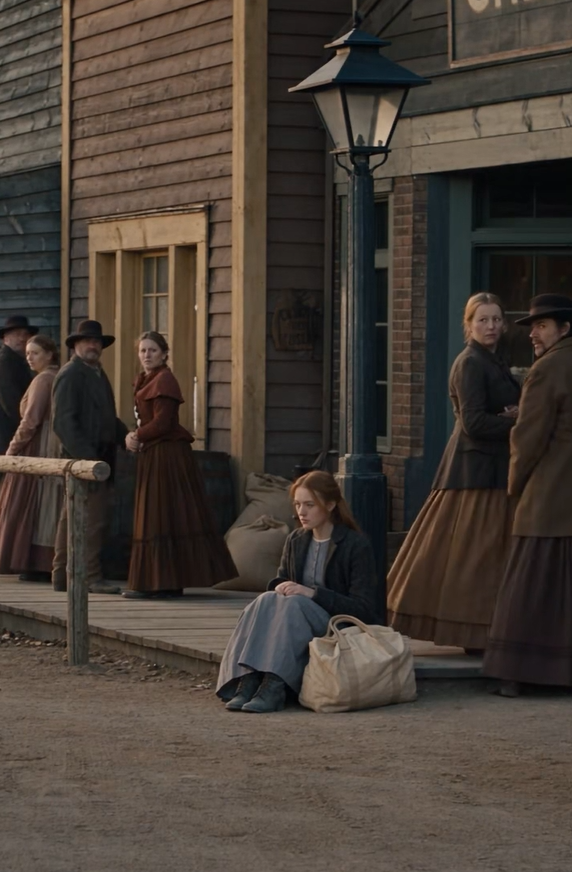
He Paid Fifty Dollars for a Woman Everyone Had Already Abandoned. By Spring, He Learned the Money Had Bought Nothing—and the Truth Could Cost Them Everything.
The entire street went silent when a father announced how much his daughter was worth.
“Fifty dollars.”
The words carried farther than they should have.
Past the feed store.
Past the hitching posts.
Past the men standing beneath the awning with tobacco tucked in their cheeks.
Even the horses seemed to settle.
Rowan Creed had been halfway through fastening a sack of flour to his saddle when he heard the price.
At first he assumed the man meant a horse.
A rifle.
Perhaps a wagon with a cracked axle.
Then he followed the direction of the gathered men’s eyes.
And saw the woman.
She sat on a wooden bench across the street with a small beige canvas bag beside her boots.
Young.
Early twenties, perhaps.
Her coat had been patched at both elbows. A dark scarf was wrapped tightly around her throat, though it wasn’t enough to keep the November wind from reaching her. Light-brown hair had been pinned loosely at the back of her head, strands escaping around a pale, exhausted face.
She wasn’t crying.
That bothered Rowan more than tears would have.
She simply sat with her hands folded in her lap.
Waiting.
As if whatever happened next had already happened to her a hundred times in her imagination.
The man beside the feed store raised his voice.
“She can cook. Clean. Sew. Strong enough for chores.”
Several men laughed uneasily.
One spat into the snow.
No one stepped forward.
Rowan stared at the speaker.
The man was perhaps fifty, with a rough beard, dusty tan coat, and a face that looked tired rather than ashamed.
Rowan crossed the street.
His boots struck the boardwalk hard enough to turn heads.
“You’re selling your daughter?”
The man met his eyes.
“Fifty dollars.”
“I heard the price.”
“Then why ask?”
Rowan glanced toward the young woman.
Her eyes had lowered.
“What is her name?”
“Lydia.”
The young woman flinched faintly when he said it.
“Lydia what?”
“Voss.”
The father held out one hand.
“Interested or not?”
Something cold moved through Rowan’s chest.
He had spent twelve years avoiding other people’s troubles.
There had been a time when he would have argued.
A younger Rowan might have dragged the man behind the feed store and taught him what fifty dollars felt like when folded into a fist.
But grief had burned most of that man away.
At forty, Rowan had built a life high in the Bitterroot Mountains where nobody could disappoint him because nobody was there.
He needed coffee.
Flour.
Ammunition.
He needed to ride home before the snow thickened.
He did not need Lydia Voss.
Yet when he looked at her again, she wasn’t watching the men who might take her.
She was staring at the ground.
She looked like someone who had already decided she had no right to hope.
Rowan reached into his coat.
He counted the money once.
Thirty dollars in bills.
Twenty in coin.
The father took it immediately.
One of the watching men gave a low whistle.
“Well, Creed,” he muttered. “Thought you came for flour.”
Rowan ignored him.
The father shoved the money into his pocket.
“She’s yours.”
Rowan’s head snapped toward him.
“No.”
The father frowned.
“No?”
Rowan’s voice lowered.
“Don’t say that again.”
The man shrugged.
“Call it whatever you please.”
Rowan turned away before anger made the decision for him.
He crossed to Lydia.
Up close, she looked even thinner.
There was a faded bruise near one wrist.
He pretended not to notice.
Rowan bent, picked up the canvas bag, and straightened.
Lydia looked at him.
Her eyes were brown.
Not weak.
Not empty.
Simply exhausted.
“Come on,” Rowan said.
She stood.
Her father didn’t say goodbye.
Lydia didn’t look back.
1
They had been riding for nearly three hours when Lydia finally spoke.
Snow had begun falling in thin white threads through the pines.
Rowan rode his bay gelding slowly so Lydia could remain beside him on the second horse he’d hired from the livery.
She sat stiffly.
Too straight.
As though even leaning into the saddle might be interpreted as laziness.
“What do you want me to do?”
Rowan looked across at her.
“For the horse?”
Her expression didn’t change.
“For you.”
The meaning settled between them.
Rowan looked ahead again.
“Nothing tonight.”
Silence.
Then Lydia said, “I can cook.”
“I know.”
“He told you.”
“He told the whole town.”
“I sew better than I cook.”
“Useful information.”
“I can wash clothes. I can mend harness if the leather isn’t too thick. I know chickens. I can milk—”
“Lydia.”
She stopped.
Rowan kept his voice even.
“You don’t need to list your skills.”
Her hands tightened around the reins.
“But you paid.”
“Yes.”
“Fifty dollars.”
Discover more
Death
children
Pregnancy & Maternity
“I remember.”
“So what did you pay for?”
Rowan could hear the fear she was trying not to put into her voice.
He pulled his horse to a stop.
Lydia stopped too.
The mountain road behind them had already begun disappearing beneath snow.
Rowan faced her.
“I paid him to stop standing in the street offering you to strangers.”
Her brows drew together.
“That doesn’t answer my question.”
“It does.”
“No. It doesn’t.”
For the first time there was something sharper beneath her quietness.
Good, Rowan thought.
Anger meant there was still something alive under all that resignation.
He nodded toward the road.
“My cabin is another two hours.”
“And when we get there?”
“You eat.”
“And after that?”
“You sleep.”
“Where?”
“Spare room.”
Her eyes searched his face.
“And then?”
Discover more
death
family
Family
Rowan understood exactly what she was asking.
He had understood from the first mile.
His jaw tightened.
“Then morning comes.”
Lydia stared at him.
He added quietly, “That’s all.”
She looked away first.
They rode on.
The cabin stood in a clearing where the mountains folded inward around a frozen creek.
It was larger than Lydia expected.
Not grand.
But solid.
Thick pine logs.
Stone chimney.
A covered woodpile against one side.
Rowan opened the door.
Warm air carried the smell of stew and smoke.
He stepped aside.
Lydia hesitated.
“You first,” he said.
She entered.
Her eyes moved quickly around the room.
Stone hearth.
Heavy wooden table.
Two chairs.
Discover more
Pregnancy & Maternity
death
Doors & Windows
Books stacked along one wall.
A rifle mounted high near the door.
Nothing decorative except a brass clock and a faded landscape painting.
Rowan carried her bag down the short hallway.
He opened a door.
Inside stood a narrow bed with a thick quilt, a washstand, a small window, and a wooden chest.
“That room is yours.”
Lydia stepped inside.
Her eyes went immediately to the door.
“There isn’t a lock.”
“I know.”
She looked at Rowan.
“For you?”
“For anyone.”
He set her bag beside the bed.
“You close the door, nobody enters unless you say so.”
She stared at him.
He realized she genuinely didn’t understand.
“You mean if I shut it…”