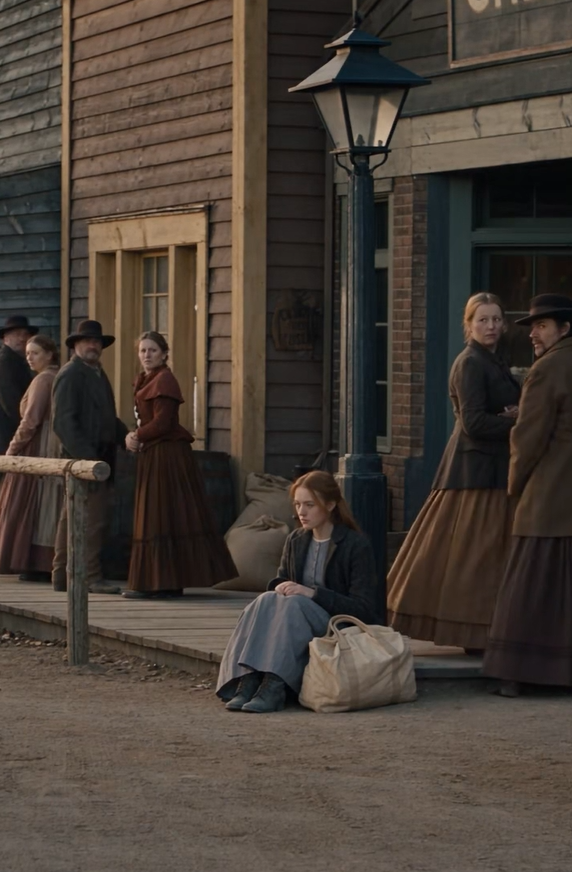
“I stay out.”
“Even if you want something?”
“Especially then.”
The silence grew uncomfortable.
Rowan turned.
“Stew’s probably burned.”
Discover more
family
door
Children
Behind him Lydia asked, “Why?”
He stopped.
“Why what?”
“Why are you being kind?”
Rowan looked back.
Her expression wasn’t grateful.
It was suspicious.
As if kindness itself were the trap.
He considered answering.
Instead he said, “Supper in five minutes.”
And left her alone.
That night Lydia closed the bedroom door.
Rowan heard the quiet click from beside the hearth.
He stared into the flames.
It was the first boundary she had been allowed to draw, and he understood that respecting it mattered more than anything he could say.
2
Rowan woke before dawn to scraping.
He reached automatically for the revolver beside his bed.
Then he recognized the sound.
Scrub brush.
Kitchen floor.
He pulled on his trousers and stepped into the main room.
Lydia was on her knees beside the table.
She had already moved both chairs.
A bucket stood near her.
The floorboards behind her were wet.
“What are you doing?”
She jumped so violently that water spilled over the bucket.
“Cleaning.”
“I can see that.”
“Was I too loud?”
“It’s five in the morning.”
“I’ll be quieter.”
“That wasn’t the point.”
Lydia looked toward the floor.
“I thought you’d want it finished before breakfast.”
Rowan rubbed one hand over his face.
“Why?”
She looked confused.
“Because it needs cleaning.”
“It was clean yesterday.”
“There was mud.”
“It’s November.”
“Yes.”
“There will be mud until May.”
Lydia said nothing.
Rowan crossed to the stove.
“Coffee?”
“I can make it.”
“I didn’t ask if you could.”
She went still.
He glanced over.
“I asked whether you wanted some.”
“Oh.”
A tiny word.
Yet Rowan felt something inside him shift.
“Yes,” she said. “Please.”
Over the next week, Lydia worked like someone trying to outrun a sentence.
She washed every shirt Rowan owned.
She reorganized the pantry.
She polished cookware that had survived fifteen years without knowing polish existed.
She mended three blankets, two pairs of trousers, and a saddlebag Rowan hadn’t realized was torn.
On the eighth morning he found her outside swinging an axe into a stubborn round of pine.
Snow reached her ankles.
Her gloves were too thin.
She had stacked enough wood beside her to heat the cabin for days.
Rowan walked over.
“Give me the axe.”
“I can finish.”
“I’m sure you can.”
“Then—”
“Give me the axe.”
Something in his tone made her obey.
Rowan leaned it against the chopping block.
“You don’t have to earn every meal.”
Lydia’s face changed.
Not visibly to anyone who wasn’t watching carefully.
But Rowan was.
Her shoulders tightened.
Her chin lifted.
“I have to be useful.”
“Why?”
She looked at him as though the answer were too obvious to deserve words.
Rowan waited.
Finally she said, “People don’t keep what isn’t useful.”
There it was.
The truth beneath everything.
Rowan glanced toward the cabin.
Smoke rose from the chimney into the white morning.
“You’re not here because I need a servant.”
“Then why did you pay him?”
“Because someone had to stop him.”
“Anyone could have.”
“They didn’t.”
“You didn’t know me.”
“No.”
“You still don’t.”
“No.”
“So you could regret it.”
Rowan picked up the axe.
“I’ve regretted plenty.”
Her mouth tightened.
“Is that supposed to reassure me?”
“No.”
He brought the axe down.
Wood split cleanly.
“But you aren’t a purchase, Lydia.”
She looked toward the mountain.
“My father thinks I am.”
“Your father is an idiot.”
Her head turned sharply.
Rowan lifted the axe again.
For a second he thought she might defend the man.
Instead—
She laughed.
Barely.
A surprised breath more than a sound.
But it was laughter.
Rowan stopped with the axe over his shoulder.
Lydia covered her mouth.
Something almost embarrassed crossed her face.
“I’m sorry.”
“Don’t.”
“For laughing?”
“For apologizing.”
Another small laugh escaped her.
Rowan looked away before she noticed he was smiling.
It was the first time Lydia laughed in his cabin.
He would remember the sound long after he forgot which piece of wood he had been splitting.
3
Winter closed over the mountains.
The road disappeared.
Snow climbed against the cabin walls.
For three weeks they saw no one.
Rowan had expected the isolation to trouble Lydia.
Instead, she seemed to breathe more easily the farther the outside world vanished.
She discovered his books.
At first she asked permission to touch them.
“You don’t need permission.”
“They’re yours.”
“They’re books.”
She chose a volume of Tennyson and read beside the fire.
Three nights later Rowan found it beside his chair with a strip of blue cloth marking a page.
“You left this.”
“I thought you’d like that poem.”
“You thought wrong.”
Her eyes widened.
Then she saw the corner of his mouth move.
“You’re terrible.”
“Been told worse.”
The books became a language between them.
She left Dickens.
He left Cooper.
She mocked his taste in adventure stories.
He accused her of choosing novels where everyone died tragically in drawing rooms.
She started eating full portions.
Then second portions.
The first time she reached for another biscuit without asking, Rowan pretended not to notice.
The first time she fell asleep in the chair beside the hearth, he draped a blanket over her and left.
By January she no longer flinched when he entered a room.
Mostly.
There were still moments.
A dropped pan.
A door slammed by wind.
A hand raised too quickly.
Then her body would remember something her mind wanted to forget.
Rowan never asked what her father had done.
Lydia never volunteered.
Until the storm.
It came at dusk.
Wind hit the cabin hard enough to shake snow from the roof.
Rowan went outside to secure the shed door.
The latch had frozen.
He was working it loose when an old pine cracked somewhere uphill.
He heard the snap.
Turned.
Too late.
A branch the thickness of his thigh came down.
It struck his shoulder and knocked him into the snow.
For several seconds he couldn’t breathe.
Then he heard Lydia.
“Rowan!”
She ran from the cabin without her coat.
He tried to stand.
Pain cut through his left side.
“Stay back.”
She ignored him.
“Can you move your arm?”
“Get inside.”
“Can you?”
“Yes.”
It was a lie.
Lydia crouched beside him.
Wind ripped loose strands of hair across her face.
She examined his shoulder with quick hands.
“You’re bleeding.”
“Branch scratched me.”
“Your coat is soaked red.”
“That seems excessive.”
“Don’t joke.”
She slid beneath his good arm.
Rowan almost laughed.
“You weigh half of what I do.”
“And you’re lying in the snow.”
Fair point.
It took them fifteen minutes to reach the cabin.
Lydia cut his shirt away from the shoulder.
The wound wasn’t deep, but the joint had dislocated.
Rowan told her how to set it.
She went pale.
“No.”
“You have to.”
“I’ll hurt you.”
“Already hurts.”
“What if I break it?”
“Then it’ll hurt differently.”
She stared at him.
“Rowan.”