Then said, “The day you asked if I wanted you to stay.”
“Why?”
“Because I finally had something to lose.”
She frowned.
“That sounds like the opposite.”
“No.”
Rowan looked at her.
“I spent years thinking a man was free when nobody could hurt him.”
“And now?”
“Now I think that’s just another kind of prison.”
Lydia leaned against him.
The road below curved past the feed store.
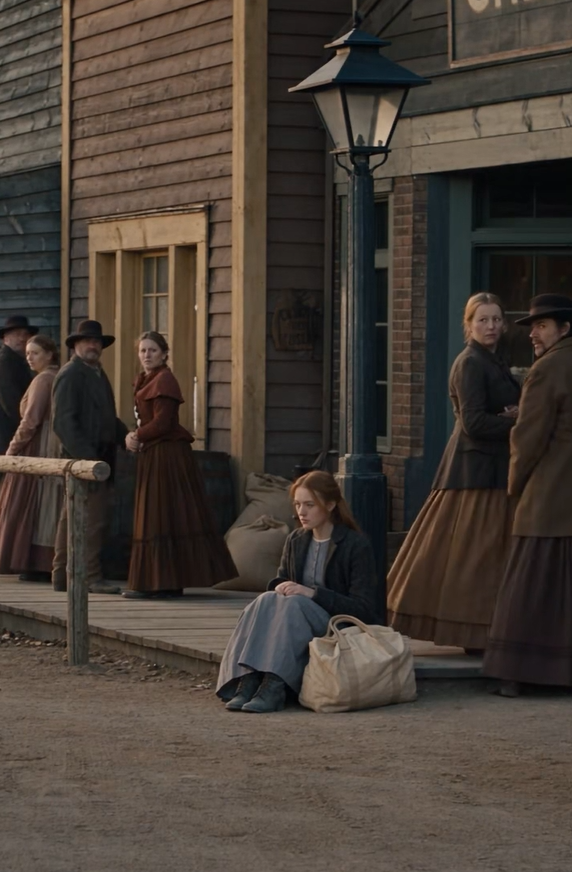
Past the place where a crowd had once gone silent over fifty dollars.
She didn’t hate the street anymore.
It had witnessed her humiliation.
But it had also witnessed the last time Amos Voss ever decided what happened to her.
20
Years later, travelers passing through Black Pine occasionally heard the story.
It changed depending on who told it.
Some said Rowan Creed bought a wife for fifty dollars.
Others said he rescued a woman from an auction.
Some claimed Lydia inherited a fortune.
Others insisted buried gold had been found beneath the hearth.
Children preferred the version involving gunfire.
Old men preferred the version in which Rowan punched Amos.
He never had.
Though he admitted regretting the omission.
Lydia corrected the story whenever she heard someone say Rowan had bought her.
“No,” she would say.
“He paid fifty dollars.”
Then she’d wait.
Someone would inevitably ask, “What’s the difference?”
Lydia would smile.
“Everything.”
Black Pine grew.
The old barn became a school.
The guest room—the room Rowan had first given Lydia—became a library.
On the inside of its door Lydia installed a lock.
Then she hung the key on a nail where anyone could reach it.
Children asked why.
She told them:
“A lock is useful only when the person inside controls the key.”
Every winter Lydia set aside fifty dollars from the ranch accounts.
The money went to women leaving dangerous homes.
Widows.
Girls needing train fare.
Mothers needing a week’s rent.
No one was asked to repay it.
Rowan called the fund Mara’s Door.
Lydia pretended the name embarrassed her.
It didn’t.
On their tenth anniversary, Rowan found her sitting beside the hearth with the old canvas bag.
The fabric had nearly worn through.
“You should replace that.”
“No.”
“It is one hard winter away from becoming dust.”
“Then I’ll sew it.”
“You criticize my sentimental habits.”
“Because yours involve broken tools.”
“Fair.”
She opened the lining.
Inside remained Mara’s letter.
The brass bank marker.
And one fifty-dollar bill.
Rowan frowned.
“I thought you spent all of it.”
“Kept one.”
“Why?”
Lydia held it up.
“For perspective.”
“Meaning?”
She smiled.
“Once, fifty dollars was supposed to be the price of my entire life.”
Rowan sat beside her.
“And now?”
“Now it wouldn’t buy enough lumber to repair the east fence.”
“Inflation is healing.”
She laughed.
Then handed him the bill.
“You keep it.”
“No.”
“Why?”
“Because it was never mine.”
“Neither was I.”
Rowan looked at her.
She leaned closer.
“That was the point.”
He kissed her.
Outside, snow began falling.
Almost exactly as it had the first night she arrived.
But the cabin was different now.
Children’s books crowded the crooked shelf.
Two coats hung beside the door.
A pair of muddy boots sat beneath Lydia’s.
Fresh bread cooled on the table.
On the mantel stood the photograph of Mara and the little girl who had once stood outside this same cabin without knowing it would someday become hers.
Not because of a deed.
Not because of inheritance.
Not because Rowan had paid fifty dollars.
Because she had chosen it.
Chosen him.
Chosen herself.
Years earlier, Lydia had asked Rowan the question that frightened them both.
“Do you actually want me to stay?”
At the time, neither understood how complicated the answer would become.
The land had been stolen.
Her death had been forged.
Her mother had been murdered.
Rowan’s father had carried a secret debt.
His wife had died trying to expose the truth.
Amos had sent Lydia to Black Pine believing he was using her to retrieve evidence.
And the fifty dollars Rowan handed him had traveled through twenty-one years of planning from Lydia’s dead mother to the exact street where her freedom was being sold.
But in the end, Mara had been right.
The money opened a door.
It did nothing more.
Everything after that belonged to Lydia.
The first laugh.
The second biscuit.
The closed bedroom door.
The axe Rowan took from her hands.
The books beside his chair.
Her hand in his after the storm.
The anger.
The forgiveness.
The kiss.
The choice.
That was why, whenever someone asked Lydia Voss Creed how much Rowan had paid for her, she never avoided the question.
She looked them directly in the eye.
“Fifty dollars.”
Then she smiled.
“And not one cent of it ever bought me.”
Because the richest thing Rowan Creed had ever given Lydia was not money.
It was not land.
It was not even love.
It was the right to walk away.
And the greatest thing Lydia ever gave him in return was something no amount of money could purchase.
She stayed.